
If you are new to trucking, learning how to scale a semi truck is a practical skill to have after the vehicle has been loaded.
A truck may appear to be loaded correctly, but the actual weight carried by the steer axle, drive axles, and trailer axles can vary significantly.
Scaling a semi truck means weighing the tractor and trailer to check not only the total vehicle weight, but also how much weight is being carried by each axle group. This makes it easier to identify uneven or improper load distribution before the truck continues its journey.
What Does “Scale a Semi Truck” Mean?
In the trucking industry, “scale a truck” usually means:
Weighing the vehicle on a truck scale.
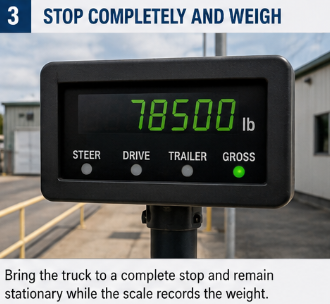
For a typical tractor-trailer combination, the weighing result usually includes four important figures:
Steer Axle Weight、Drive Axle Weight、Trailer Axle Weight、Gross Vehicle Weight
Gross Weight tells you how much the entire loaded truck weighs, but it is not the only number that matters.
Even when the total vehicle weight is within a reasonable range, one axle group may still be carrying too much weight. That is why individual axle weights should also be checked.
How to Scale a Semi Truck?
The exact procedure may vary depending on the type of truck scale being used, but the basic steps are usually straightforward.
1. Finish Loading the Truck
Whenever possible, the truck should be weighed in the same condition in which it will actually travel.
The cargo should already be loaded and secured, the tractor and trailer should be properly connected, and the driver’s normal tools and other onboard equipment should remain in the vehicle.
Fuel weight should also be considered. This is especially important when the truck is already close to its target load, because the amount of fuel in the tanks can affect the final weighing result.
2. Find a Suitable Truck Scale
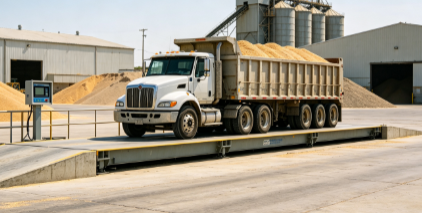
Semi trucks can be weighed at truck stops, warehouses, logistics and distribution centers, factories, freight terminals, mines, quarries, and public weighing stations. Depending on the application, these locations may use full-length truck scales, multi-platform axle scales, or portable truck scales.
3. Drive Slowly onto the Scale
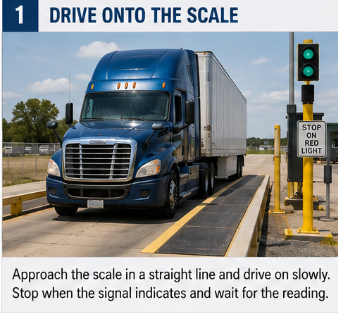
As the vehicle approaches the truck scale, keep it as straight as possible and drive onto the weighing platform at low speed.
Avoid sudden braking or frequent steering corrections while entering the scale.
Correct vehicle positioning directly affects the stability and accuracy of the weighing result.
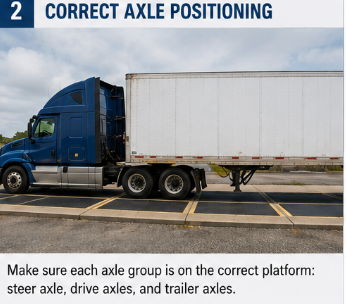
When using a multi-platform truck scale, different axle groups can be positioned on separate weighing platforms so that the steer axle, drive axles, and trailer axles can be measured at the same time.
4. Position Each Axle Group Correctly
A typical semi truck has three main axle groups.
The Steer Axle is located at the front of the tractor.
The Drive Axles are usually located behind the cab.
The Trailer Axles are located toward the rear of the semi-trailer.
When using a sectional or multi-platform scale, make sure each axle group is positioned completely within the correct weighing section.
If a wheel is sitting between two platforms, or if part of a wheel is outside the effective weighing area, the axle weight reading may be inaccurate.
5. Bring the Vehicle to a Complete Stop
Once the truck is correctly positioned on the scale, it should remain completely stationary. The vehicle should not move while the weight is being recorded. Vehicle movement, sudden braking, or incorrect positioning can interfere with the weighing result. After weighing is complete, the driver can view or obtain the vehicle weight data.
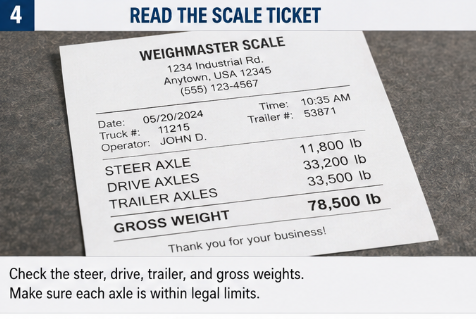
How to Read a Semi Truck Scale Ticket
A semi truck scale ticket usually divides the vehicle weight into several sections.
A common mistake is to look only at the Gross Weight. In practice, each axle group should also be checked separately. The purpose of weighing a truck is not only to confirm that the total vehicle weight is within a reasonable range, but also to make sure the cargo weight is properly distributed between the tractor and trailer axle groups.
A complete truck scale ticket may also record important information such as the tractor number, trailer number, weighing date, weighing time, and weighing location.
What Should You Do If One Axle Group Is Too Heavy?
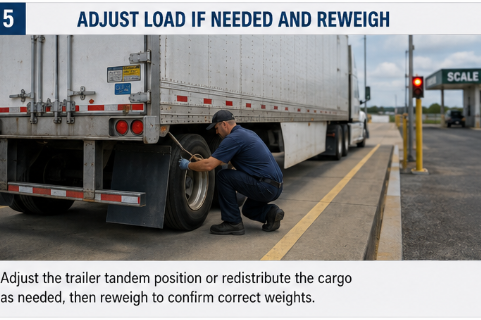
If the weighing result shows that one axle group is carrying too much weight, the truck may need to be adjusted before continuing the trip.
One common method is to adjust the position of the trailer tandem axles.
Moving the trailer axle group forward or backward can redistribute part of the cargo weight between the drive axles and trailer axles.
Depending on the vehicle configuration, adjusting the position of the fifth wheel may also change the weight distribution between the steer axle and drive axles.
If these vehicle adjustments are not enough to solve the problem, the cargo itself may need to be repositioned.
For example, pallets or other cargo can be moved slightly forward or backward so that the weight is distributed more evenly across the axle groups.
If the problem is not an overloaded axle but an excessive gross vehicle weight, part of the cargo may need to be removed.
Reweigh the Truck After Making Adjustments
After adjusting the trailer axles, moving the cargo, or making other weight-distribution changes, the truck should be weighed again. Do not rely only on experience or visual judgment to determine whether the weight is acceptable. Reweighing confirms whether the steer axle, drive axles, trailer axles, and gross vehicle weight are within the appropriate range. This is especially important for trucks operating close to their target load.
Can Portable Truck Scales Weigh a Semi Truck?
Yes.
A full-length truck scale is not the only option for weighing a semi truck. Portable truck scales and axle weighing systems can measure individual wheel or axle weights and, depending on the system configuration, calculate single-axle, axle-group, and total vehicle weight. Portable truck scales are suitable for construction sites, farms, remote industrial areas, temporary weighing stations, and other locations where installing a permanent scale may not be practical. High-volume weighing locations such as logistics centers, factories, ports, and large warehouses generally use fixed truck scales. The right weighing system mainly depends on daily truck traffic, available installation space, and whether the application requires permanent or mobile weighing.
Conclusion
Understanding how to scale a semi truck is not simply about obtaining one total vehicle weight. The more important part is understanding how the weight is distributed across the different axle groups.
A complete weighing process can be summarized as:
Load the Truck → Drive onto the Truck Scale → Check Each Axle Weight → Make Adjustments if Needed → Reweigh
Checking the steer axle, drive axles, trailer axles, and gross vehicle weight separately can help drivers and fleet managers identify load-distribution problems earlier.
For factories, logistics parks, freight terminals, and fleet operations, choosing the appropriate full-length truck scale, axle scale, or portable truck scale based on actual operating requirements can also make vehicle weighing and weight management more efficient.

Need customized model matching your production line, technical drawings and accurate quotation?
Submit your inquiry now, our engineering sales team will send full solution within 24 working hours.