
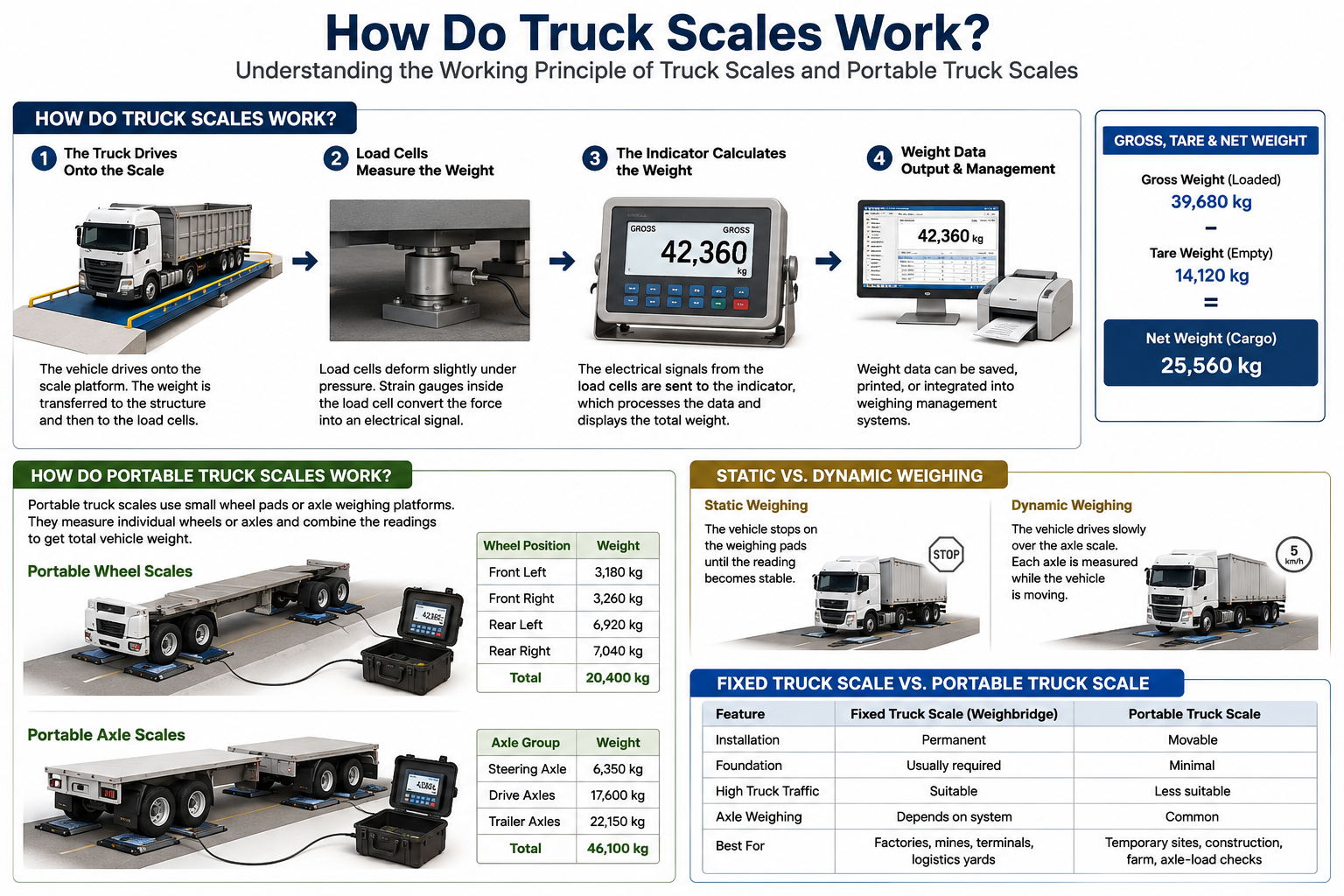

Truck scales are widely used at factories, mines, grain terminals, recycling yards, logistics centers and construction sites. They are mainly used to measure the total weight of trucks and calculate cargo weight.
So, how do truck scales work, and how do portable truck scales work?
The basic principle is simple:
Vehicle Load → Load Cells → Electrical Signal → Weighing Indicator → Weight Result
1. What Is a Truck Scale?
A truck scale, also called a weighbridge, is a heavy-duty weighing system designed for trucks and other large vehicles.
A typical truck scale includes:
- Weighing indicator
- Weighing software
The vehicle drives onto the platform, and its weight is transferred to the load cells underneath.
2. How Do Truck Scales Work?
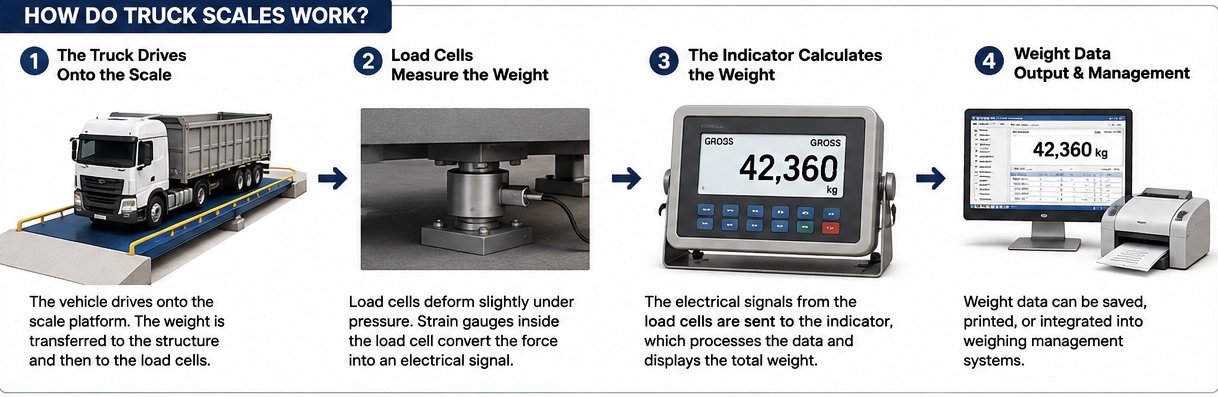
- The Truck Drives Onto the Scale
For a full-length truck scale, the entire vehicle normally needs to be positioned on the platform.
The steel or concrete deck transfers the vehicle load to several weighing points underneath.
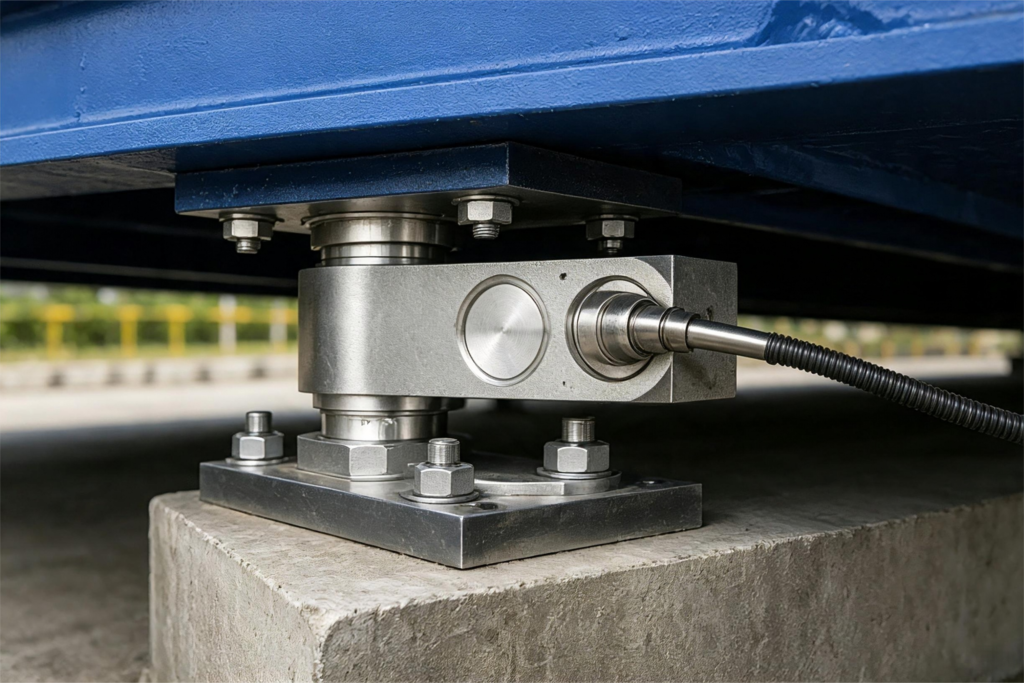
- Load Cells Measure the Weight
Load cells are the core components of a truck scale.
When a truck applies force to the scale, the load cells deform by a very small amount.
Strain gauges inside the load cells detect this change and convert it into an electrical signal.
Multiple load cells work together to measure the total vehicle weight.
- The Indicator Calculates the Weight
The load cell signals are sent to a junction box or digital weighing system and then to the weighing indicator.
The indicator converts the electrical signal into a readable value, such as:
Gross Weight: 42,360 kg
The data can also be sent to a computer, printer or weighing management system.
3. How Do Portable Truck Scales Work?
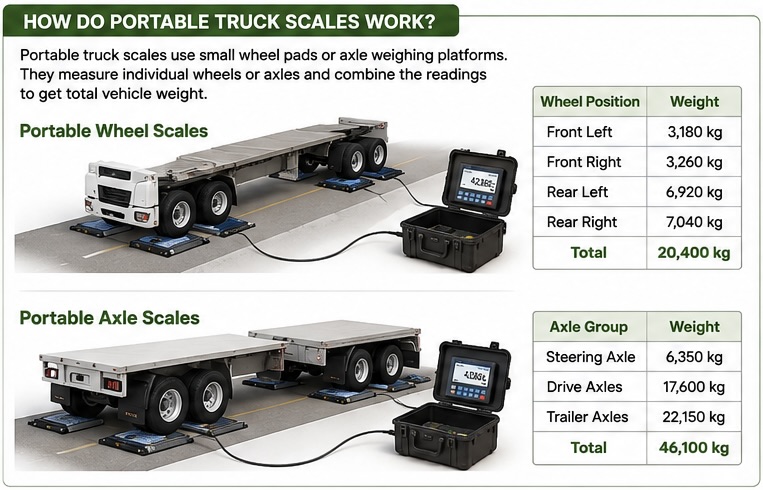
Portable truck scales use the same basic weighing principle, but they do not require one large permanent weighbridge.
Instead, the vehicle is weighed using smaller wheel pads or axle weighing platforms.
The system measures individual wheels, axles or axle groups and combines the readings.
4. Portable Wheel Scales
Portable wheel scales measure the load under each wheel.
For example:
| Wheel Position | Weight |
| Front Left | 3,180 kg |
| Front Right | 3,260 kg |
| Rear Left | 6,920 kg |
| Rear Right | 7,040 kg |
| Total | 20,400 kg |
The individual readings can also help identify uneven vehicle loading.
5. Portable Axle Scales
Portable axle scales measure one axle or axle group at a time.
For example:
| Axle Group | Weight |
| Steering Axle | 6,350 kg |
| Drive Axles | 17,600 kg |
| Trailer Axles | 22,150 kg |
| Total | 46,100 kg |
This is useful when operators need both total vehicle weight and axle load information.
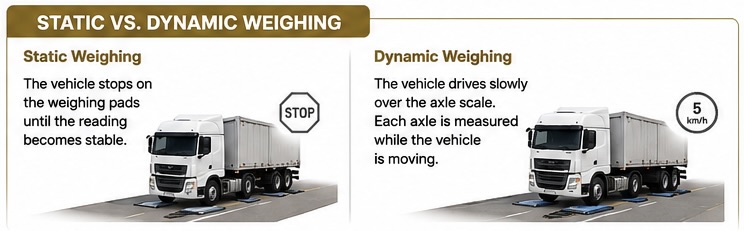
6. Static vs. Dynamic Weighing
Portable truck scales can work in two common ways.
- Static Weighing
The vehicle stops on the weighing pads until the reading becomes stable.
This method usually provides more stable measurement conditions.
- Dynamic Weighing
The truck slowly passes over the axle scale.
Each axle is measured while the vehicle is moving.
Vehicle speed, braking and road conditions can influence the reading, so correct operation is important.
7. Fixed Truck Scale vs. Portable Truck Scale
| Feature | Fixed Truck Scale | Portable Truck Scale |
| Installation | Permanent | Movable |
| Foundation | Usually required | Minimal |
| High truck traffic | Suitable | Less suitable |
| Axle weighing | Depends on system | Common |
| Temporary sites | Less suitable | Suitable |
A permanent weighbridge is normally better for factories, mines, terminals and logistics yards with regular daily traffic.
Portable truck scales are more suitable for temporary sites, farms, construction projects and vehicle axle-load checks.
8. What Can Affect Truck Scale Accuracy?
Several practical factors can affect weighing results.
- Foundation or Ground Condition
The scale needs a stable and level installation surface.
- Vehicle Movement
Braking, acceleration or suspension movement can cause unstable readings.
- Load Cell Condition
Moisture, corrosion, damaged cables or sensor faults may affect the signal.
- Calibration
Truck scales should be calibrated according to the application and local metrology requirements.
9. Does a Truck Scale Measure Cargo Weight Directly?
No. A conventional truck scale measures the entire vehicle.
Cargo weight is calculated from the difference between loaded and empty vehicle weight.
Cargo Weight = Gross Weight – Tare Weight
10. How to Choose the Right Truck Scale?
Before choosing a truck scale, focus on a few key questions:
- What is the maximum truck weight?
- What is the truck length?
- How many trucks are weighed each day?
- Do you need total weight or axle weight?
- Is the weighing location permanent or temporary?
- Do you need weighing software or automatic vehicle identification?
These questions usually determine whether a permanent weighbridge or portable truck scale is more suitable.
11. FAQ
Truck scales transfer vehicle weight to load cells. The load cells convert the force into electrical signals, and the weighing indicator converts those signals into a weight value.
Portable truck scales measure individual wheels or axles using small weighing platforms and combine the readings to calculate vehicle weight.
Static scales require the vehicle to stop. Some dynamic axle scales can measure a truck while it moves slowly across the platform.
In most industrial applications, they refer to the same type of heavy vehicle weighing system.
12. Conclusion
A truck scale works by transferring vehicle weight through the scale deck to several load cells. The sensors convert the applied force into electrical signals, and the weighing indicator processes those signals into a final weight reading.
Portable truck scales use the same basic principle but rely on smaller wheel or axle weighing platforms instead of a permanent full-length weighbridge.
For fixed industrial sites with frequent truck traffic, a permanent truck scale is usually the more practical solution.
For temporary locations or applications where axle weight is important, portable truck scales offer greater flexibility.

Need customized model matching your production line, technical drawings and accurate quotation?
Submit your inquiry now, our engineering sales team will send full solution within 24 working hours.