
Choosing a conveyor belt scale by maximum capacity alone is a common mistake.
Two conveyors can both run at 500 t/h and still create very different weighing conditions.
One may move slowly with a deep material bed. Another may run much faster with less material on each meter of belt.
The hourly flow is the same.
The load signal available to the weighing system is not.
That is why belt-scale selection should start with the conveyor and operating conditions—not the model number.
For the basic measurement principle, see how a conveyor belt scale works.
1. Start With the Operating Range, Not Maximum Flow
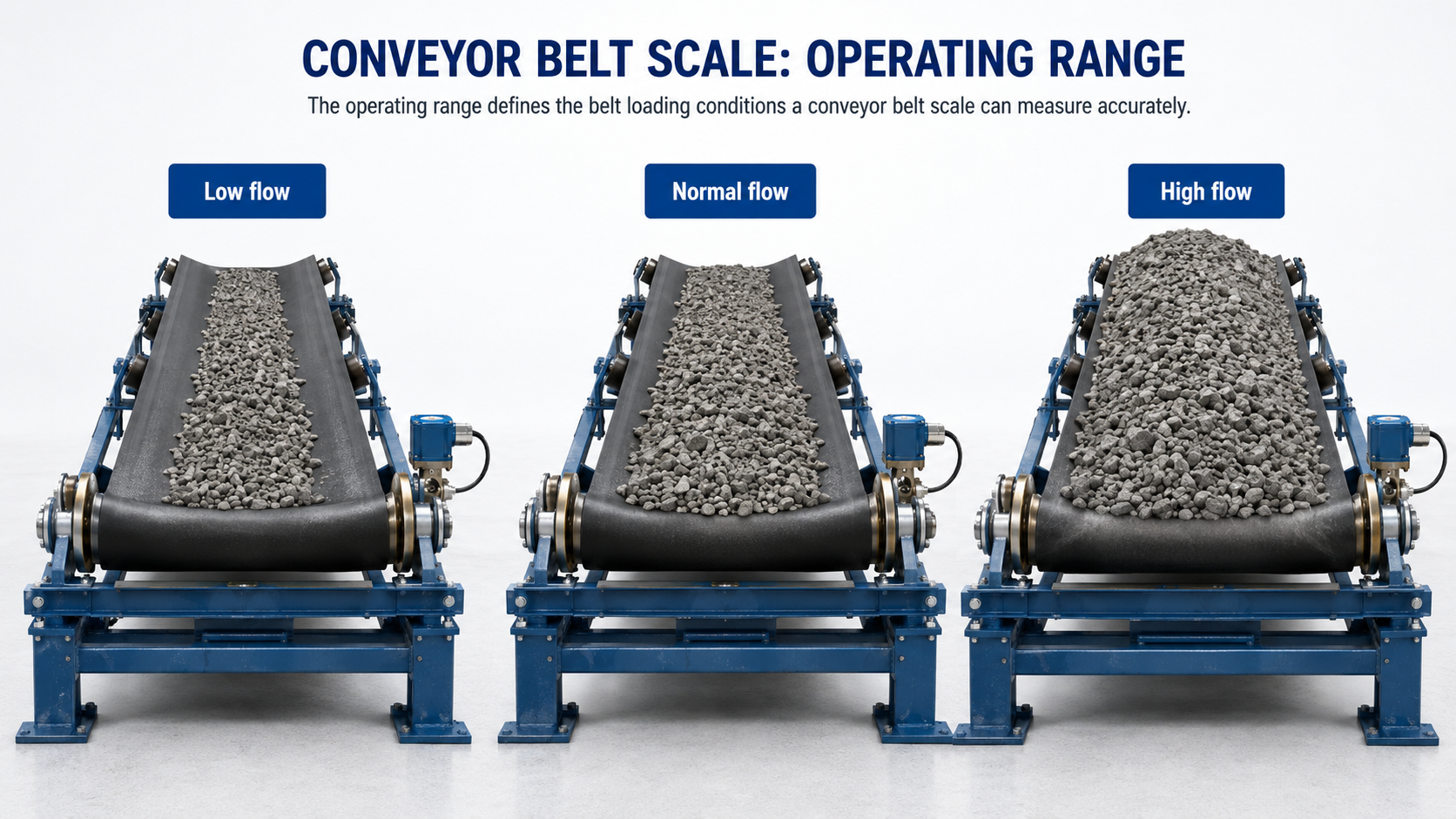
Maximum flow is only one operating point.
A better starting point is:
minimum flow / normal flow / maximum flow
For example: 50–500 t/h
is a very different weighing application from: 300–500 t/h
even though both have the same maximum capacity.
At low flow, the material signal becomes smaller, so zero variation, belt tare, vibration, and small mechanical disturbances can have a larger percentage effect.
This is why the minimum operating range matters as much as the maximum.
2. Check Belt Loading in kg/m
A belt scale calculates flow from:
Flow = Belt Load × Belt Speed
So t/h alone does not describe the weighing condition.
At 100 t/h:
At 0.5 m/s belt speed: ≈ 55.6 kg/m
At 2.0 m/s: ≈ 13.9 kg/m
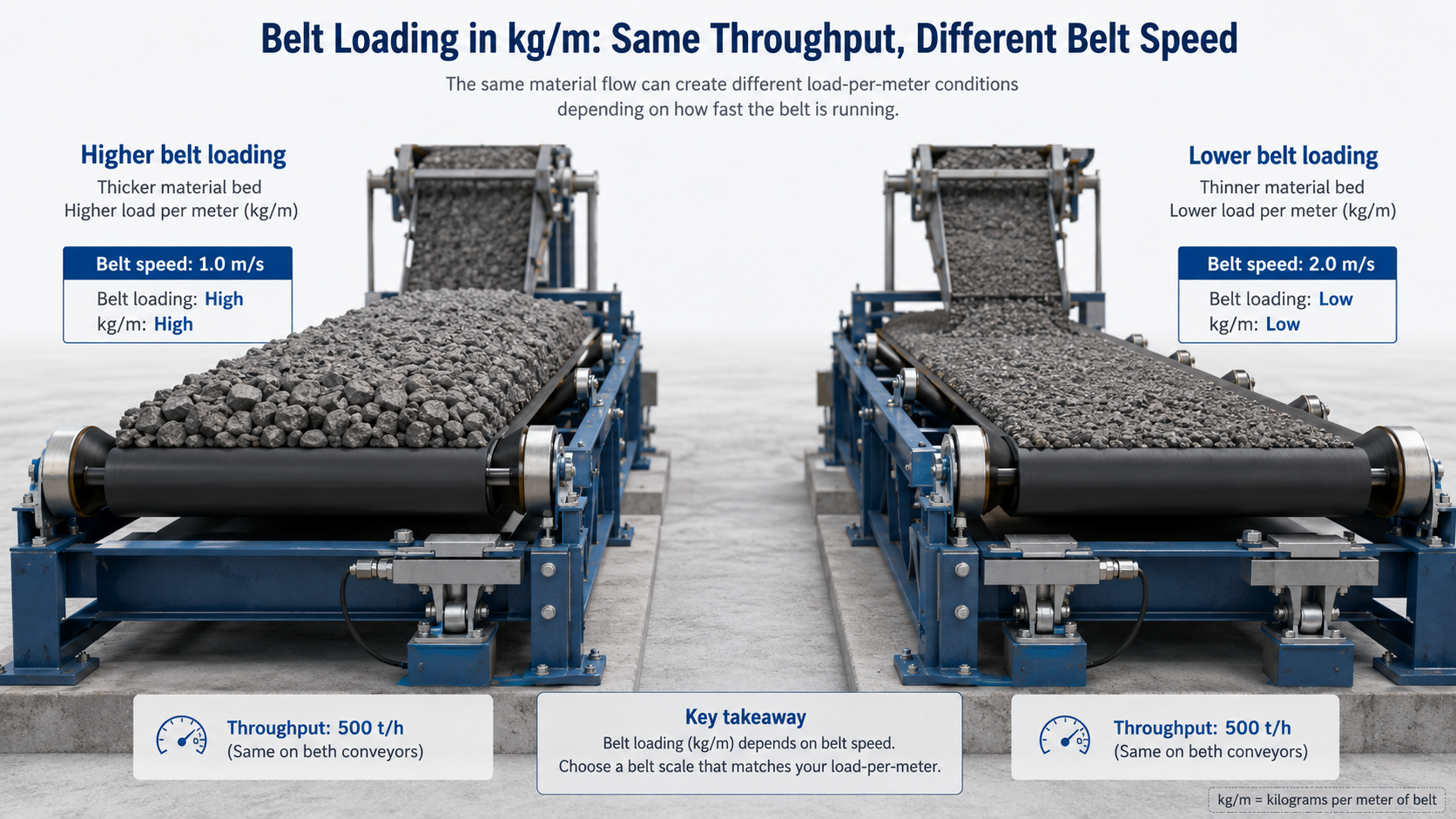
The production rate is identical, but the second conveyor gives the scale only one-quarter of the material load per meter.
That can make zero stability and mechanical disturbances more important.
When requesting a belt-scale recommendation, provide: t/h + belt speed + kg/m
not only maximum capacity.
3. Define the Accuracy You Actually Need
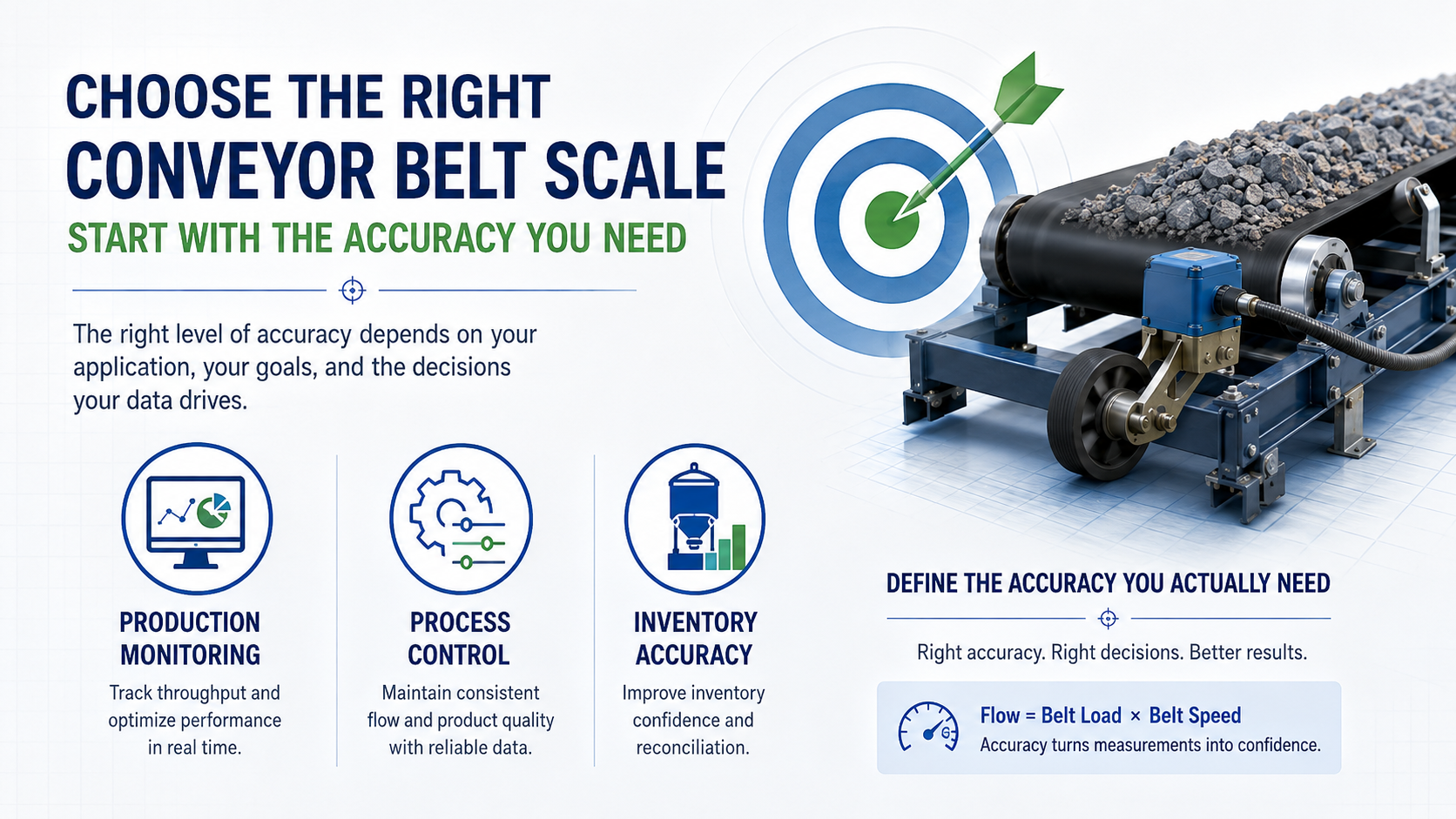
“High accuracy” is too broad.
The real requirement depends on the process.
For production monitoring, the main concern may be long-term totalized weight.
For process control, stable response to changing flow may matter more.
For tighter inventory work, repeatability across the full operating range becomes important.
So instead of asking only:
“What is the accuracy?”
ask:
“Over what flow range is that accuracy expected?”
and:
“Under what installation and calibration conditions?”
For more detail, see conveyor belt scale accuracy.
4. Make Sure the Conveyor Has a Suitable Weighing Zone
A good belt scale cannot fully compensate for a poor installation location.
Before choosing the model, confirm that the conveyor provides a section with:
- settled material
- stable belt tracking
- aligned idlers
- no major vertical curve nearby
- a mechanically free weigh frame
- reliable speed measurement
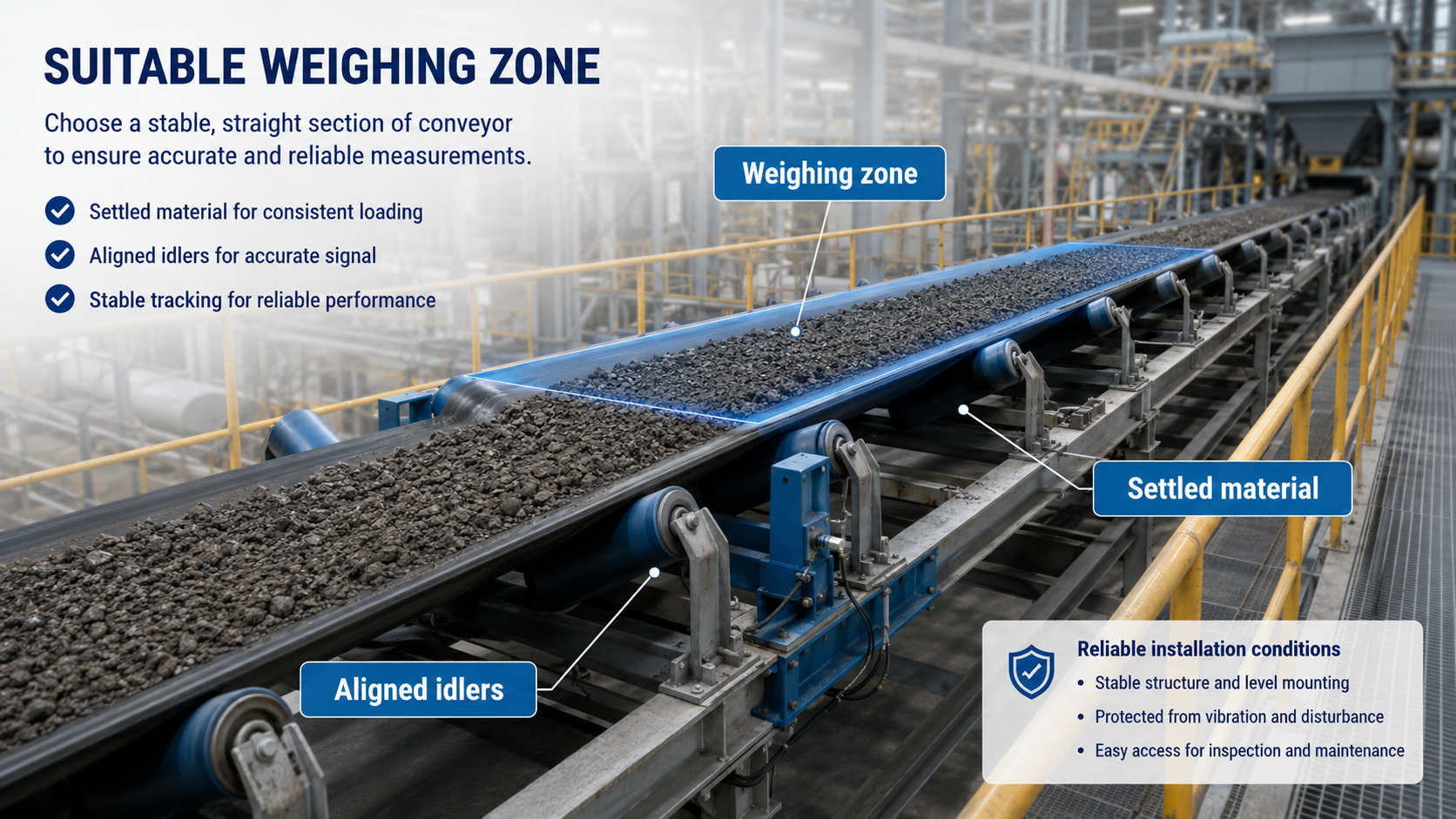
If the only possible location is directly below a loading chute or close to a major conveyor transition, installation conditions may limit performance more than the scale specification.
See conveyor belt scale installation for the main site requirements.
5. Single-Idler or Multi-Idler?
More weigh idlers do not automatically mean better accuracy.
A single-idler system may be suitable when:
- the conveyor is stable
- installation space is limited
- the required accuracy is moderate
A longer or multi-idler weighing section can average local belt and idler variations over a greater weighing length.
That may be useful for:
- wider conveyors
- variable loading
- applications requiring higher stability
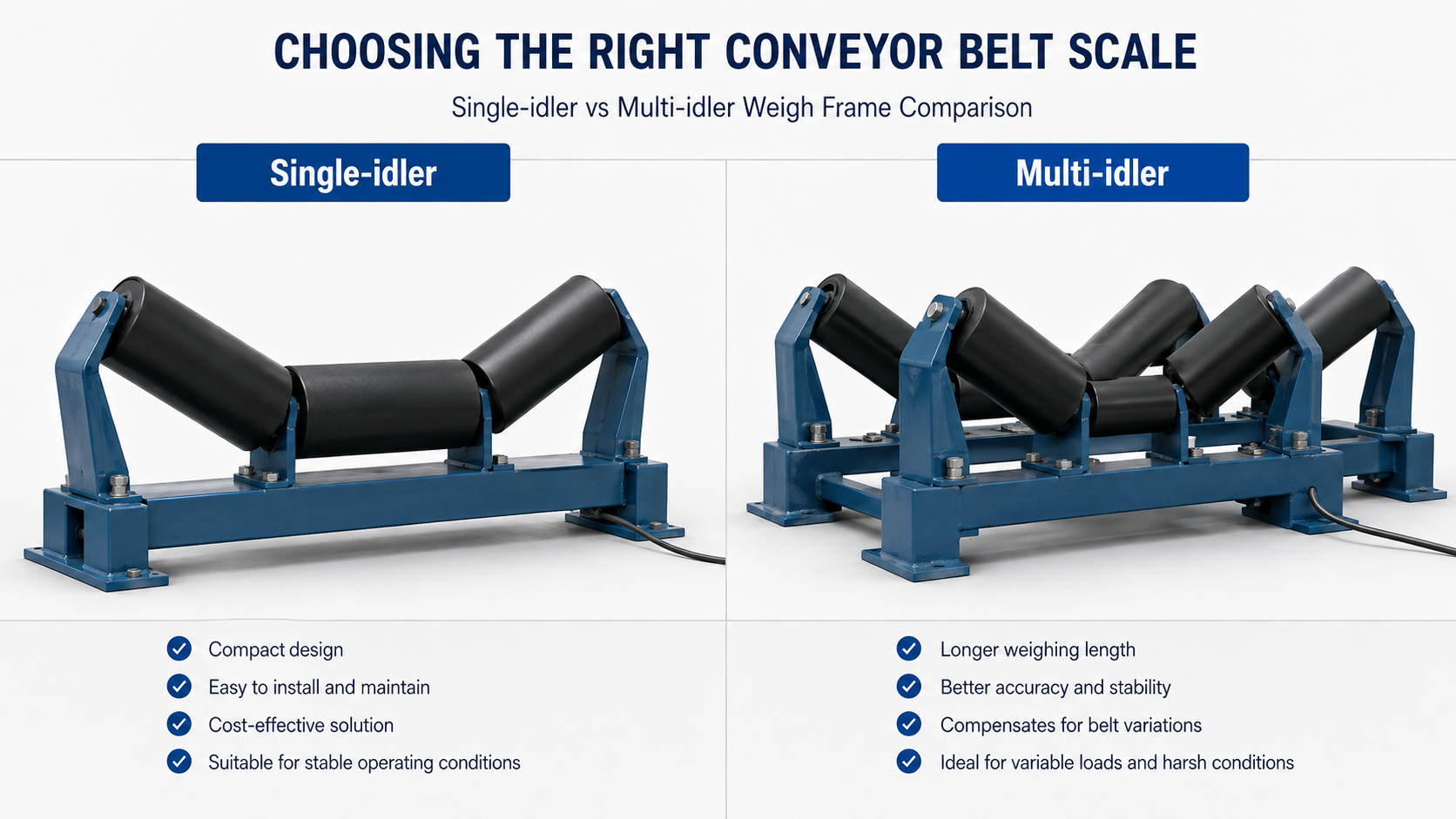
But more idlers also mean more alignment work and a larger mechanical structure that must remain stable.
The useful question is not:
“Which scale has more weigh idlers?”
It is:
“How much weighing length does this conveyor actually need?”
6. Look at the Mechanical Load Path
The load cells are only one part of the weighing system.
The material load still has to travel through:
Belt → Weigh Idler → Weigh Frame → Load Cells
If that force path is unstable, a high-specification load cell will not solve the problem.
When comparing scales, look at:
- how the weigh frame transfers load
- whether the design minimizes unnecessary mechanical restraints
- how the structure responds to off-center loading
For a component-level explanation, see conveyor belt scale components.
7. Speed Measurement Is Part of the Scale Selection
The speed sensor should not be treated as a secondary accessory.
Because:
Flow = Belt Load × Belt Speed
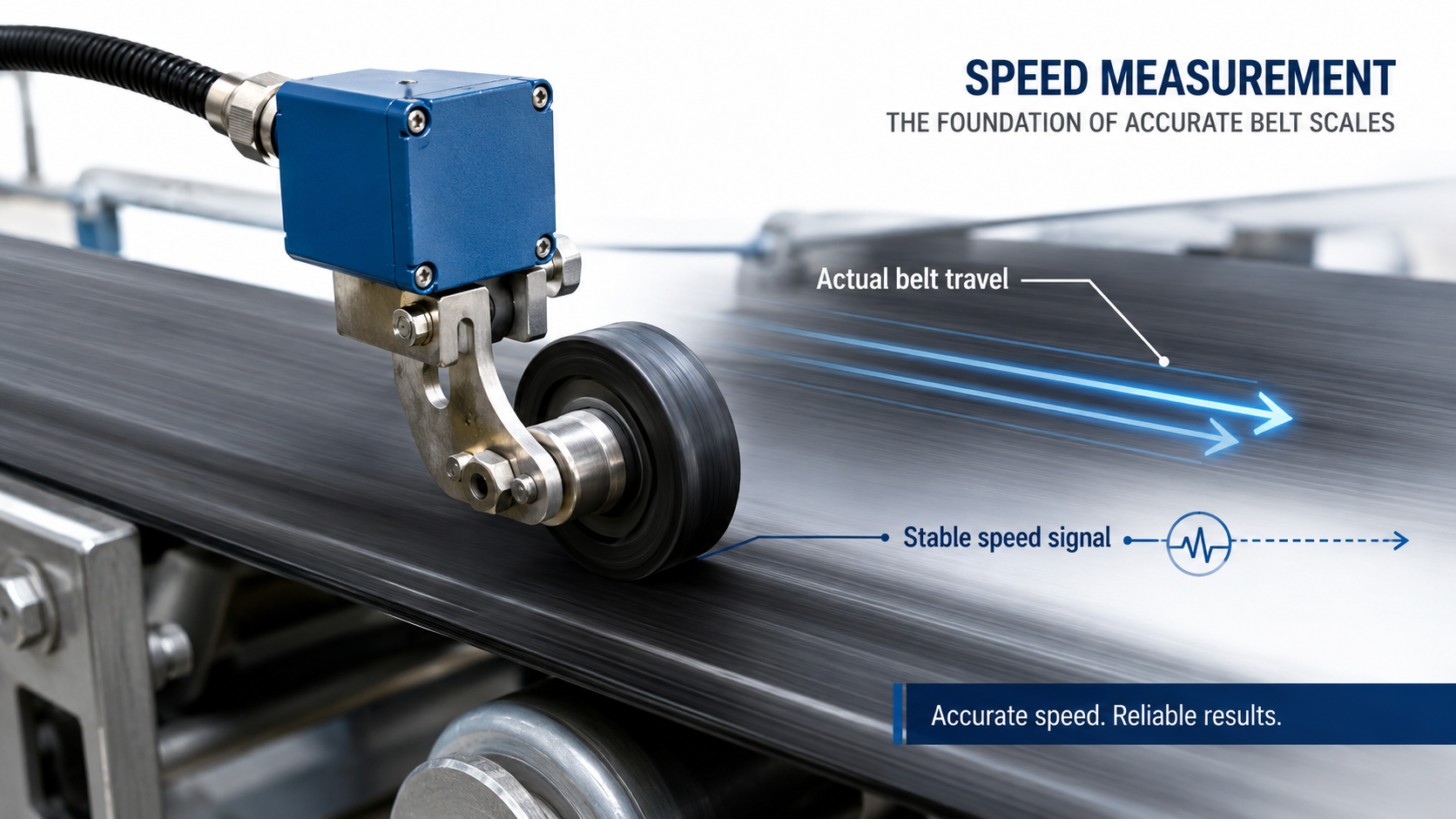
a speed error passes directly into the final result.
If the speed signal is 1% high, calculated flow will also be about 1% high when the load signal is correct.
For variable-speed conveyors especially, ask:
- Does the sensor measure actual belt travel?
- Can the measuring wheel slip?
- Will the sensor maintain reliable contact with the belt?
A stable-looking speed signal is not enough.
It must represent the belt itself.
See the belt scale speed sensor for the speed-measurement stage.
8. What Information Should You Send to the Manufacturer?
A useful application review should include:
- material type
- minimum and maximum flow
- belt width
- belt speed
- conveyor incline
- idler spacing
- required accuracy
- installation photos or drawings
For more difficult applications, also provide:
- material buildup tendency
- off-center loading
- variable-speed operation
- the distance from the loading point
This information tells the manufacturer much more than:
“Capacity: 500 t/h.”
A supplier should also be able to support belt scale calibration and belt scale troubleshooting after installation.
9. Where the LCS-Series Fits
The LCS-Series high-accuracy conveyor belt scale uses a floating-balance weighing structure with dual Keli load cells.
The design is intended to reduce unnecessary force-transfer paths and reduce sensitivity to off-center loading.
It is better suited to applications that require:
- stable continuous weighing
- higher accuracy
- wider or higher-capacity conveyors
- better control of mechanically induced weighing errors
But model selection should still begin with the real application data.
Useful application data include:
belt width + belt speed + min/max flow + kg/m loading + incline + material behavior + installation geometry
10. The Main Point
The right conveyor belt scale is not simply the one with the highest capacity.
It is the one that matches:
the operating range, belt loading, required accuracy, installation conditions, and speed measurement.
The most useful selection questions are:
What is the minimum as well as maximum flow?
How much material is actually on each meter of belt?
Is the weighing zone mechanically stable?
What accuracy is required across the real operating range?
Does the speed signal represent actual belt travel?
Capacity tells you how much material the conveyor can move.
It does not tell you how easy that material is to weigh.

Need customized model matching your production line, technical drawings and accurate quotation?
Submit your inquiry now, our engineering sales team will send full solution within 24 working hours.