
A belt conveyor may move hundreds of tons of coal, ore, aggregate, or grain every hour, yet the material never stops on a weighing platform.
So how does a belt scale measure it?
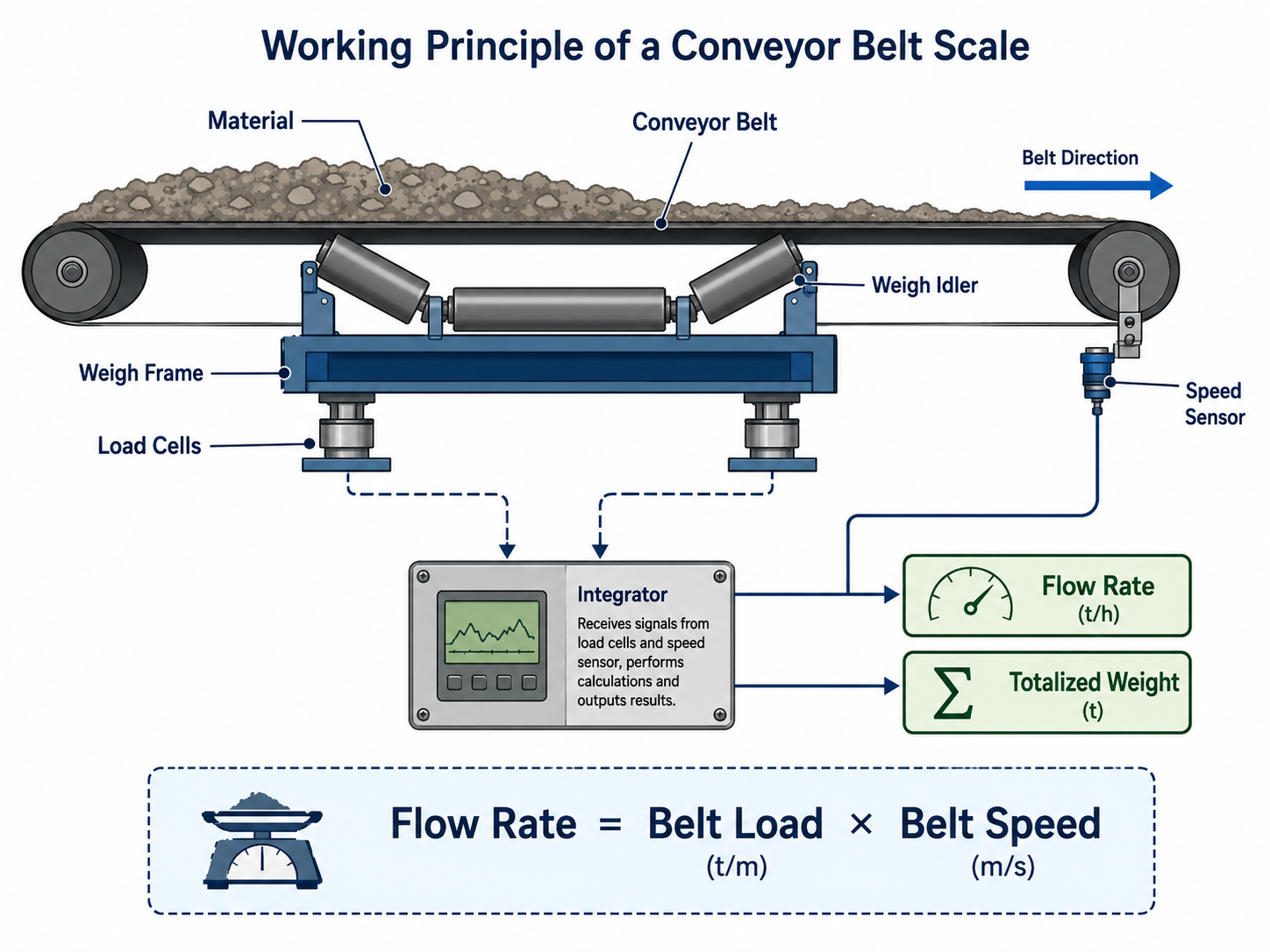
A conveyor belt scale continuously measures two things:
- How much material is carried on each meter of belt
- How fast the belt is moving
The weighing system combines these values to calculate material flow.
In simplified form:
Flow rate (t/h) = Belt load (kg/m) × Belt speed (m/s) × 3.6
The equation is simple. Reliable measurement on a working conveyor is not.
The real challenge is making sure the load and speed signals represent the actual material flow rather than changes in belt tension, alignment, vibration, buildup, or other mechanical conditions.
1. What Does a Conveyor Belt Scale Measure?
A conveyor belt scale, also called a belt weigher, is a continuous dynamic weighing system installed on a belt conveyor.
Unlike a static scale, it does not measure one stationary load.
Instead, it determines the material load per unit length of belt and combines this with measured belt speed.
For example, if the belt carries:
80 kg/m at 1 m/s
the flow rate is:
80 × 1 × 3.6 = 288 t/h
If belt speed increases to 1.5 m/s while loading remains unchanged:
80 × 1.5 × 3.6 = 432 t/h
This explains why a belt scale needs both a load measurement and a speed measurement. A load cell alone cannot determine tons per hour.
2. The Scale Only Measures a Defined Section of Conveyor
A belt scale does not weigh all the material on the conveyor.
It measures a specific weighing zone.
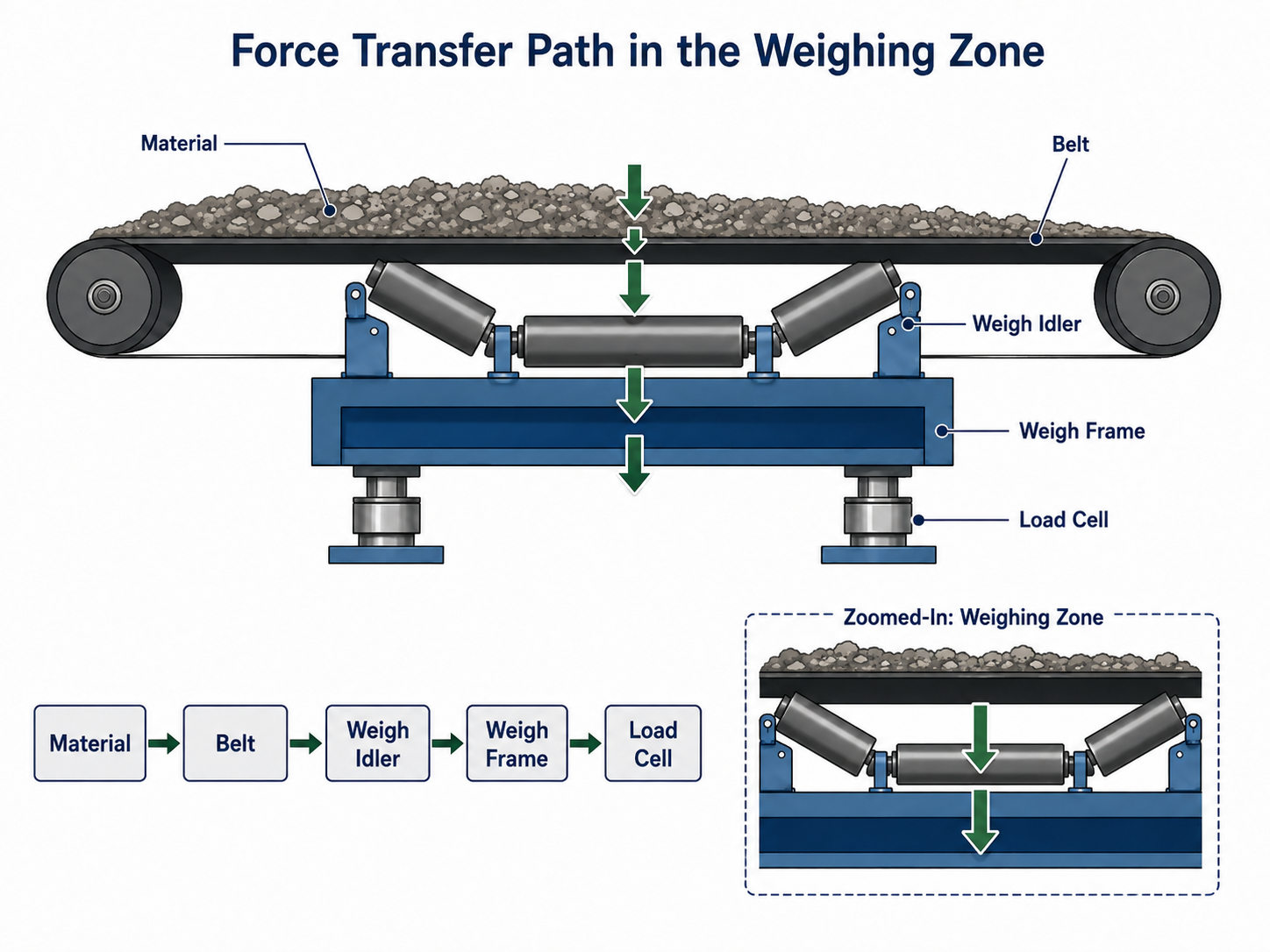
The force path is approximately:
Material → Belt → Weigh Idler → Weigh Frame → Load Cell
As material passes over the weigh idler, part of its vertical force is transferred through the weighing structure to the load cells.
This mechanical path is important.
If the weigh frame is restricted, an idler is misaligned, or material buildup interferes with movement, the load cell may detect forces that are not caused only by the conveyed material.
That is why belt scale performance depends on more than sensor accuracy.
The conveyor itself becomes part of the measuring system.
3. Why the Weigh Frame Matters
A highly accurate load cell cannot compensate for poor force transfer.
The weigh frame must support the conveyor while allowing small changes in material load to reach the sensors consistently.
Material is also rarely distributed perfectly across the center of a belt.
A loading chute may feed more material to one side, or the material profile may change as flow conditions change.
The KELISCALES LCS-Series uses a floating-balance weighing structure with dual load cells mounted at the ends of the load-bearing beam. This arrangement is designed to reduce unnecessary force-transfer links and improve response to eccentric loading on wide or high-speed conveyors.
The important point is not simply that the system uses two load cells.
It is that mechanical geometry affects the quality of the measurement.
4. The Load Cell Does Not Know Why the Force Changed
A load cell converts mechanical force into an electrical signal.
But it cannot identify the source of that force.
It may respond to:
- actual material load
- belt tension acting through a misaligned idler
- mechanical interference
- material buildup
- vibration
This explains a common misunderstanding:
A high-accuracy load cell does not automatically create a high-accuracy belt scale.
The load cell is only one part of the complete measurement chain.
In actual operation, the result is also influenced by:
- weigh-frame design
- speed measurement
- calibration
- belt condition
- material distribution
- idler alignment
- installation
For this reason, belt scales should be evaluated as complete systems rather than by load-cell specification alone.
5. Belt Speed Is Equally Important
Once belt loading is known, the system still needs to know how fast the material is moving.
A speed sensor measures belt travel and sends this information to the integrator.
If the load measurement is correct but belt speed is measured 2% too high, the calculated flow will also tend to be high.
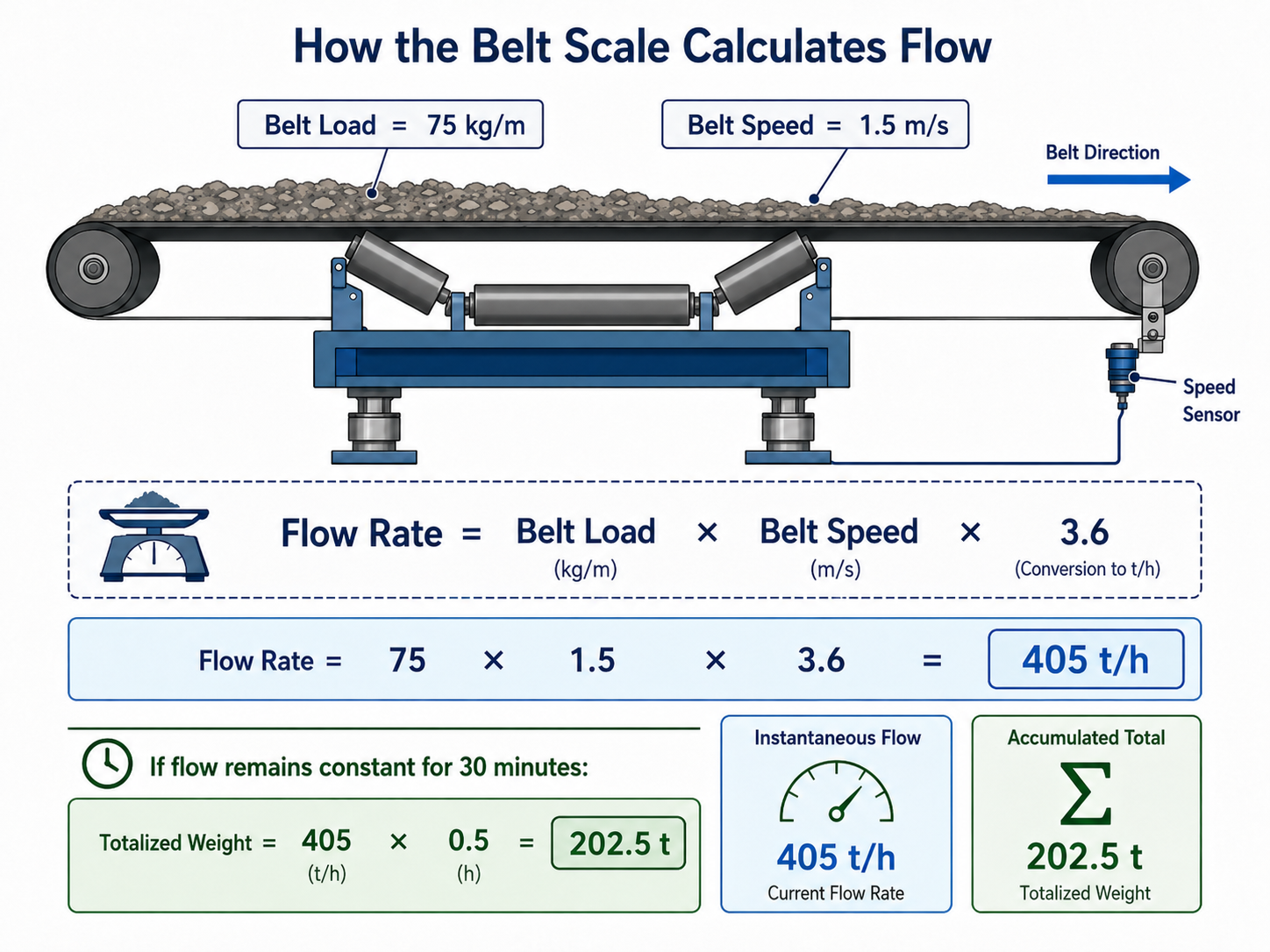
The integrator combines the two signals:
Load signal + Speed signal → Flow rate → Totalized weight
For example:
- Belt load: 75 kg/m
- Belt speed: 1.5 m/s
Then:
75 × 1.5 × 3.6 = 405 t/h
If that flow remained constant for 30 minutes:
405 × 0.5 = 202.5 tons
In reality, loading and speed change continuously, so the system repeatedly calculates and integrates the flow.
This produces two different values:
Instantaneous flow: 405 t/h
Accumulated total: 12,580 t
Flow rate tells the operator how quickly material is moving now.
Totalized weight tells the operator how much material has passed the scale over time.
6. One Important Detail: An Empty Belt Is Not “Zero”
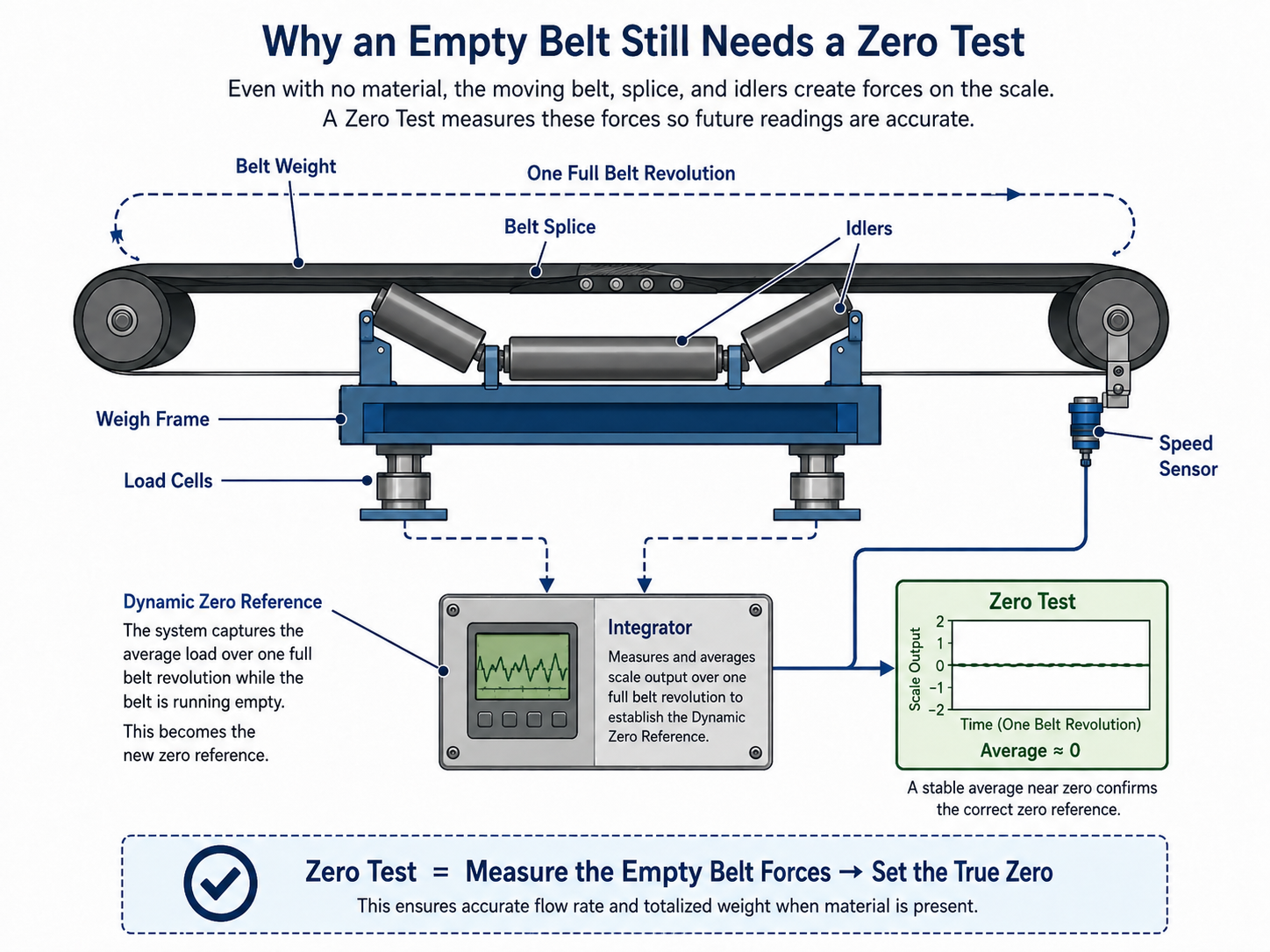
An empty conveyor is still a moving mechanical system.
The belt has weight. The splice may have a slightly different mass or stiffness. Idlers are rotating. Belt tension remains present.
A belt scale therefore needs a dynamic zero reference with the conveyor running empty.
This is why zero tests are normally carried out over complete belt revolutions rather than for an arbitrary short period.
If one section of the belt is slightly heavier, or the splice creates a repeating disturbance, measuring a complete revolution helps average that effect.
This also creates a useful troubleshooting clue:
If zero changes in a repeating pattern at approximately the same point during every belt revolution, inspect the belt splice, belt condition, or another repeating mechanical source before blaming the load cell.
A drifting zero may also indicate:
- material buildup
- changing belt tracking
- changed tension
- idler replacement
- mechanical contact with the weigh frame
Recalibration may hide the symptom without correcting the cause.
7. Why Idler Alignment Affects Weight
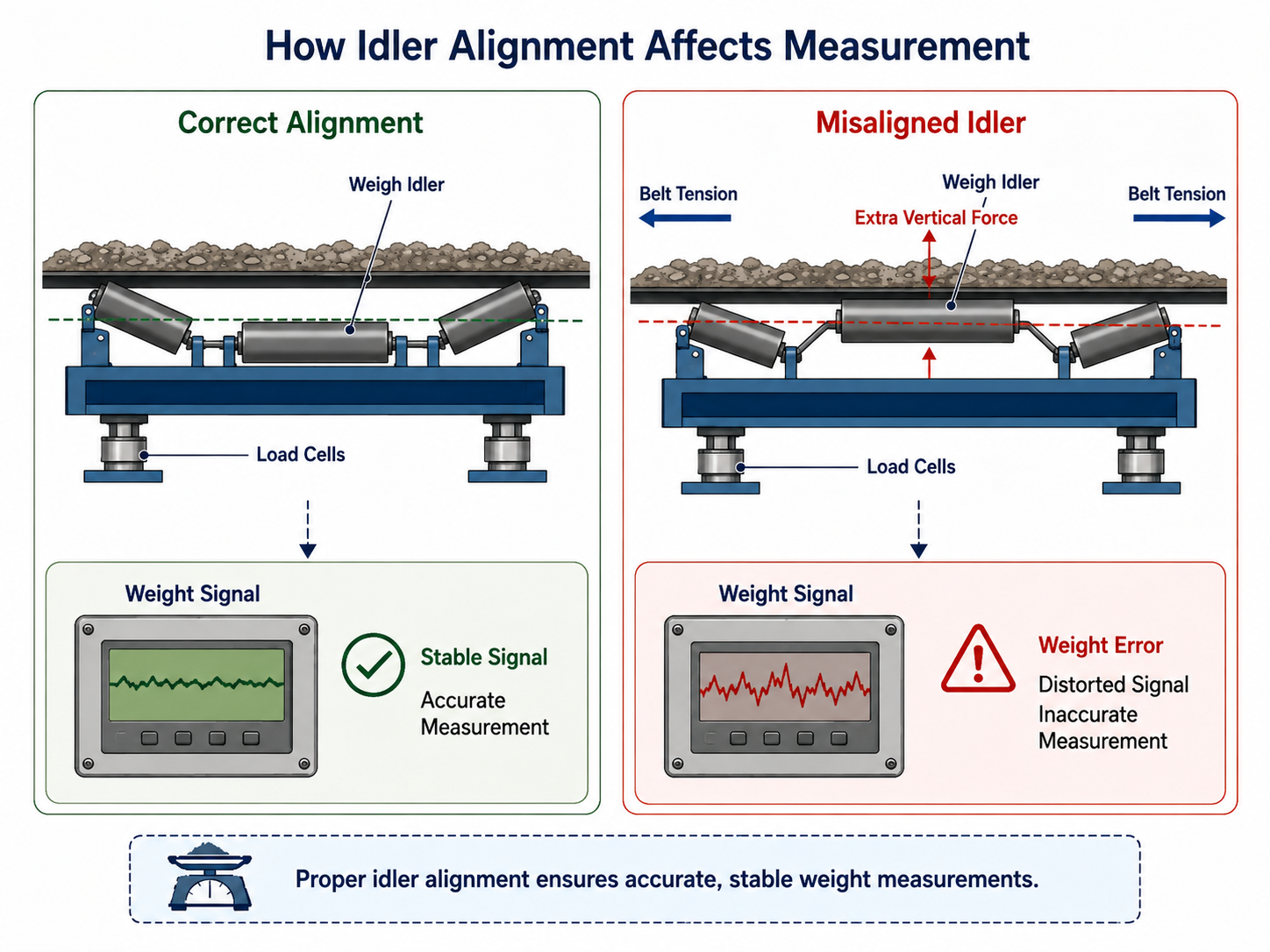
Suppose the weigh idler sits slightly higher than the adjacent idlers.
The belt must rise as it enters the weighing zone.
Because the belt is under tension, this geometry creates an additional vertical force on the weigh idler.
The load cells detect that force.
They cannot distinguish it from material weight.
The same issue can occur when the weigh idler is too low or nearby idlers are poorly aligned.
This is why idler alignment is not simply an installation detail.
It is part of measurement accuracy.
Scale location matters for the same reason.
If a belt scale is installed immediately after a loading chute, the material may still be bouncing, accelerating, or changing profile.
A more stable material stream generally provides better weighing conditions.
8. Why Material Testing Is More Valuable Than Test Weights Alone
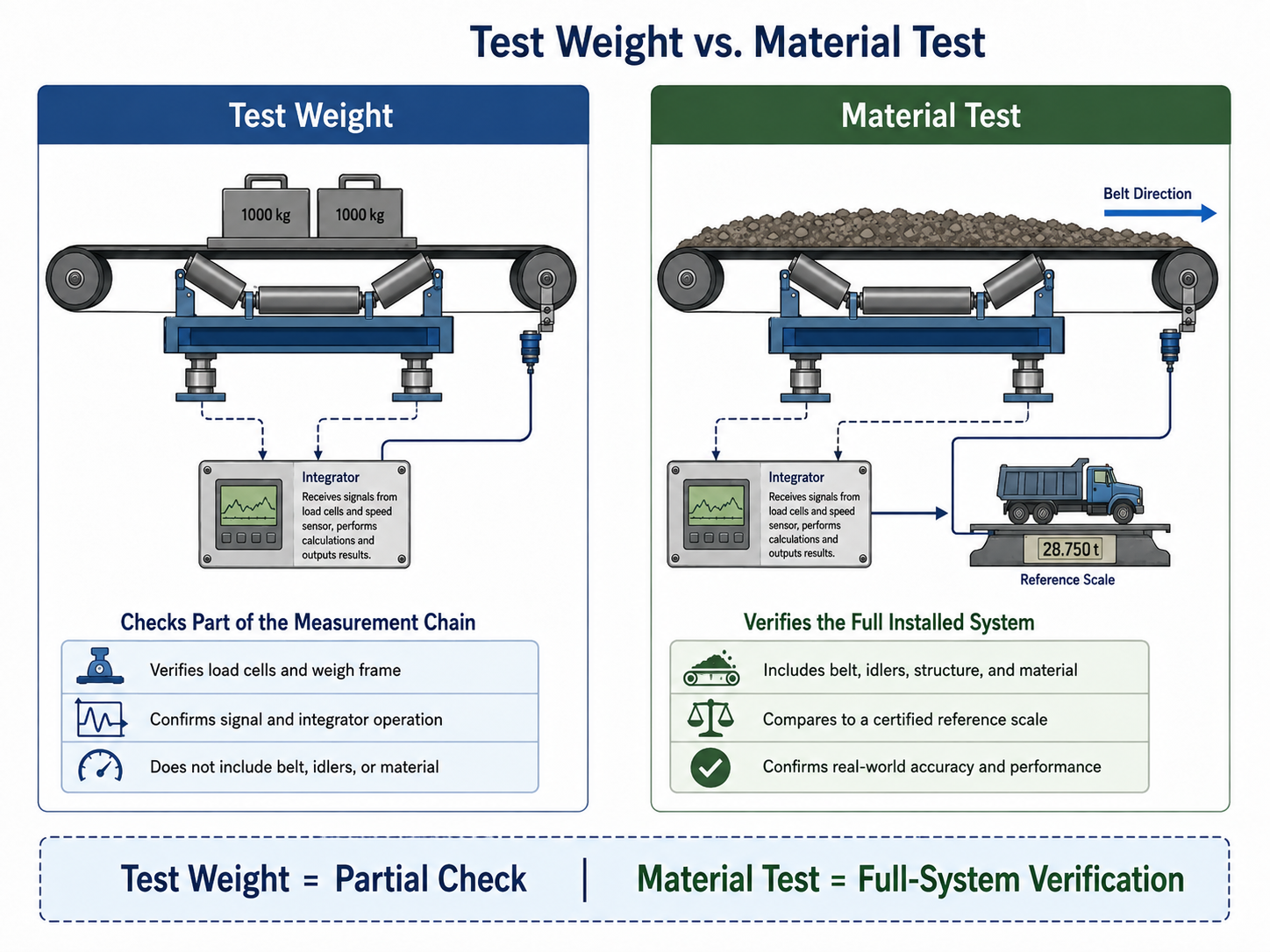
Test weights are useful because they apply a known force to the weighing mechanism.
But they do not reproduce all operating conditions.
They do not fully simulate:
- actual material distribution
- belt deflection under load
- changing belt tension
- real conveyor speed
- material settling
A material test checks the entire installed system.
A known quantity of actual product passes through the belt scale, and the totalized result is compared with an independent reference weight.
This can reveal problems that a static calibration method may not show.
A useful way to think about the difference is:
Test weight: checks part of the measurement chain.
Material test: checks how the complete system performs with real material.
This is especially important when a belt scale calibrates normally but continues to disagree with truck scales, hopper scales, or inventory totals.
9. What Does the Error Pattern Tell You?
Instead of immediately changing the calibration factor, look at how the error behaves.
If the error is similar at different flow rates, span or calibration may deserve attention.
If the error becomes much larger at low loading, zero stability becomes more important.
If the error appeared after conveyor maintenance, inspect mechanical alignment first.
If the error repeats once every belt revolution, inspect the belt or splice.
If the reading changes when belt speed changes, check the speed measurement.
These patterns do not prove the cause, but they make troubleshooting much more efficient than adjusting calibration blindly.
10. How the LCS-Series Approaches the Measurement Problem
The KELISCALES LCS-Series uses a floating-balance weighing frame with dual Keli load cells.
The structure is designed to reduce unnecessary mechanical force-transfer links, while the dual-load-cell arrangement helps the system respond to off-center loading.
This is particularly relevant for wide belts and higher-speed conveyors.
However, no weighing frame can compensate for every conveyor problem.
Final performance still depends on:
- correct scale location
- idler alignment
- belt condition
- accurate speed measurement
- calibration
- the actual loading conditions
This is why belt scale selection should start with real conveyor data rather than capacity alone.
Useful information includes:
- material
- normal and maximum flow
- belt width
- the required measurement purpose
- belt speed
- conveyor inclination
- loading-point position
Two conveyors rated at 500 t/h may require very different weighing solutions.
11. Belt Scale or Weigh Belt Feeder?
A belt scale mainly answers:
“How much material is moving?”
A weigh belt feeder answers:
“How much material should be fed, and how can that rate be controlled?”
A belt scale normally measures material already moving on an existing conveyor.
A weigh belt feeder measures and actively controls the feeding rate.
The correct choice therefore depends on whether the process needs measurement only or measurement plus controlled feeding.
12. The Key Point
A conveyor belt scale works according to a simple principle:
Belt load × belt speed = material flow
But accurate belt weighing depends on much more than that formula.
The load cell cannot tell why a force changed. The speed sensor cannot tell whether the material profile is stable. The integrator can only calculate from the signals it receives.
Reliable belt weighing therefore depends on the whole chain:
Material → Conveyor → Weigh Frame → Load Cells → Speed Measurement → Integrator → Calibration
Understanding this makes it easier to select, install, calibrate, and troubleshoot a conveyor belt scale—and explains why two systems with similar sensor specifications may perform very differently in the field.

Need customized model matching your production line, technical drawings and accurate quotation?
Submit your inquiry now, our engineering sales team will send full solution within 24 working hours.