
If you have worked with industrial weighing equipment, there is a good chance you have already come across the Keli name.
Keli Sensing Technology is well known for load cells, weighing sensors, indicators and other weighing components. More recently, buyers looking for complete weighing equipment may also come across another name: KELISCALES.
That naturally raises a question: what is the difference between Keli and KELISCALES?
They are not competing companies.
Keli Sensing Technology and KELISCALES belong to the same weighing technology ecosystem, but they serve different types of customers.
Keli Sensing Technology is mainly associated with sensors, load cells, weighing electronics and measurement technology. KELISCALES focuses on complete industrial weighing equipment and integrated weighing systems for overseas customers.
For a buyer, the distinction is fairly practical.
If you need a load cell, you are probably looking for Keli.
If you need an entire truck scale, belt scale or automated weighing system, KELISCALES is the more relevant place to start.
1. Keli Sensing Technology: The Component and Sensing Side
Keli has spent decades developing weighing and force-measurement technology.
Its product range covers load cells, force sensors, weighing indicators, junction boxes and other measurement components, as well as weighing systems and industrial IoT applications.
For many customers outside China, the Keli name is especially familiar because of its load cells.
That background matters.
A load cell may be a relatively small part of a truck scale or belt scale, but it is the part that actually senses the load. Its performance affects accuracy, repeatability, stability and long-term reliability.
This is why Keli’s experience in sensors is relevant even when the final product is a much larger piece of industrial equipment.
The company is not entering the weighing industry from the outside. Complete weighing equipment is an extension of technologies Keli has been working with for many years.
2. So Where Does KELISCALES Fit In?
KELISCALES was created for customers who are not simply buying individual components.
Its focus is complete weighing equipment and complete project requirements.
That includes products such as:
- truck scales and weighbridges
- platform scales
- conveyor belt scales
- hopper weighing systems
- weigh belt feeders
- dynamic checkweighers
- unattended weighing systems
- weighing automation and IoT solutions
The difference becomes easier to understand when you look at a real purchasing situation.
A scale manufacturer may only need eight load cells, a junction box and an indicator.
A mining company, on the other hand, may need a 120-ton truck scale, vehicle identification, traffic lights, barriers, cameras, weighing software and remote data management.
Both projects involve weighing technology, but they are completely different purchases.
KELISCALES is intended for the second type of requirement.
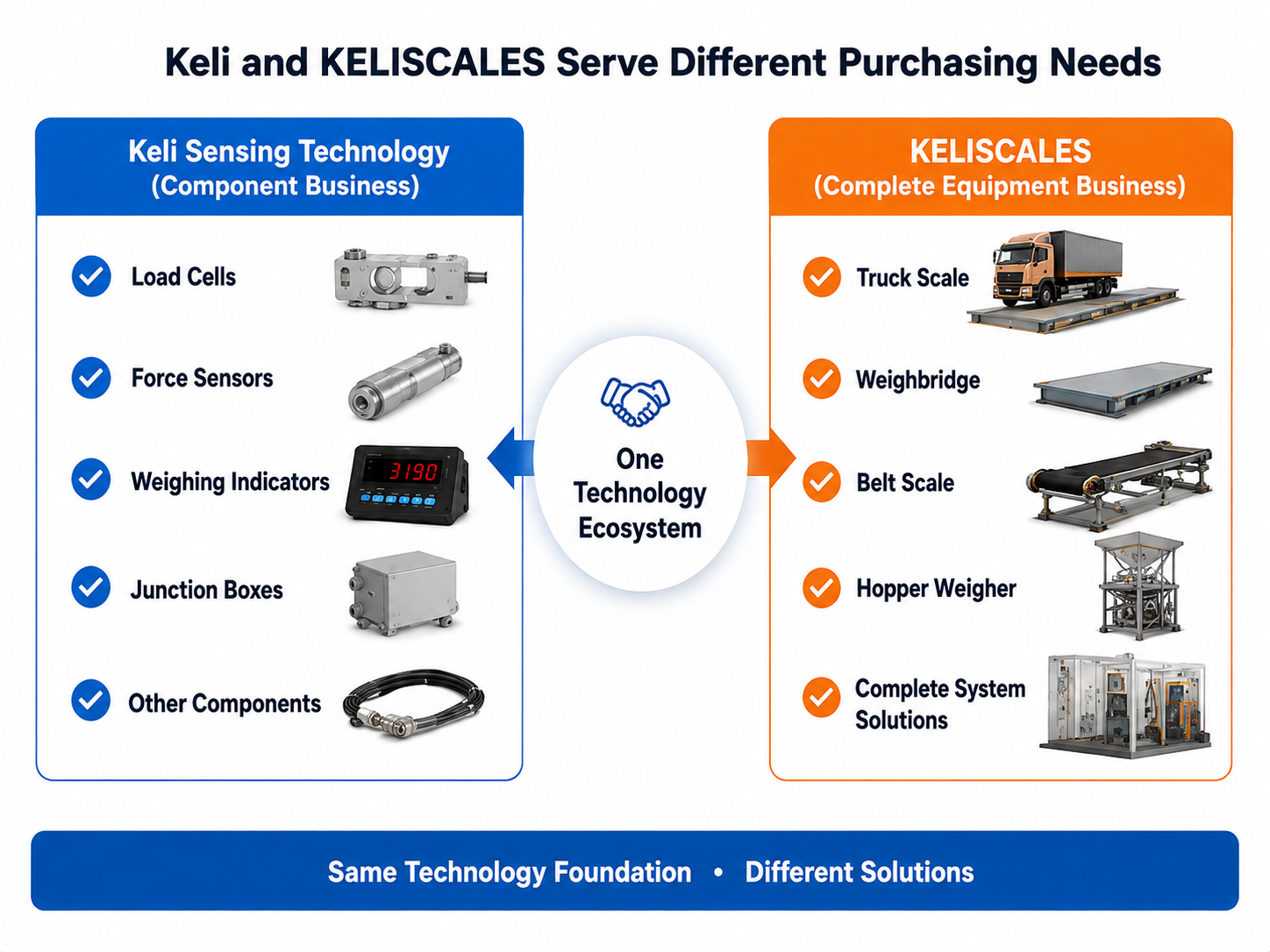
3. Keli and KELISCALES Serve Different Purchasing Needs
A simple way to look at the two businesses is this:
| What You Need | Where to Start |
| Load cell | Keli Sensing Technology |
| Force sensor | Keli Sensing Technology |
| Weighing indicator | Keli Sensing Technology |
| Junction box | Keli Sensing Technology |
| Individual weighing components | Keli Sensing Technology |
| Truck scale | KELISCALES |
| Weighbridge | KELISCALES |
| Belt scale | KELISCALES |
| Hopper weigher | KELISCALES |
| Checkweigher | KELISCALES |
| Unattended weighing system | KELISCALES |
| Complete industrial weighing project | KELISCALES |
This is less a brand separation than a purchasing separation.
One side supplies the core measurement technology.
The other supplies the finished equipment and system around it.
4. Why Create a Separate KELISCALES Brand?
Industrial weighing projects have become more complicated.
Years ago, a buyer might have been satisfied with a weighing platform and an indicator. Today, many industrial customers expect the weighing equipment to communicate with the rest of the plant.
A truck scale may need to connect with license-plate recognition, barriers, cameras and ERP software.
A belt scale may need to provide continuous production data to a control room.
A hopper weighing system may be linked to batching, inventory or loading operations.
At that point, the customer is no longer purchasing a simple scale. They are buying a small industrial system.
This creates a very different sales and engineering process from selling load cells or indicators.
A dedicated complete-equipment business therefore makes sense, especially for overseas customers who need help with equipment selection, system design, customization, software integration and project support.
That is the role KELISCALES is intended to fill.
5. From a Keli Load Cell to a Complete Weighing System
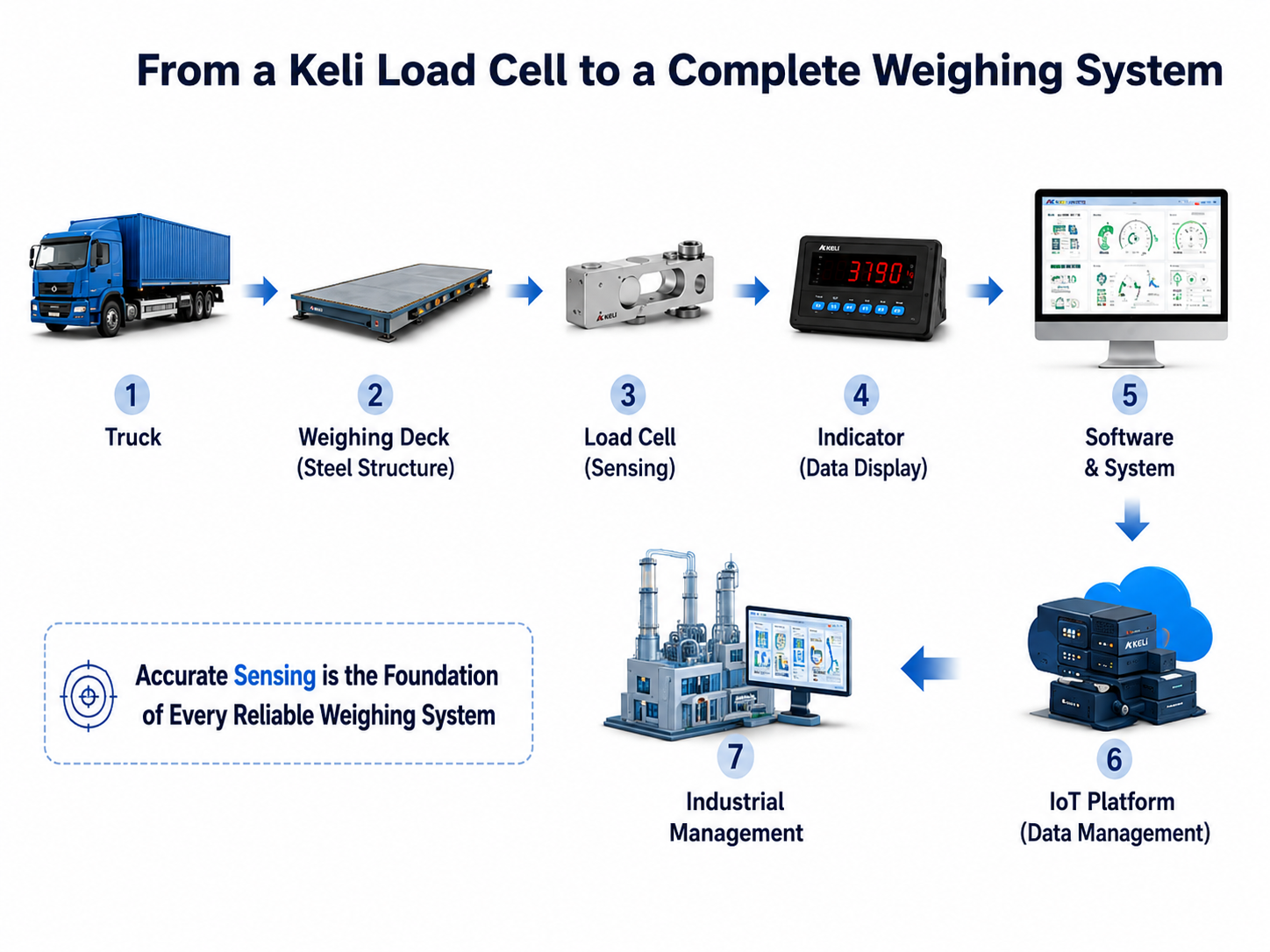
A truck scale is a good example of how the two sides connect.
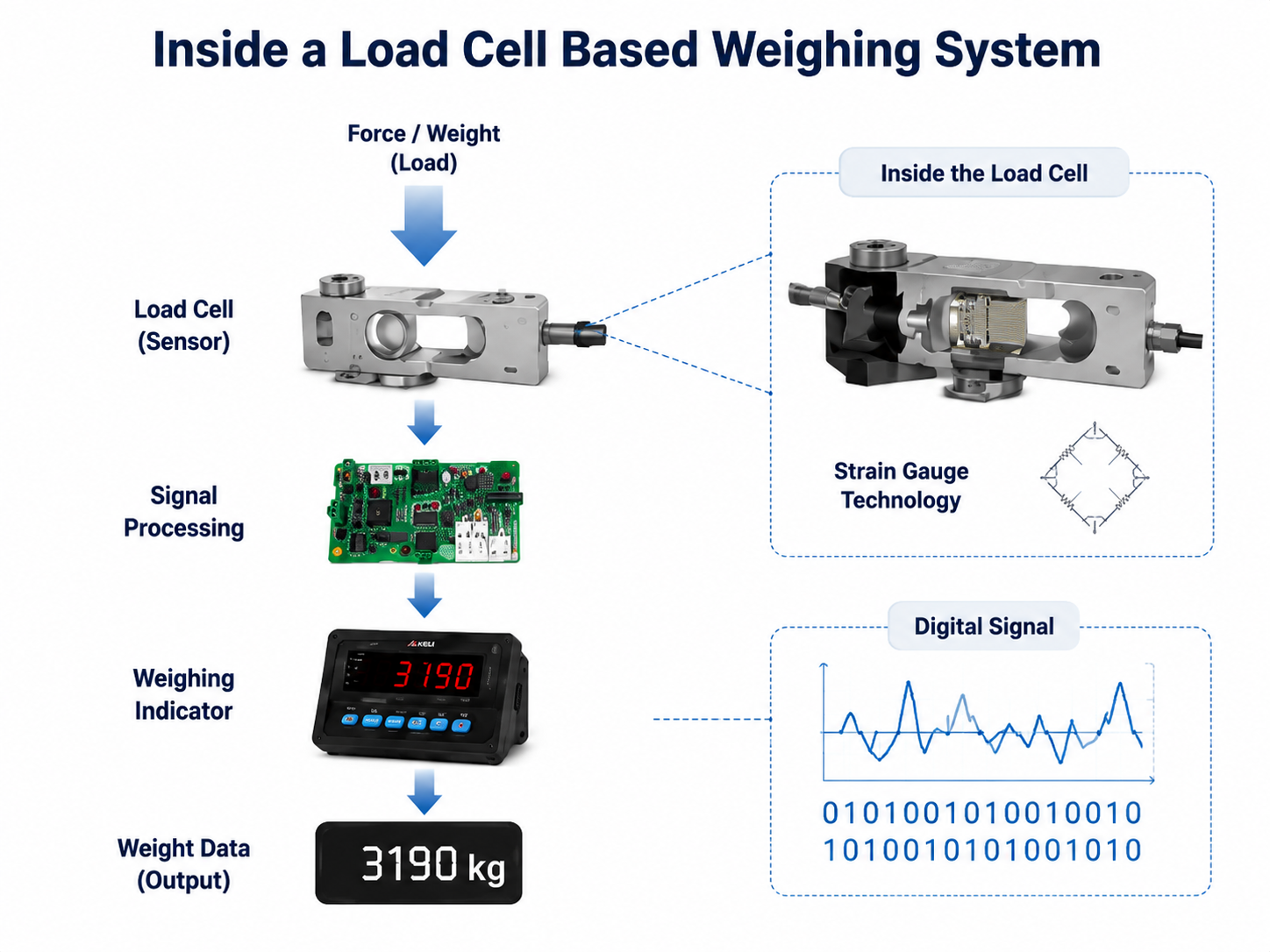
When a loaded truck drives onto the weighbridge, the steel deck transfers the load to a group of load cells underneath it.
The load cells produce electrical signals according to the force applied.
Those signals then pass through the weighing electronics and are converted into a weight reading.
In a modern installation, the process may continue much further.
The system can identify the vehicle, record the weight, take photographs, open or close a barrier, print a ticket and send transaction data to a central management system.
So a complete truck weighing system may include:
steel structure + load cells + weighing electronics + software + automation + data management
Keli has traditionally been strongest in the sensing and measurement part of this chain.
KELISCALES brings those technologies together with mechanical equipment, automation and software to provide the complete system.
That is probably the clearest way to understand the relationship.
6. Why the Sensor Background Matters?
Not every weighing equipment manufacturer starts with sensor technology.
Some companies specialize mainly in steel fabrication. Others purchase most of the measurement components from outside suppliers and focus on assembling the finished machine.
Keli comes from the other direction.
Its background is in weighing sensors and measurement technology.
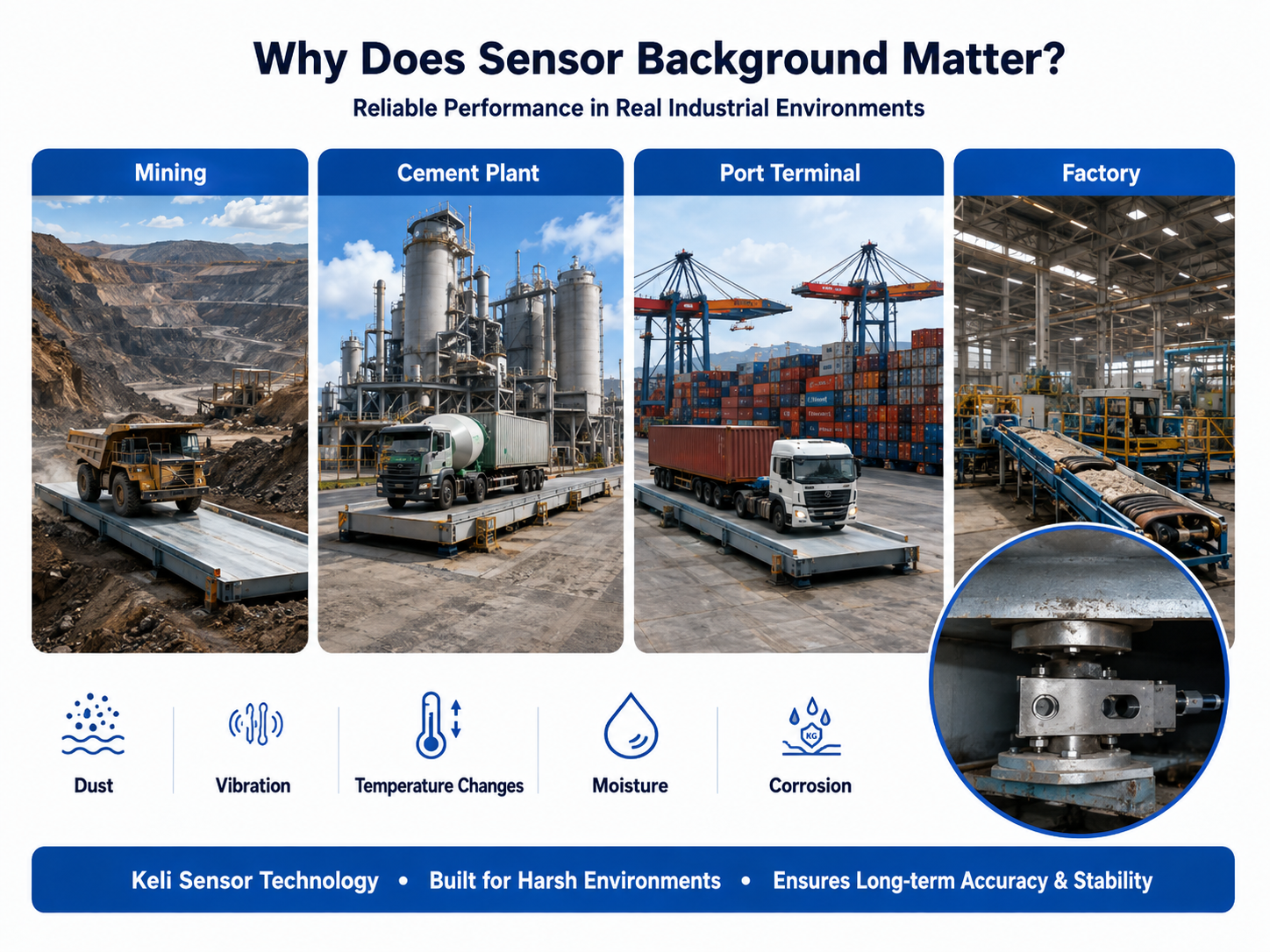
That gives KELISCALES access to experience in areas that are easy to overlook when people compare industrial scales only by dimensions, capacity and steel thickness.
For example, long-term weighing performance can be affected by temperature, moisture, vibration, overload, corrosion, installation conditions and signal stability.
These issues are especially important in industries such as mining, cement, grain handling and ports, where weighing equipment often operates outdoors and under continuous heavy loads.
A good steel structure is important.
So is what is happening underneath it.
7. Does KELISCALES Use Keli Load Cells?
KELISCALES equipment is supported by Keli’s sensing, weighing and industrial technology capabilities, and Keli load cells are used in specific KELISCALES weighing products.
The belt scale range is one example.
In this type of application, the sensor continuously measures material moving on a conveyor. Accuracy depends not only on the mechanical frame, but also on the load cells, speed measurement, calibration and signal processing.
The same principle applies to truck scales, hopper weighers and many other industrial weighing systems.
The finished equipment may look very different, but the basic measurement chain still begins with sensing.
This is where Keli’s existing load-cell experience becomes useful to KELISCALES.
8. Keli Is No Longer Only About Load Cells
Although many buyers still associate Keli primarily with load cells, the company’s business has expanded well beyond individual sensors.
Its technology portfolio also covers weighing indicators, weighing systems, industrial IoT and system integration.
That direction is closely related to where the weighing industry itself is going.
More customers now want weighing data to become part of their production and management systems.
For example, a weighbridge at a factory entrance can become part of an unattended logistics process.
A belt scale can provide live production data.
A hopper weigher can help calculate material throughput.
A checkweigher can automatically remove an underweight product and send the result to a factory database.
The scale is still measuring weight, but the value increasingly comes from what happens to that data afterwards.
KELISCALES sits naturally in this part of the business.
9. Which Website Should You Use?
For most customers, the answer depends on what you are buying.
If you manufacture weighing equipment yourself and need load cells, sensors, indicators or other weighing components, Keli Sensing Technology is the logical starting point.
If you are looking for a finished weighing machine or a complete system for a mine, cement plant, port, grain terminal, logistics facility or factory, KELISCALES is the more suitable channel.
A customer buying eight load cells and a customer building a complete truck weighing station are both buying Keli weighing technology.
They are simply buying it at different levels.
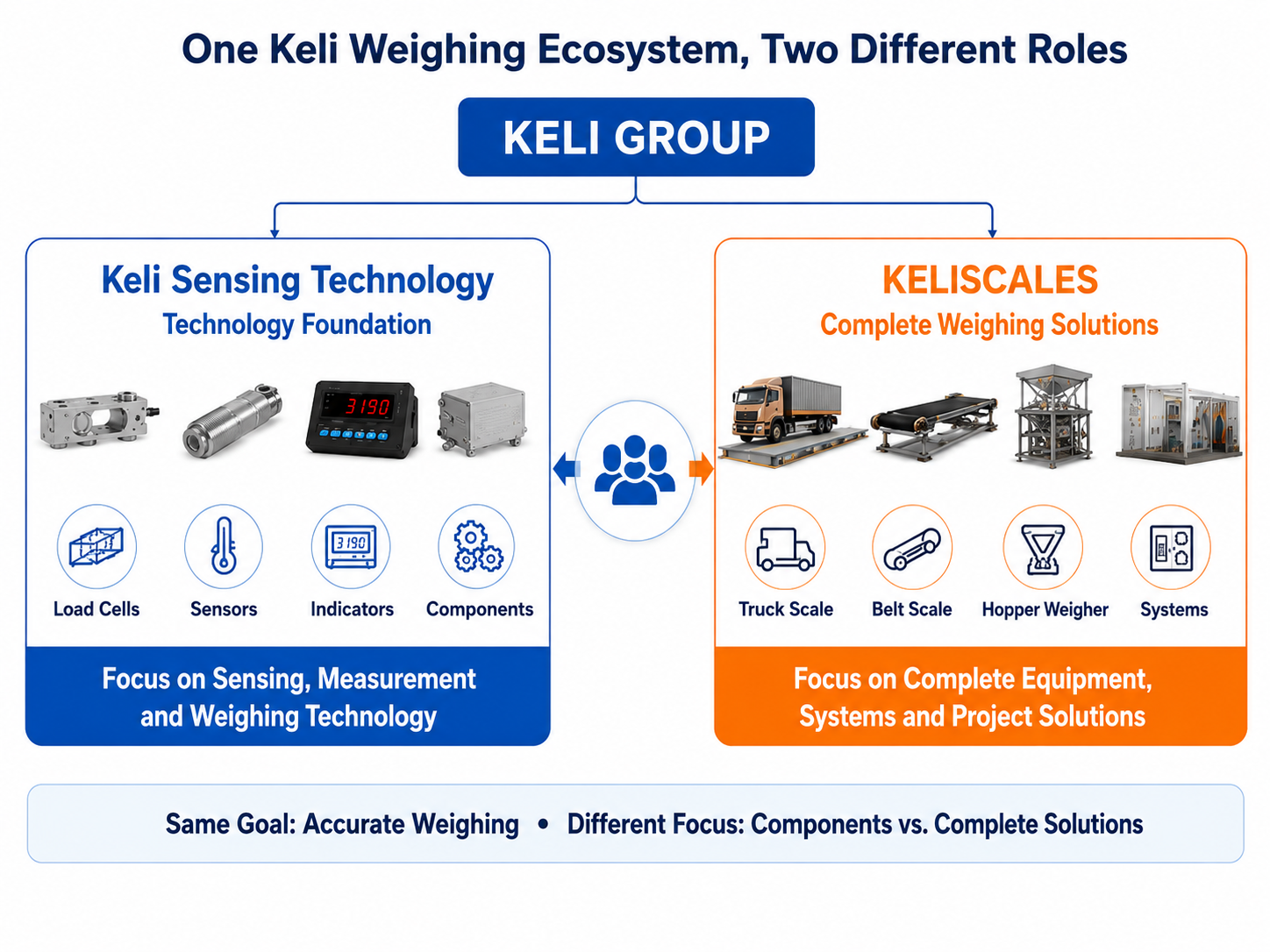
10. One Keli Weighing Ecosystem, Two Different Roles
Keli and KELISCALES are easier to understand when you stop thinking of them as two separate manufacturers.
Keli Sensing Technology provides much of the sensing, measurement and weighing technology foundation.
KELISCALES takes that foundation into complete industrial weighing equipment and project solutions.
The relationship can be summarized quite simply:
Keli develops the technology used to measure.
KELISCALES turns that technology into complete equipment used in industrial operations.
For customers, that makes the purchasing path clearer.
Need a load cell or weighing component? Start with Keli Sensing Technology.
Need a truck scale, belt scale, hopper weigher, checkweigher or complete industrial weighing system? Talk to KELISCALES.
11. FAQ
No. They serve different areas of the same weighing technology ecosystem. Keli Sensing Technology is strongly focused on sensors, load cells and weighing technology, while KELISCALES focuses on complete weighing equipment and industrial weighing solutions.
Yes. KELISCALES is the Keli business focused on complete industrial weighing equipment for overseas customers.
If you need individual load cells, sensors or weighing components, Keli Sensing Technology is the appropriate channel.
For a complete truck scale, weighbridge or truck weighing project, KELISCALES is the more suitable contact.
The product range includes truck scales, platform scales, belt scales, hopper weighing systems, weigh belt feeders, checkweighers, unattended weighing systems and other industrial weighing solutions.
Yes. Industrial weighing projects can be configured according to capacity, accuracy requirements, site conditions, materials, automation requirements and data-management needs.

Need customized model matching your production line, technical drawings and accurate quotation?
Submit your inquiry now, our engineering sales team will send full solution within 24 working hours.