A checkweigher inquiry often starts with three numbers:
Product weight: 500 g
Accuracy: ±1 g
Throughput: 120 packs/min
These numbers are important, but they are not enough to select a checkweigher.
For dynamic weighing, engineers also need to know the product length, product gap, actual conveyor speed and how the package behaves while moving.
One question is especially useful:
How much usable weighing time does each product actually have?
1. Throughput Does Not Tell You the Whole Speed Condition
Production rate is closely related to product pitch:
Product Pitch = Product Length + Product Gap
A simplified relationship is:
Belt Speed (m/s) = Product Pitch (m) × Throughput (pcs/min) ÷ 60
For example:
- Product length: 200 mm
- Product gap: 200 mm
- Throughput: 120 pcs/min
Product Pitch = 0.2 + 0.2 = 0.4 m
So:
Belt Speed = 0.4 × 120 ÷ 60 = 0.8 m/s
If the product length and gap are both smaller, the same 120 pcs/min may correspond to a much lower conveyor speed.
Pieces per minute describes production capacity. Product pitch helps describe how that capacity actually moves through the machine.

2. Usable Weighing Time Is Often Shorter Than Expected
Assume:
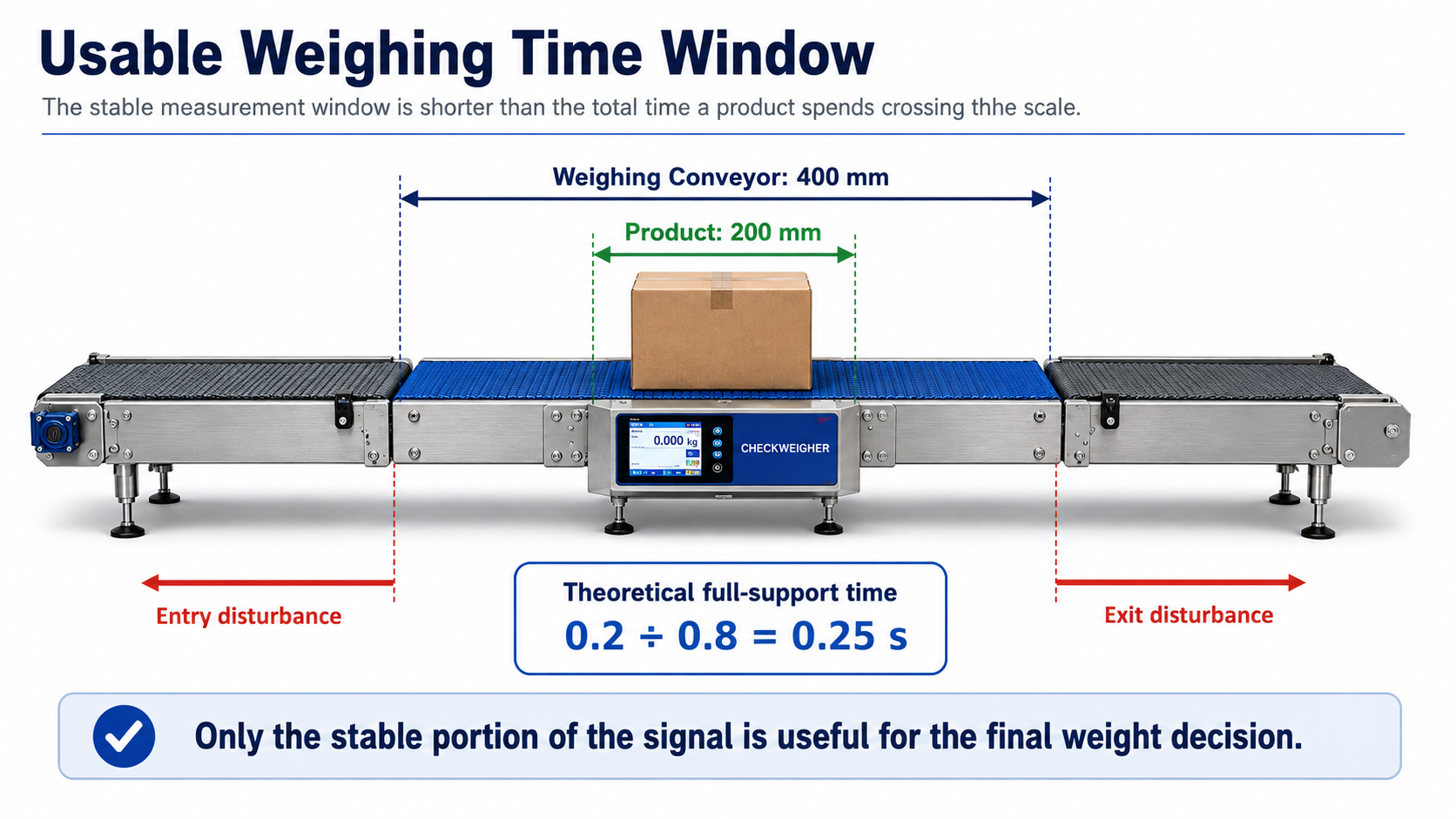
- Weighing conveyor length: 400 mm
- Product length: 200 mm
- Conveyor speed: 0.8 m/s
400 − 200 = 200 mm
The corresponding time is:
0.2 ÷ 0.8 = 0.25 s
or:
250 ms
But not all 250 ms are necessarily available for the final weight calculation.
When the product enters the weighing section, the signal may still contain transfer impact, conveyor vibration and product movement. The controller needs a sufficiently stable portion of the signal before calculating the final result.
So the actual usable weighing window may be shorter than the theoretical 250 ms.
Dynamic checkweighing is largely a measurement-window problem.
3. Product Length and Package Type Change the Application
Two products can have the same weight but require very different checkweigher configurations.
A 150 mm carton and a 600 mm carton require different weighing-conveyor lengths and transition conditions.
During the valid weighing period, the product should normally be fully supported by the weighing conveyor rather than bridging the upstream and downstream conveyor sections.
Package behavior matters too.
A rigid 500 g carton may settle quickly, while a 500 g liquid bottle may continue oscillating after it has entered the weighing section. The movement of the liquid can keep changing the instantaneous force transmitted to the load cell.
Soft bags, tall bottles, rolling products and packages with loose contents can create similar challenges.
Same nominal weight does not mean the same dynamic weighing behavior.

4. The Production Line Can Affect Checkweigher Accuracy
A checkweigher does not operate independently from the surrounding conveyors.
Accuracy may be affected when product spacing is irregular, two products touch each other, upstream speed is unstable, conveyor heights are not aligned, or nearby equipment transmits vibration.
If one product is on the weighing conveyor while still touching another product, the system is no longer weighing a mechanically isolated item.
So product separation is not only a conveying issue. It is also part of weighing performance.

5. An Accuracy Number Needs Operating Conditions
A specification may state:
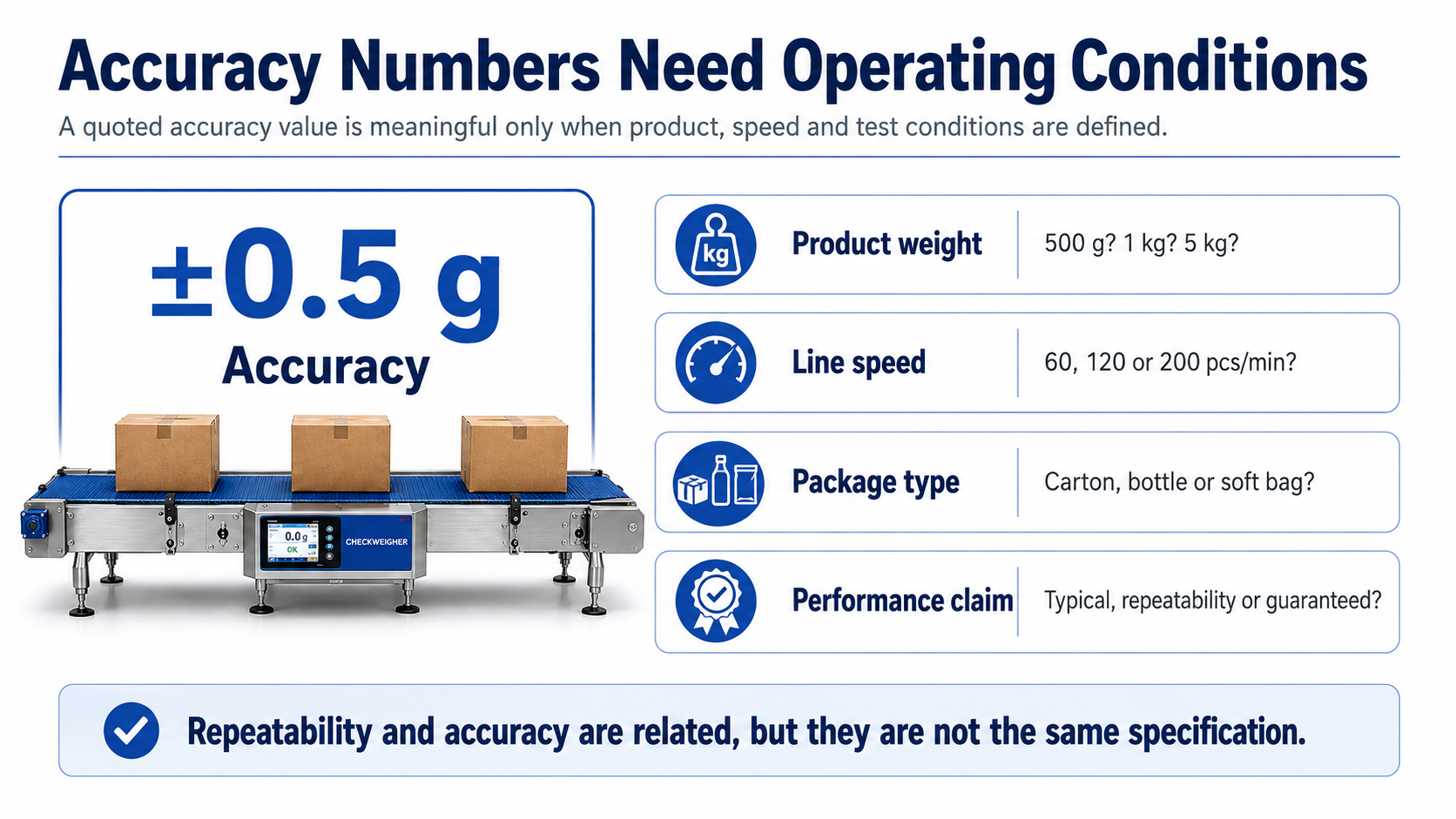
Accuracy: ±0.5 g
That number is incomplete without the operating conditions attached to it.
A buyer should also confirm:
At what product weight?
At what production speed?
What product size and package type?
Is the value typical performance, repeatability or a guaranteed specification?
A machine can produce highly repeatable readings and still have a fixed offset.
So repeatability and accuracy should not be treated as the same specification.
6. Reject Timing Is Also Part of the System
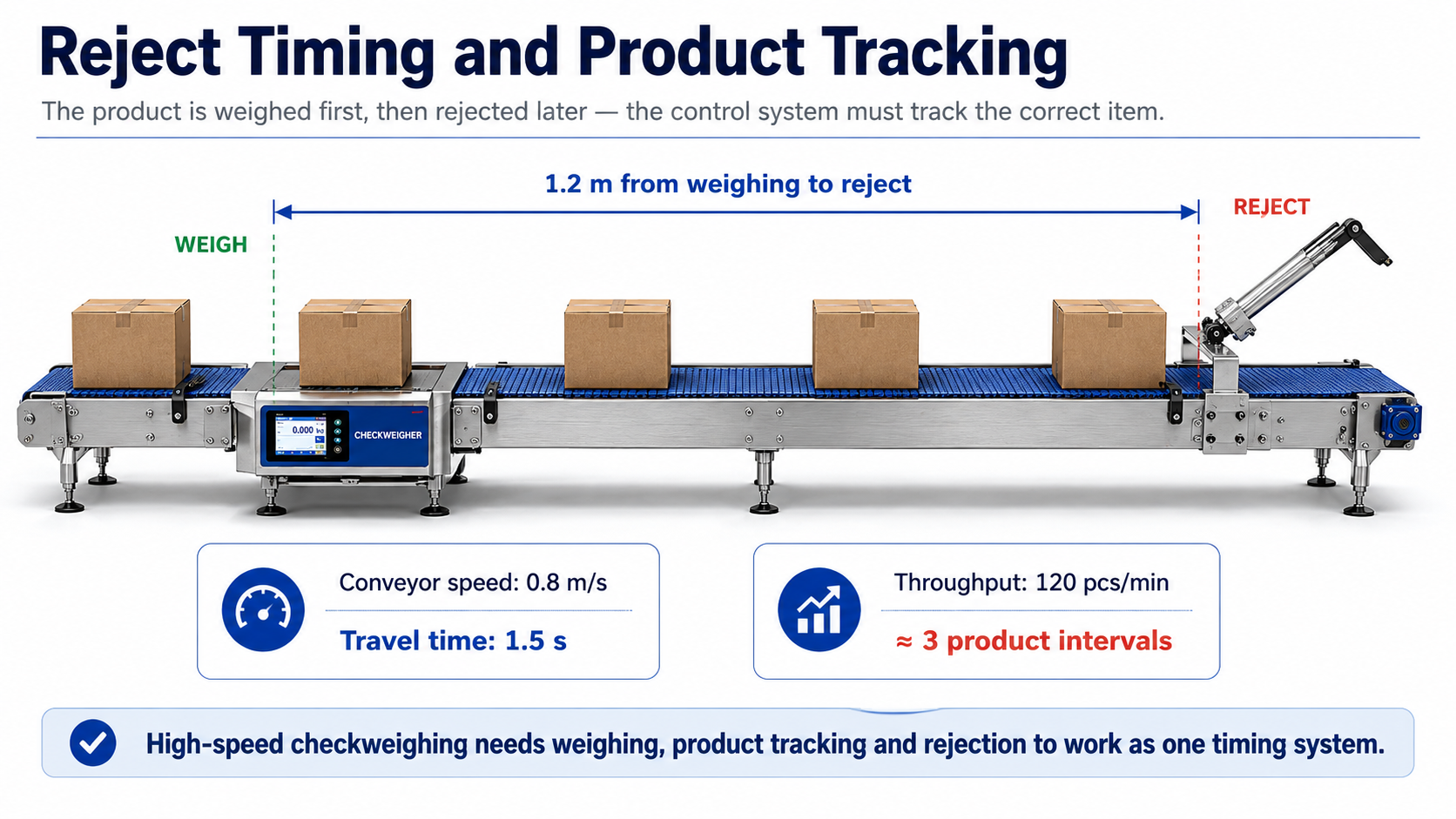
The reject station is usually located some distance after the weighing section.
Suppose:
- Conveyor speed: 0.8 m/s
- Distance from weighing section to reject station: 1.2 m
The travel time is approximately:
1.2 ÷ 0.8 = 1.5 s
At 120 pcs/min, one product interval is:
60 ÷ 120 = 0.5 s
That means there are roughly three product intervals between weighing and rejection.
The control system therefore needs to know which product failed, where that product is now, and when to activate the reject device.
At high production speeds, weighing, product tracking and reject control should be considered as one system.
7. What Engineers Need for Checkweigher Selection
| Basic RFQ Information | More Useful Engineering Information |
| Product weight | Minimum / normal / maximum weight |
| Packs per minute | Product pitch and actual conveyor speed |
| Accuracy target | Accuracy under which speed and product condition |
| Belt width | Product length, width and height |
| Product type | Package stability and dynamic behavior |
| Reject required | Reject method, distance and available space |
| PLC connection | Communication and product-tracking requirements |
For an existing production line, a short operating video can also be very useful. It can show irregular product spacing, package movement, vibration and transfer conditions that may not appear in an RFQ sheet.
8. From Weighing Technology to a Complete Checkweigher
A dynamic checkweigher is more than a load cell installed under a conveyor.
The complete process is closer to:
Product Separation → Weighing Conveyor → Load Cell → Signal Processing → Weight Decision → Product Tracking → Reject
Keli’s weighing and sensing technology supports the measurement layer, while KELISCALES extends that capability into complete dynamic checkweighing equipment and production-line integration.
9. Before Selecting the Machine
Instead of asking only:
“Can the machine achieve ±1 g?”
First confirm:
How fast is the product actually moving?
How long is the usable weighing window?
Is the product mechanically stable during that window?
Can the line separate, track and reject each product correctly?
Once these conditions are clear, the accuracy requirement becomes much more meaningful.
A checkweigher does not weigh a specification sheet. It weighs a moving product during a limited measurement window.

Need customized model matching your production line, technical drawings and accurate quotation?
Submit your inquiry now, our engineering sales team will send full solution within 24 working hours.