
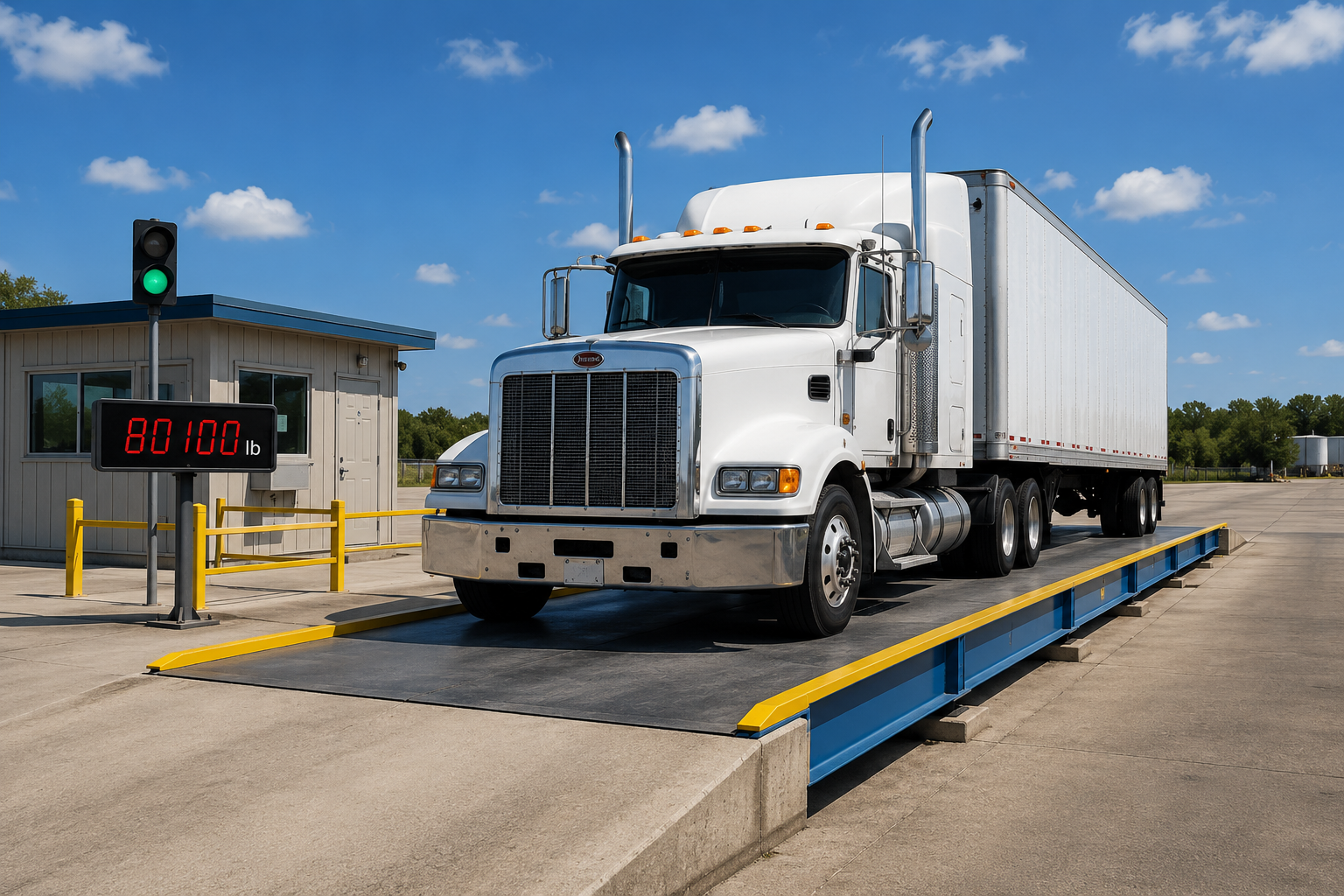
1. How Wide Are Truck Scales?
If you are planning a truck scale installation, width is one of the first dimensions you need to confirm.
For most full-size commercial truck scales, the weighing deck is around 10 to 12 feet wide, or approximately 3.05 to 3.66 meters.
An 11-foot-wide truck scale is also a common choice. It gives a standard commercial truck enough room to drive onto the platform without taking up too much extra site space.
That said, there is no single width that fits every project.
Some truck scales are narrower, while heavy-duty or special-purpose systems may be 14 feet wide or even customized for unusual vehicles.
So instead of asking only, How wide is a truck scale?, a better question is:
How wide should the truck scale at my site be?
2. What Is the Standard Width of a Truck Scale?
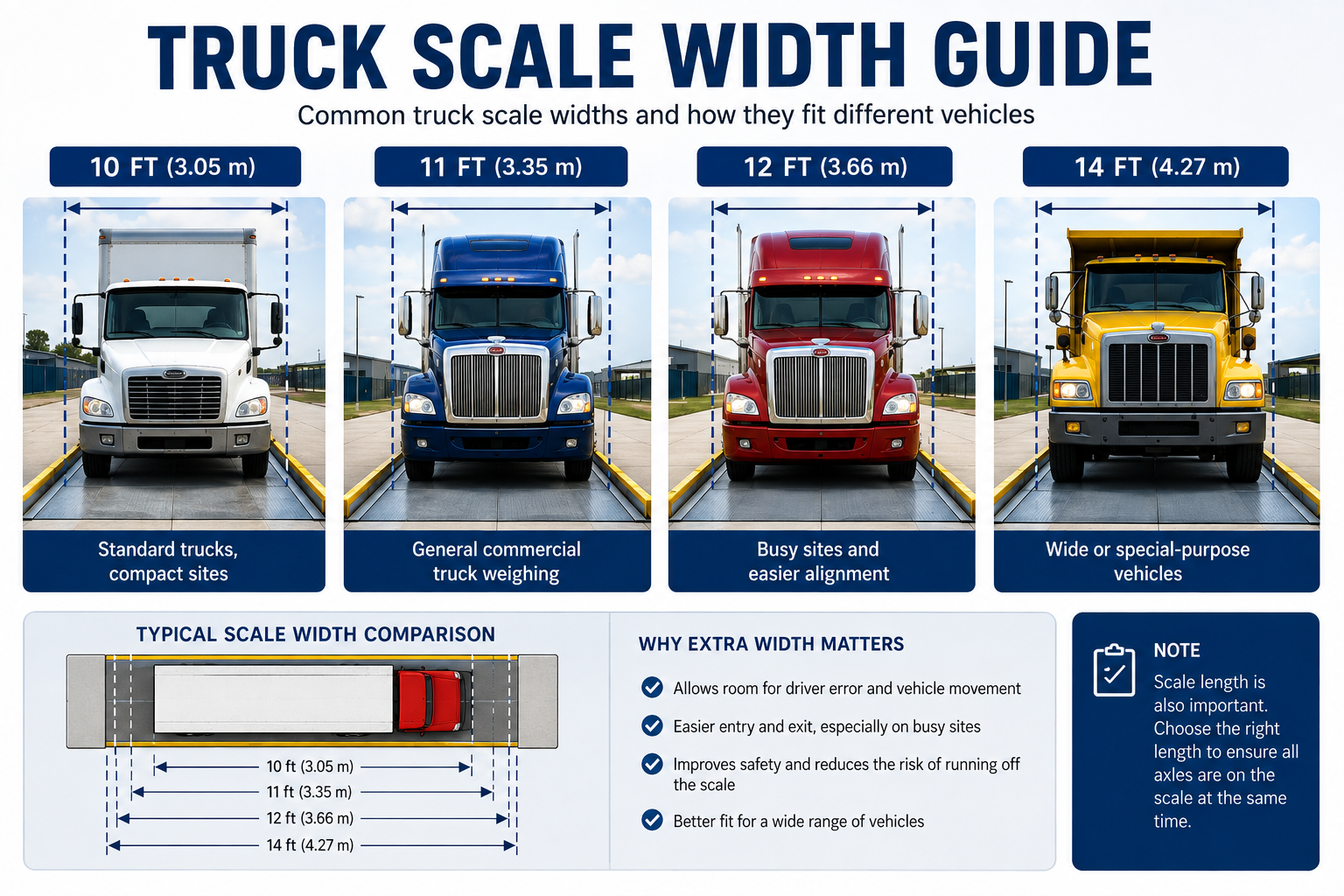
In everyday industrial weighing projects, you will commonly see the following sizes:
| Truck Scale Width | Metric Width | Typical Use |
| 10 ft | 3.05 m | Standard trucks, compact sites |
| 11 ft | 3.35 m | General commercial truck weighing |
| 12 ft | 3.66 m | Busy sites and easier truck alignment |
| 14 ft | 4.27 m | Wide or special-purpose vehicles |
For ordinary highway trucks, 10 ft, 11 ft and 12 ft are the sizes most buyers are likely to encounter.
A 10-foot scale can work perfectly well when vehicles have a straight approach.
An 11-foot platform gives drivers a little more room.
A 12-foot platform is often more comfortable where trucks arrive frequently or have to turn shortly before entering the scale.
3. Why Is a Truck Scale Wider Than the Truck?
A truck scale cannot be designed to match the exact width of the vehicle.
Drivers need some room on both sides when entering the weighing platform.
A highway truck may be about 8.5 feet wide, but it will rarely approach the scale with perfect centimeter-level alignment.
This is especially true when the scale is located behind a gate, next to a loading area, beside a warehouse or immediately after a turn.
The extra deck width gives the driver room to correct the steering before all axles are fully positioned on the scale.
For example, compared with an 8.5-foot-wide vehicle:
- a 10-foot deck leaves about 1.5 ft of total extra space
- an 11-foot deck leaves about 2.5 ft
- a 12-foot deck leaves about 3.5 ft
That difference may not look large on a drawing, but drivers can definitely notice it in daily use.
4. Is a 10-Foot-Wide Truck Scale Enough?
For many sites, yes.
A 10 ft × 60 ft or 10 ft × 70 ft truck scale is a practical configuration when the site mainly handles standard commercial trucks and the approach road is straight.
It also has an obvious advantage: it uses less space.
That can matter at older factories or plants where the truck scale has to be installed inside an existing traffic route.
The downside is simply that the driver has less room to work with.
If a truck approaches the platform slightly off-center, the driver may need to slow down, stop or make another steering correction.
For a low-traffic site, that may not matter much.
For a facility weighing dozens or hundreds of trucks every day, the difference becomes more noticeable.
5. Why Do Many Buyers Choose an 11-Foot Truck Scale?
An 11-foot truck scale sits somewhere in the middle.
It does not take up dramatically more space than a 10-foot scale, but the extra foot gives drivers noticeably more room.
For many factories, warehouses, grain facilities and logistics yards, this is a sensible balance.
It is also one reason why you frequently see truck scales described as:
11 ft × 60 ft
or
11 ft × 70 ft
when manufacturers discuss standard highway truck weighing.
If your vehicles are mainly conventional tractor-trailers, dump trucks or delivery trucks, an 11-foot deck is often worth considering.
6. When Does a 12-Foot Truck Scale Make More Sense?
A wider deck starts to make more sense when traffic gets busy.
Think about a grain terminal during harvest season, an aggregate plant with dump trucks arriving continuously, or a recycling yard where different vehicle types enter throughout the day.
Drivers are not always familiar with the site.
Vehicles are not always identical.
And trucks do not always approach from a perfectly straight lane.
In this kind of environment, a 12-foot truck scale can make daily operation less awkward.
The extra width may help:
- reduce steering corrections
- make entry easier for unfamiliar drivers
- accommodate a wider range of vehicle bodies
- improve traffic flow during busy periods
That does not mean every busy facility must install a 12-foot scale.
It simply means operating conditions should be considered alongside purchase price.
7. What About a 14-Foot-Wide Truck Scale?
A 14-foot platform is wider than most standard highway truck weighing applications require.
But there are situations where it makes sense.
Examples include:
- unusually wide industrial vehicles
- mining trucks
- construction vehicles
- off-road trucks
- special vehicle bodies
- sites where vehicle alignment is particularly difficult
A wider platform naturally requires more space, and the foundation and surrounding civil works may also become larger.
So wider is better is not a useful rule for truck scales.
The better rule is:
Choose the width that matches the vehicles and traffic pattern at the site.
8. Truck Scale Width and Truck Scale Length Are Different
This sounds obvious, but it causes a surprising amount of confusion when people ask for quotations.
A buyer may say:
I need a 70-foot truck scale.
That tells the manufacturer the required length, but it does not tell them the full scale size.
A more complete specification would be:
70 ft long × 11 ft wide
or:
21 m long × 3.4 m wide
Length mainly determines whether the required vehicle axles can fit on the weighing platform at the same time.
Width mainly determines how much lateral space the driver has while entering and positioning the truck.
For a full tractor-semitrailer, truck scale lengths of around 60–80 ft are common, although the right length depends on the actual vehicle combination.
If you are not sure how the tractor and trailer should be positioned during weighing, read our guide on how to scale a semi truck.
9. Above-Ground Scale or Pit-Mounted Scale: Does Width Change?
Not necessarily.
Both pit-mounted and above-ground truck scales can use similar deck widths.
The real difference is the way vehicles enter the platform.
A pit-mounted scale is usually close to the surrounding road level.
An above-ground truck scale needs ramps because the deck is elevated.
This makes the approach layout especially important.
For example, a perfectly adequate 11-foot-wide deck may still be awkward to enter if:
- the entrance ramp starts immediately after a sharp turn
- there is not enough straight road before the scale
- a wall or building restricts the driver’s turning radius
In other words, platform width cannot fix poor site layout.
When planning the project, the scale itself and the approach road should be designed as one system.
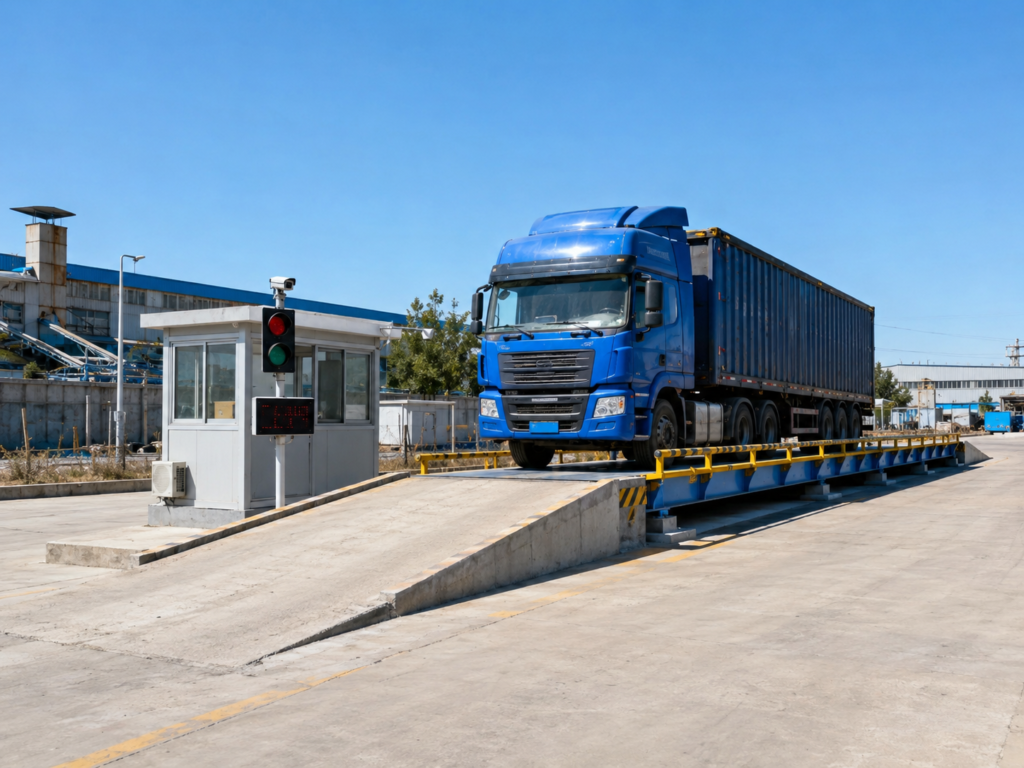
Above-Ground Scale
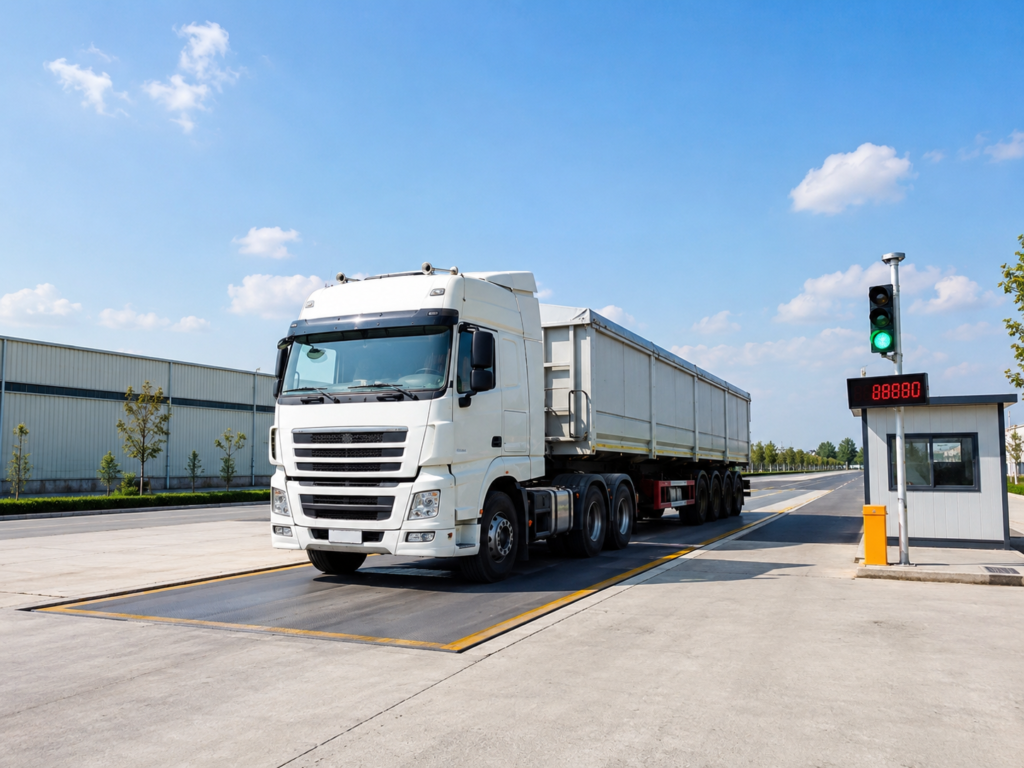
Pit-Mounted Scale
10. How Should You Choose the Right Width?
Before choosing a scale from a catalog, look at the trucks using your site.
Ask a few practical questions:
What is the widest vehicle we normally weigh?
Do trucks enter the scale in a straight line?
How many trucks are weighed each day?
Do different outside carriers frequently visit the site?
Will oversized or special-purpose vehicles use the scale?
If you mainly weigh standard road trucks and have a good straight approach, 10 or 11 feet may be enough.
If the site has frequent traffic or a less convenient approach, 12 feet may make daily operation easier.
For mining or special industrial vehicles, you may need to look at 12 ft, 14 ft or a customized platform.
The actual vehicle fleet is more useful than simply copying a standard dimension from another project.
11. Platform Width Is Not Always the Total Installation Width
This point is easy to miss during the early planning stage.
If a manufacturer says the truck scale is 11 feet wide, that figure normally describes the weighing deck.
The complete structure may occupy more space.
Depending on the design, additional width may be needed for:
- curbs
- side rails
- guardrails
- structural beams
- foundation walls
- access space
- service or maintenance areas
So if you have only 12 feet of available space, do not automatically assume an 11-foot truck scale will fit.
Always check the final foundation drawing before civil construction begins.
heavy-duty industrial truck scale
12. Width Matters, but So Does Accurate Weighing
Choosing the right deck size solves only one part of the problem.
Once a truck is on the scale, the operator also needs to understand the weighing result.
A typical truck scale ticket may include:
- Gross Weight
- Tare Weight
- Net Weight
- vehicle number
- product or material
- date and time
- customer or supplier information
For example:
Gross Weight – Tare Weight = Net Weight
Understanding these values is especially important when the scale is used for buying and selling materials.
If you are new to vehicle weighing, our guide on how to read a truck scale ticket explains Gross, Tare and Net Weight with practical examples.
13. Common Questions About Truck Scale Width
Most full-size commercial truck scales are approximately 10–12 ft wide.
For many standard highway semi trucks, yes.
An 11-foot-wide deck normally gives the driver reasonable space on both sides, provided the scale approach is properly designed.
No.Ten feet is common, but 11-foot and 12-foot scales are also widely used. Some applications use 14-foot or customized platforms.
A typical full-size weighbridge is around 3.0–3.7 meters wide, although the exact dimension depends on the manufacturer and project.
14. Final Answer: How Wide Are Truck Scales?
For most commercial truck weighing applications, a good starting range is:
10–12 ft (3.05–3.66 m).
A 10-foot platform is compact and works well when trucks have a straight approach.
An 11-foot platform gives drivers a little more room and is a practical general-purpose size.
A 12-foot platform may be more comfortable at busy sites or where vehicle alignment is more difficult.
And for wider industrial or off-road vehicles, 14-foot or customized scales may be considered.
But width should not be selected on its own.
Before ordering a truck scale, confirm:
- vehicle width
- vehicle length
- axle configuration
- scale capacity
- daily traffic
- approach road
- turning radius
- available installation space
- pit-mounted or above-ground installation
A truck scale that fits the vehicles and the site will usually be easier to operate than one selected simply because it matches a standard catalog size.
You can also explore our truck scale and industrial weighing solutions for different vehicle capacities, platform dimensions and installation conditions.

Need customized model matching your production line, technical drawings and accurate quotation?
Submit your inquiry now, our engineering sales team will send full solution within 24 working hours.