

Choosing a truck scale manufacturer is not the same as purchasing ordinary industrial equipment. A truck scale is often expected to remain in service for many years and may process hundreds of vehicle weighings every day. Once the foundation is completed and the equipment is installed, correcting an unsuitable deck structure, load cell configuration, or weighing system can become very costly. Therefore, truck scale purchasing decisions should not be based on the initial quotation alone.
A reliable truck scale / weighbridge manufacturer should be able to clearly answer questions about deck structure, load cells, calibration, certification, software, installation, spare parts, and long-term maintenance. The real purchasing question is not: “Who offers the lowest truck scale price?” but rather: “Which manufacturer can provide a weighing system that remains stable, maintainable, and truly suitable for the site conditions over the long term?”

What Should You Look for in a Truck Scale Manufacturer?
A qualified truck scale supplier should not simply be viewed as a steel fabrication company. It should have the ability to design and deliver a complete weighing system.
The following eight areas deserve particular attention.
1. Manufacturing Capability
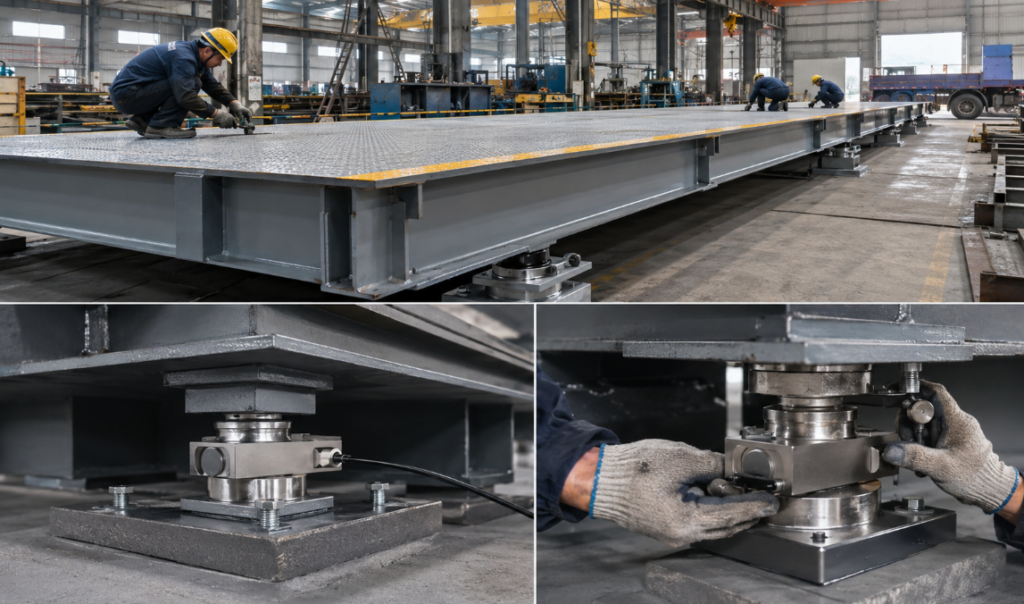
A truck scale deck is repeatedly subjected to wheel loads and axle loads over long periods. Although steel plate thickness is important, it is not the only factor that determines structural strength. Buyers should also understand how axle loads are distributed across the deck, how the main beams are arranged, how the structure performs under long-term heavy loading, and which deck structures are suitable for different traffic volumes.
For example, KELISCALES currently offers different deck structures, including U-beam, channel-steel, and concrete platforms. For high-frequency heavy-duty projects, structures with stronger bending resistance and lower deformation can be prioritized, while other projects can select different configurations according to traffic volume and installation conditions.
A professional manufacturer should recommend the structure according to the actual vehicles and operating conditions rather than simply telling customers that “thicker steel is always better.”
2. Load Cell Technology
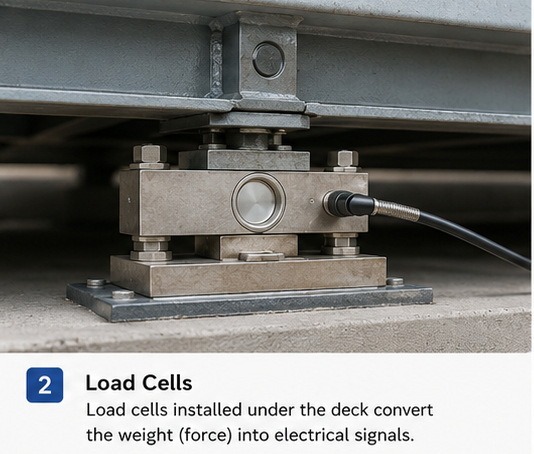
The weighing deck carries the vehicle load, but the core components that actually measure the weight are the load cells. When comparing different manufacturers, buyers should pay particular attention to load cell type, rated capacity, accuracy and repeatability, temperature performance, protection level, overload capability, signal output, and ease of replacement. OIML R 60 provides internationally recognized metrological and technical requirements for load cells.
Therefore, a truck scale supplier with genuine technical capability should not only explain the steel deck structure but also be able to describe the weighing technology used beneath the platform.
3. Truck Scale Engineering Experience
A standard specification such as 100 t × 18 m × 3 m does not fully define a truck scale project. Two trucks with the same gross weight can impose very different actual loads on the weighbridge because of differences in axle number, axle spacing, vehicle length, and traffic frequency. For this reason, experienced truck scale manufacturers usually ask for additional information, including maximum vehicle weight, vehicle dimensions, axle number and spacing, daily weighing frequency, foundation conditions, installation environment, required verification scale interval, and possible future changes in vehicle specifications. This type of engineering experience is especially important for projects involving mines, cement plants, ports, quarries, grain terminals, and logistics centers.
4. International Certifications
Certification is one of the most commonly misunderstood parts of truck scale purchasing. A supplier claiming that its equipment has OIML certification does not necessarily mean that the complete truck scale can automatically be used for commercial trade settlement in every country. Some certificates may apply only to a load cell, weighing indicator, or specific model rather than the entire truck scale system.
For the U.S. market, buyers also need to understand requirements related to NTEP and NIST Handbook 44. NIST Handbook 44 specifies technical requirements, tolerances, and testing requirements for commercial weighing and measuring equipment.
Therefore, buyers should ask: “Which component or equipment model does this certificate apply to? After installation, is any additional local verification or approval required?” This question is far more useful than simply asking the supplier to provide several certification logos.
5. Weighing Software and Automation Capability
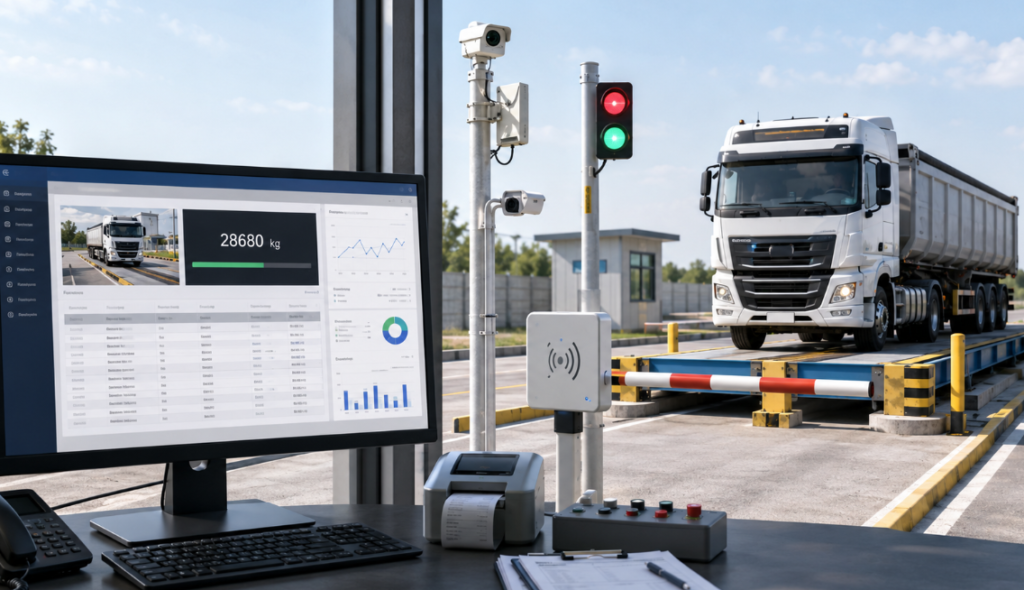
Modern truck scales are no longer limited to displaying a weight value. Depending on project requirements, a complete system can create a data chain connecting truck → load cells → weighing indicator → weighing software → ERP or plant management system. It can also integrate RFID, license plate recognition, cameras, traffic lights, automatic barriers, remote displays, automatic data recording, and transaction reports. For high-traffic industrial projects, software performance directly affects vehicle throughput and data traceability. For example, KELISCALES truck scale systems can work with weighing software and support integration with factory automation and weighing data management systems.
6. Installation and After-Sales Support
Even if the truck scale itself is manufactured to a high standard, improper foundation work or installation can still affect final weighing performance. Before purchasing, buyers should confirm who provides the foundation drawings, who provides installation guidance, how the load cells should be installed, how the electrical system should be wired, who is responsible for commissioning and calibration, whether operator training is available, and whether remote technical support is provided. The supplier should be able to provide sufficiently complete engineering documentation so that local civil contractors and installation teams can complete the foundation and equipment installation correctly.
7. Spare Parts and Long-Term Maintenance
A truck scale is a long-term industrial asset, so spare-parts availability should be confirmed before purchase rather than after a failure occurs. Buyers should verify whether load cells, weighing indicators, junction boxes, cables, and electronic modules can be supplied over the long term. Standardized and replaceable components can significantly reduce future downtime risk.
Keli Sensing Technology’s product portfolio includes load cells, weighing indicators, junction boxes, weighing systems, software integration, and industrial IoT technologies. This broad weighing technology base can also support the long-term maintenance and future expansion of industrial projects.
8. Total Cost of Ownership
The lowest-priced truck scale is not necessarily the lowest-cost solution over its working life.
Buyers should instead consider: Equipment Purchase Cost + Foundation + Installation + Calibration + Maintenance + Spare Parts + Downtime Loss = Total Cost of Ownership
If a low-cost deck develops obvious deformation after long-term heavy loading, if replacement load cells are difficult to source, or if the software lacks ongoing support, the resulting maintenance cost may far exceed the amount saved during the initial purchase.
For high-traffic industrial sites, durability and maintainability are usually more important than a small difference in initial quotation.
Keli’s Experience in Weighing Sensor Technology
Keli Sensing Technology has long focused on industrial measurement and weighing technologies.
Load cells, digital weighing components, weighing indicators, and junction boxes together form the foundation of a weighing system and can be integrated with industrial IoT applications. For truck scale buyers, this background in sensing and measurement technology is important because a truck scale is fundamentally still a measurement system.
The steel structure carries the vehicle, while stable weighing depends on the complete signal chain:
Load → Load Cell → Signal Processing → Weighing Indicator → Weight Data

How Does KELISCALES Apply Keli Technology to Complete Truck Scale Systems?
KELISCALES extends these weighing technologies from individual components into complete industrial weighing equipment.
A KELISCALES Truck Scale / Weighbridge can integrate the following components:
The truck scale deck, digital load cells, weighing indicator, and supporting weighing software. At the same time, different deck structures can be configured according to vehicle type, daily traffic volume, and site environment. Therefore, the technology relationship can be understood as:
Keli Sensor Technology → KELISCALES Complete Truck Scale → Industrial Application
Request a Truck Scale Solution
Choosing a truck scale supplier should ultimately be an engineering decision rather than a simple price comparison.
A truly capable manufacturer should be able to explain:
how the deck carries the vehicle load, how the load cells measure weight, how the system meets applicable standards, how the data is managed, and how the equipment will be maintained after installation.
KELISCALES can configure a Truck Scale / Weighbridge solution according to the actual operating conditions of the project rather than simply providing a standard platform quotation.

Need customized model matching your production line, technical drawings and accurate quotation?
Submit your inquiry now, our engineering sales team will send full solution within 24 working hours.