
A load cell can be working correctly while the complete weighing system still gives the wrong result.
The reason is simple:
A load cell measures the force that actually reaches it. It does not know whether that force comes from the intended load or from mechanical interference.
So when a weighing system becomes inaccurate, replacing the load cell should not always be the first step.
A better question is:
Is the correct force reaching the sensor, and is the sensor signal reaching the indicator correctly?
1. Check the Load Path Before Blaming the Sensor
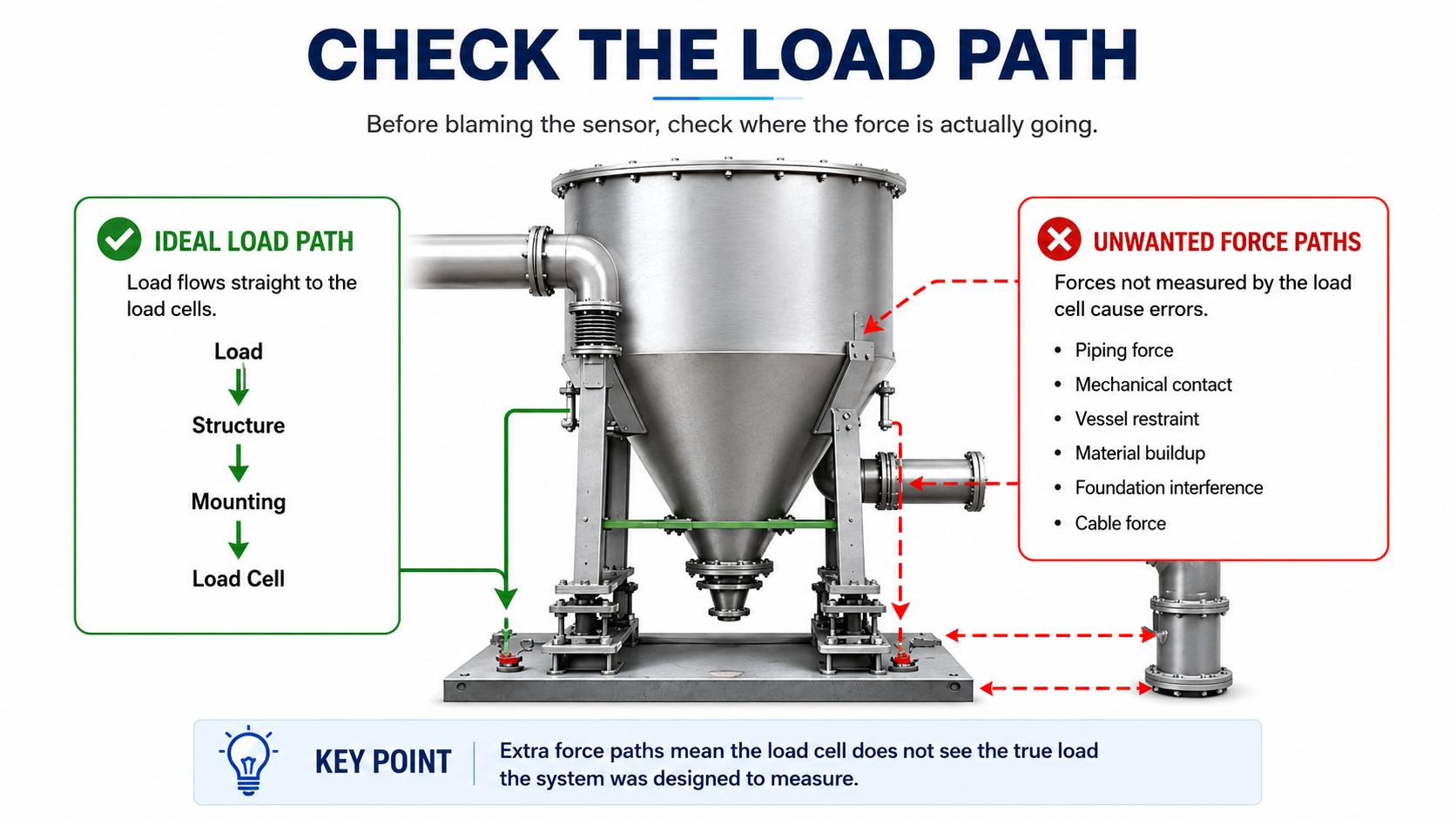
An ideal weighing system has a clear load path:
Load → Structure → Mounting → Load Cell
But after installation or long-term operation, additional force paths can appear.
For example, a truck-scale deck may touch surrounding concrete or accumulated debris. A weighing hopper may be pulled by rigid piping. A belt scale may be affected by unstable idlers, belt tension or vibration.
In these cases, the load cell itself may be perfectly healthy.
The problem is that the force reaching it is no longer the force the system was designed to measure.
Before checking sensor accuracy, check where the force is actually going.
2. A Correct Load Cell Can Still Be Installed Incorrectly
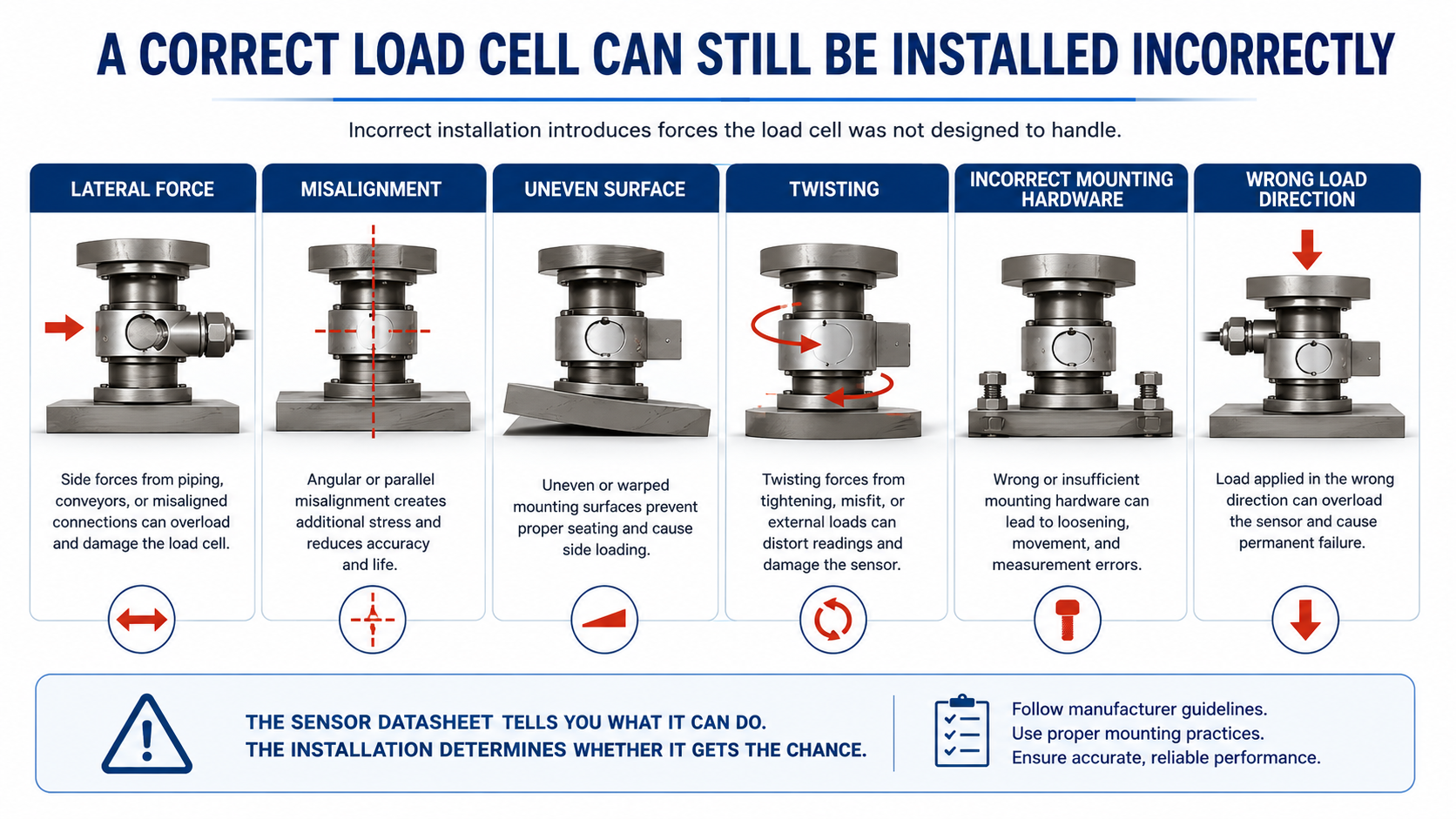
Load-cell specifications are measured under defined loading conditions.
The real installation determines whether those conditions actually exist.
Typical problems include lateral force, poor alignment, uneven mounting surfaces, twisting and unsuitable mounting hardware.
For example, if a hopper support is not level, part of the intended vertical load may become a combination of vertical and lateral forces.
This is why the load cell and its mounting system should be treated as one mechanical assembly.
The sensor datasheet tells you what the load cell can do. The installation determines whether it gets the chance to do it.
3. The Problem May Be in the Cable or Junction Box
Not every unstable weighing signal means that a load cell has failed.
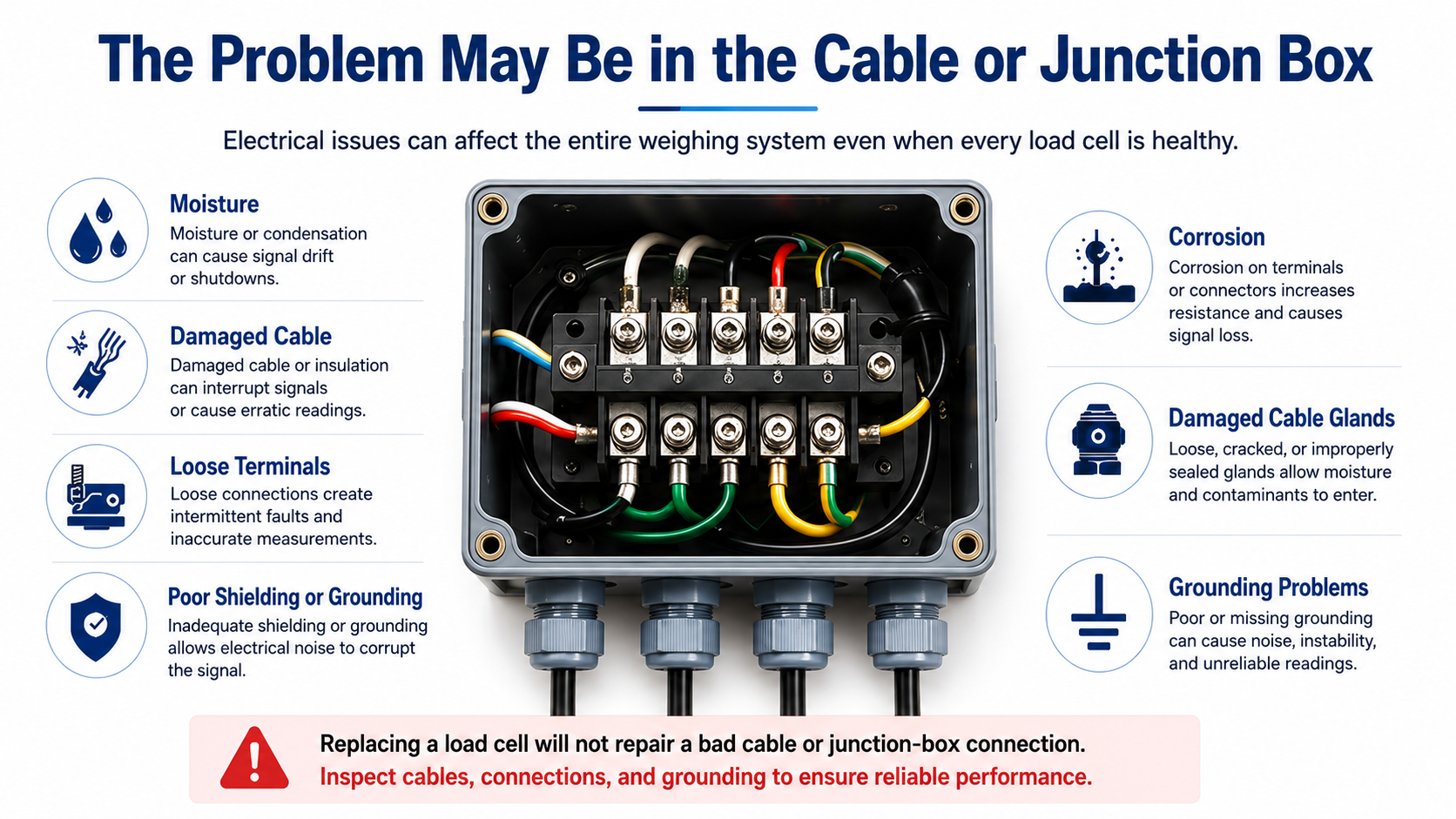
In multi-load-cell systems, cables and junction boxes are also part of the measurement chain.
Common problems include:
- damaged cables
- loose terminals
- moisture or condensation
- corrosion
- poor shielding
- grounding problems
Outdoor truck scales provide a good example.
A poorly sealed junction box may work normally in dry weather but begin to drift or fluctuate after rain.
That relationship with weather is useful diagnostic information.
Replacing a load cell will not repair a bad cable or junction-box connection.
4. Stable Readings Are Not Always Accurate
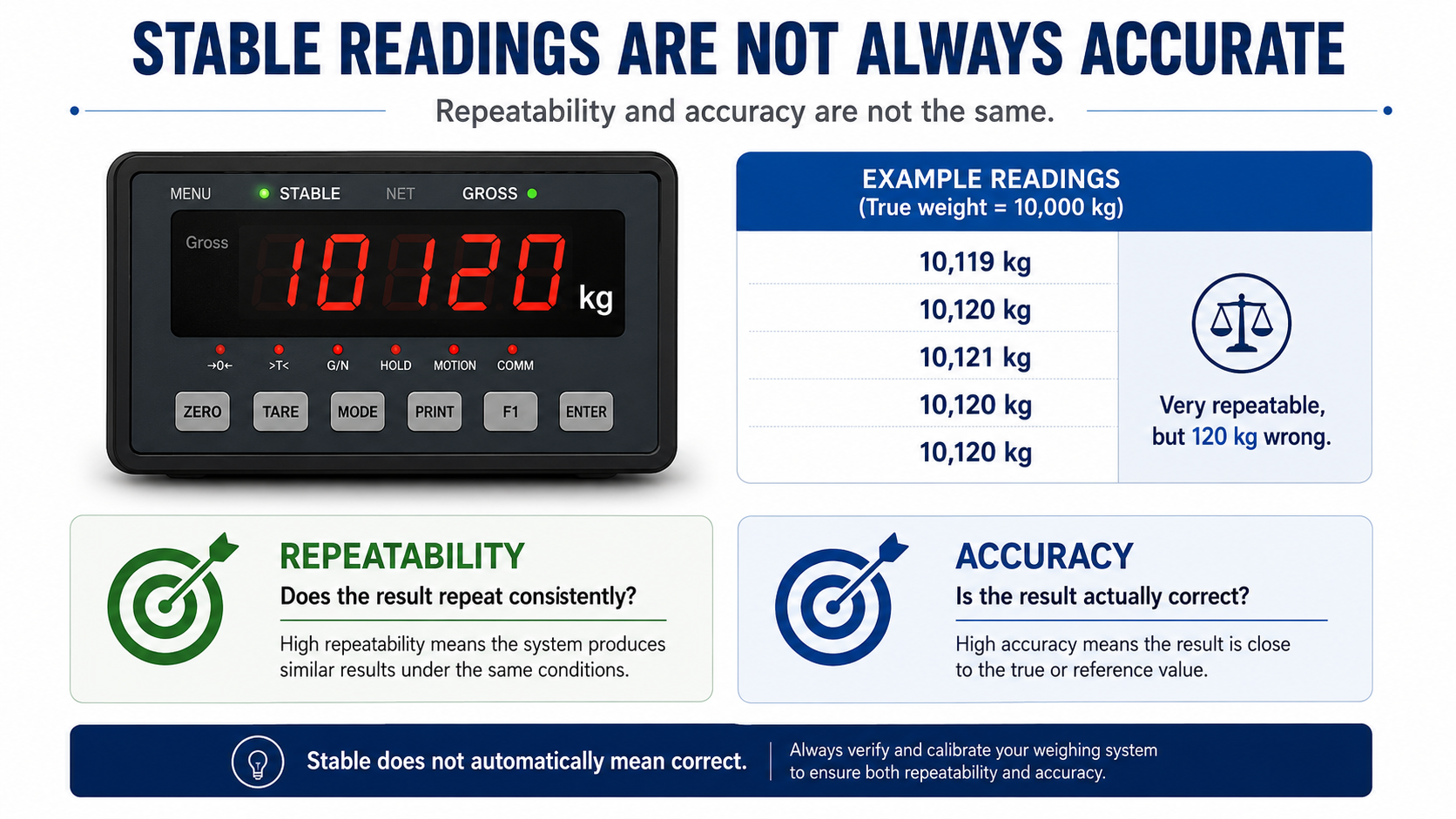
Suppose the true reference weight is:
10,000 kg
The scale repeatedly displays:
10,119 kg
10,120 kg
10,121 kg
10,120 kg
The system is very repeatable.
But it is still approximately 120 kg wrong.
So two questions should be separated:
Does the result repeat consistently?
and
Is the result actually correct?
A stable but consistently wrong reading can come from calibration error, an unreliable reference weight, fixed mechanical force or incomplete load transfer.
Repeatability tells you whether the system behaves consistently. It does not prove accuracy.
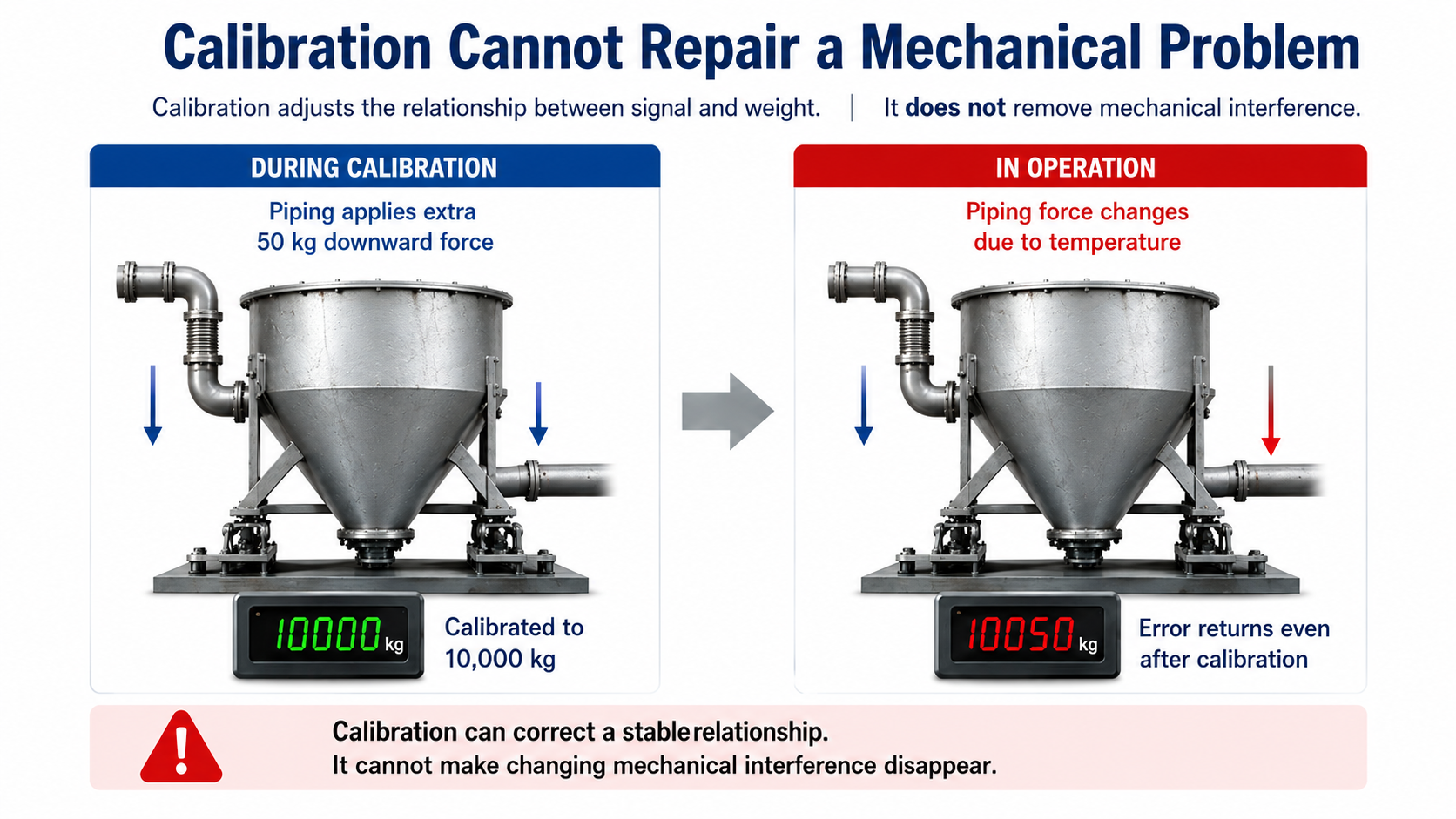
5. Calibration Cannot Repair a Mechanical Problem
Calibration establishes the relationship between the measured signal and displayed weight.
It does not repair the load path.
Suppose a rigid pipe applies extra downward force to a weighing hopper during calibration.
The system may still be adjusted to display the expected value.
But if that piping force changes because of temperature, valve movement or process conditions, the weighing error can return.
The calibration did not suddenly fail.
The mechanical condition changed.
Calibration can correct a stable measurement relationship. It cannot make changing mechanical interference disappear.
6. What the Error Pattern Can Tell You
| What You See | Check First |
| Zero slowly drifts | Piping, mechanical restraint, temperature, moisture |
| Error changes with load position | Support points, mounting, foundation, load distribution |
| Reading suddenly jumps | Cable, terminals, junction box, vibration |
| Stable but consistently wrong | Calibration, reference weight, fixed external force |
| One load-cell output differs greatly | Sensor, mounting, cable, local structure |
| Problem mainly appears after rain | Junction box, cable sealing, insulation |
| Error appears only while equipment runs | Vibration, belt tension, agitator, piping or dynamic force |
This table is not a complete troubleshooting procedure.
Its purpose is to avoid one common mistake:
Replacing the load cell before checking the system around it.
7. Before You Replace a Load Cell
A practical inspection sequence is:
Load Path → Mechanical Contact → Mounting → Cable / Junction Box → Individual Sensor Output → Calibration
If the mechanical and electrical conditions are normal and the abnormal behavior clearly follows one specific sensor or signal channel, then replacing that load cell becomes a much stronger conclusion.
8. Load Cell Performance vs Complete System Performance
Industrial weighing depends on a longer measurement chain:
Mechanical Load → Structure & Mounting → Load Cell → Cable / Junction Box → Weighing Electronics → Calibration → Final Weight Data
Keli’s weighing technology is closely connected with load cells, signal measurement and weighing electronics.
KELISCALES extends that measurement chain into complete industrial weighing equipment and system integration.
The distinction is important:
A better load cell improves one part of the measurement chain. Reliable weighing requires the entire chain to work correctly.
9. Before You Blame the Sensor
When a weighing result looks wrong, start with three questions:
Does the error change with load position?
If yes, inspect the mechanics and load distribution.
Does the error change with rain, temperature or machine operation?
If yes, inspect moisture, mechanical restraint and dynamic forces.
Does the error consistently follow one load cell or signal channel?
If it does, and the surrounding mechanical and electrical conditions have already been checked, replacing the sensor becomes a much stronger diagnosis.
A load cell can be perfectly healthy while the weighing system around it is not.

Need customized model matching your production line, technical drawings and accurate quotation?
Submit your inquiry now, our engineering sales team will send full solution within 24 working hours.