
A belt scale used for rice follows the same weighing principle as other conveyor belt scales, but grain applications can be more sensitive to zero drift, low belt loading, dust, husk, carryback, and changes in the material loading profile.
This means a scale may pass a routine calibration check and still show noticeable error during normal production.
For a rice conveyor, three questions are especially important:
Is the empty-belt zero stable?
How much rice is actually being carried per meter of belt?
Does the material test represent normal production conditions?
1. Why Rice Conveyors Can Be More Sensitive to Zero Error
Rice is often conveyed at a lower belt loading than ore, coal, or aggregate.
Suppose the system has a zero-related offset equivalent to: 0.5 kg/m
If the conveyor is carrying: 100 kg/m
that offset represents only: 0.5%
If the rice conveyor is carrying only: 20 kg/m
the same offset represents: 2.5%
The offset has not increased. The useful material signal has become smaller.
This leads to a useful diagnostic rule:
If weighing error becomes much worse at low rice flow, check zero stability before changing the span calibration.

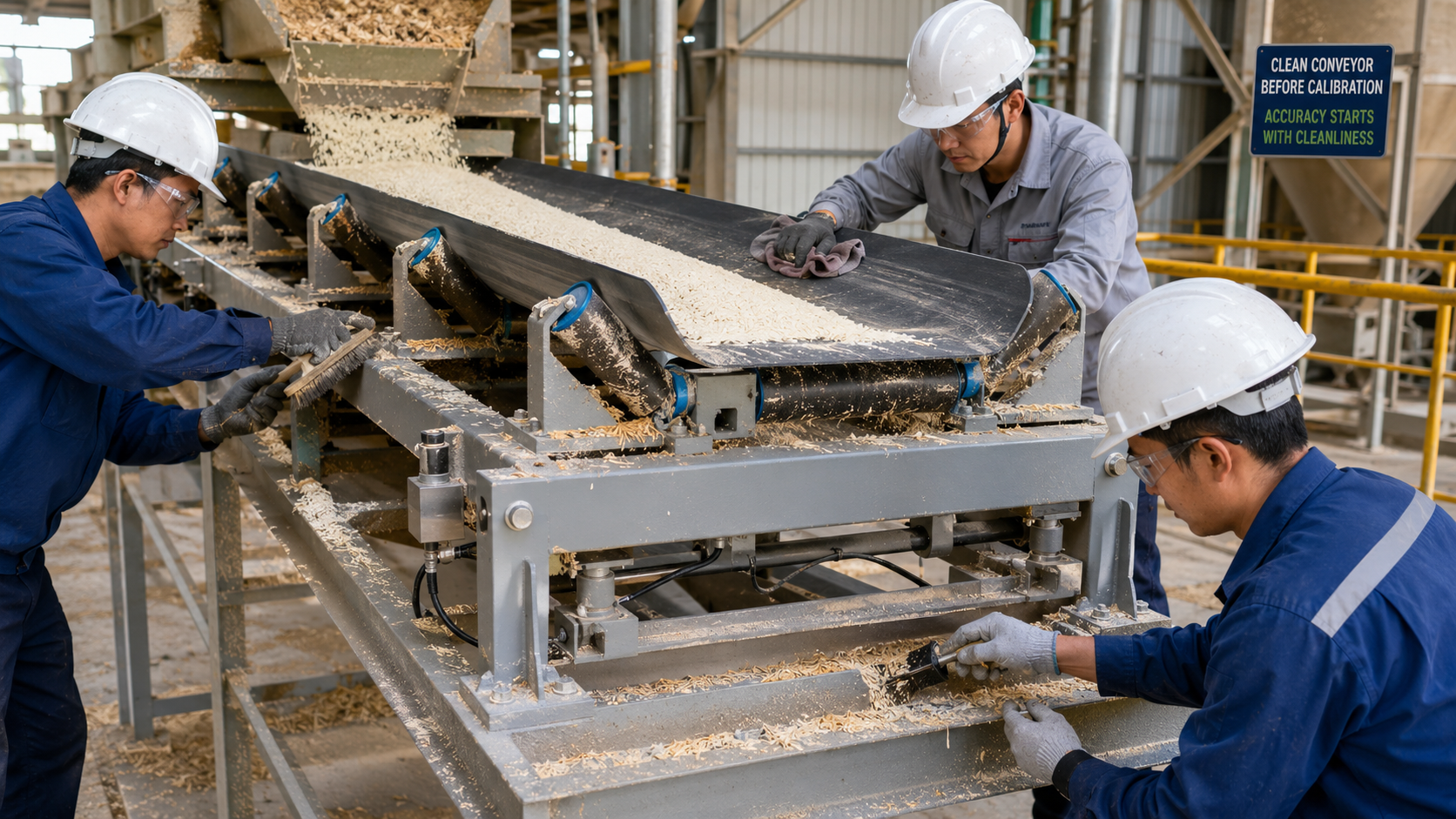
2. Clean the Conveyor Before Calibration
Rice handling systems often generate dust, husk, broken grain, and fines.
These materials can accumulate on the belt, idlers, and weigh frame. Some may also remain on the return side of the belt as carryback.
Carryback changes the effective tare seen by the weighing system.
If the scale is zeroed while material is stuck to the belt and that material later falls away, the zero condition changes again.
Before calibration:
- clean the weighing area
- make sure the weigh frame can move freely
- inspect the weigh idlers
- confirm that the belt is tracking normally
- verify the speed sensor
A useful rule is:
Do not use zero adjustment to compensate for temporary material buildup.
3. Watch the Zero Pattern, Not Just the Number
A single zero reading tells you very little about the condition of the conveyor.
The way the zero changes is often more useful.
If the zero shifts at roughly the same point during every belt revolution, inspect:
- the belt splice
- a damaged section of belt
- localized contamination
4. If the zero gradually drifts over time, inspect:
- material buildup
- belt tracking
- belt tension
- mechanical contact around the weighing structure
The pattern often tells you more than the absolute zero value.
5. Tons per Hour Is Not Enough
Throughput alone does not fully describe the weighing condition of a belt scale.
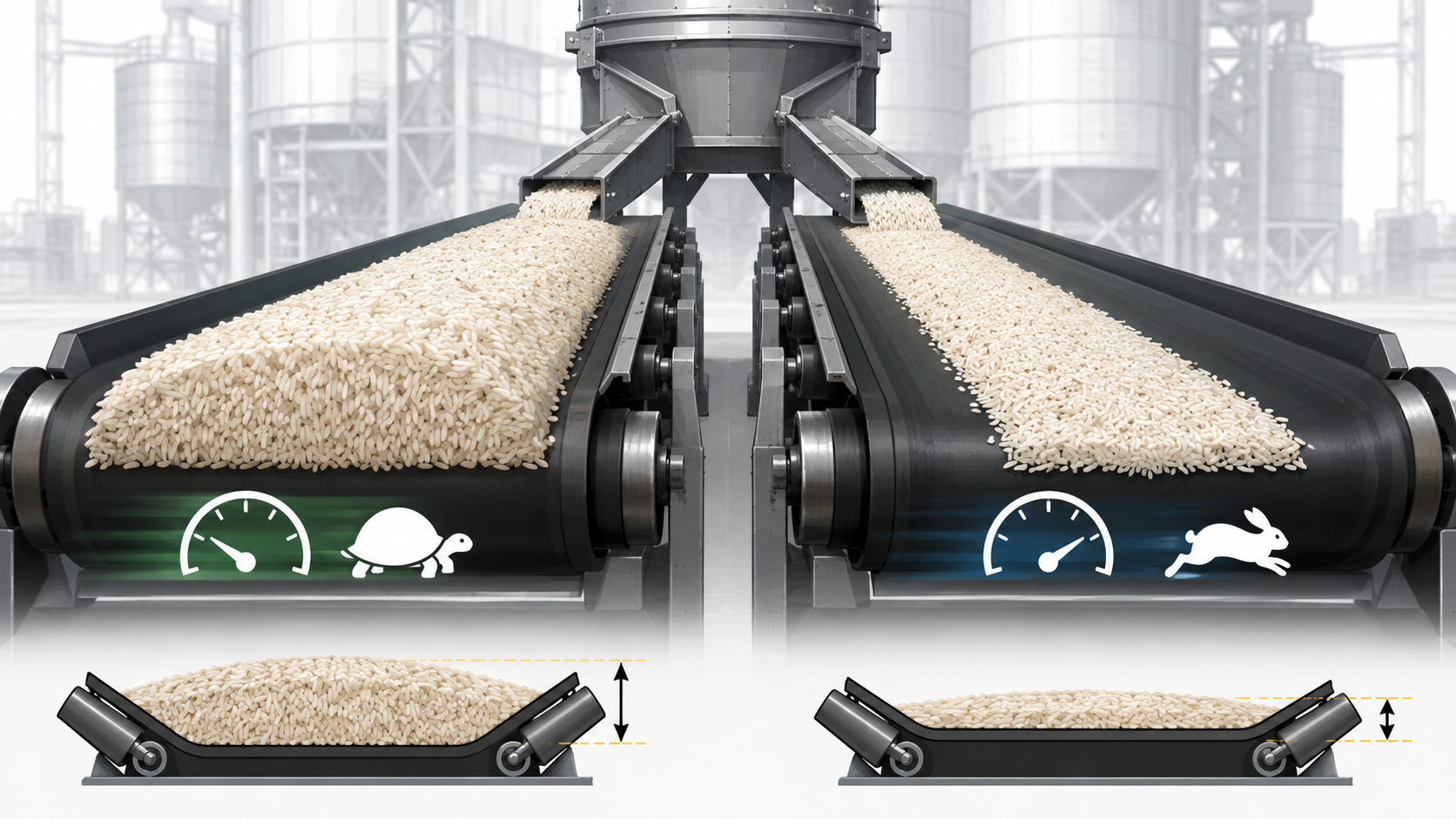
The amount of material carried on each meter of belt also depends on belt speed.
Consider the same rice flow: 40 t/h ≈ 11.1 kg/s
At a belt speed of: 0.5 m/s
the linear belt loading is approximately: 11.1 ÷ 0.5 = 22.2 kg/m
At: 2.0 m/s
the linear belt loading falls to: 11.1 ÷ 2.0 = 5.6 kg/m
The plant is still moving 40 t/h.
However, the second conveyor carries only one-quarter as much rice per meter of belt.
As a result, the useful weighing signal is smaller relative to belt tare, vibration, and zero variation.
For grain applications:
kg/m can be more useful than t/h when evaluating the actual weighing condition.
6. Check the Material Loading Profile
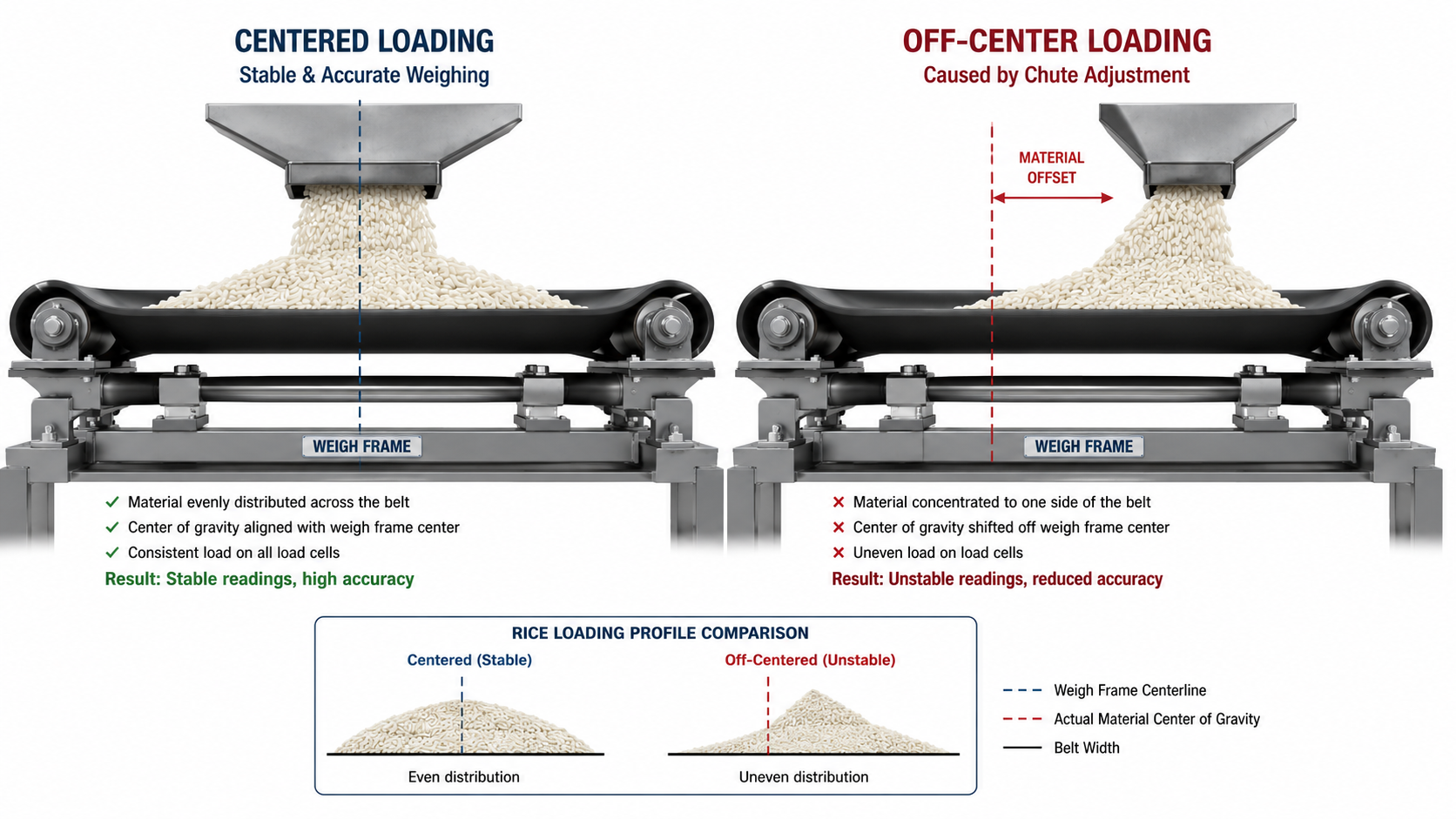
Rice does not always remain perfectly centered on the belt.
Changes to a chute, gate, feeder, or upstream equipment can shift the material toward one side.
The total flow rate may remain almost unchanged, while the load distribution across the weigh frame changes significantly.
During a material test, observe:
- whether the rice is reasonably centered
- whether the loading profile remains stable
- whether the profile changes as flow rate changes
If weighing error appears immediately after a chute adjustment, inspect the material loading profile before assuming that the calibration factor is wrong.
7. Moisture Is Usually an Indirect Cause
Moisture does not automatically make a belt scale inaccurate.
The scale should measure the actual mass of the rice, including changes in moisture content.
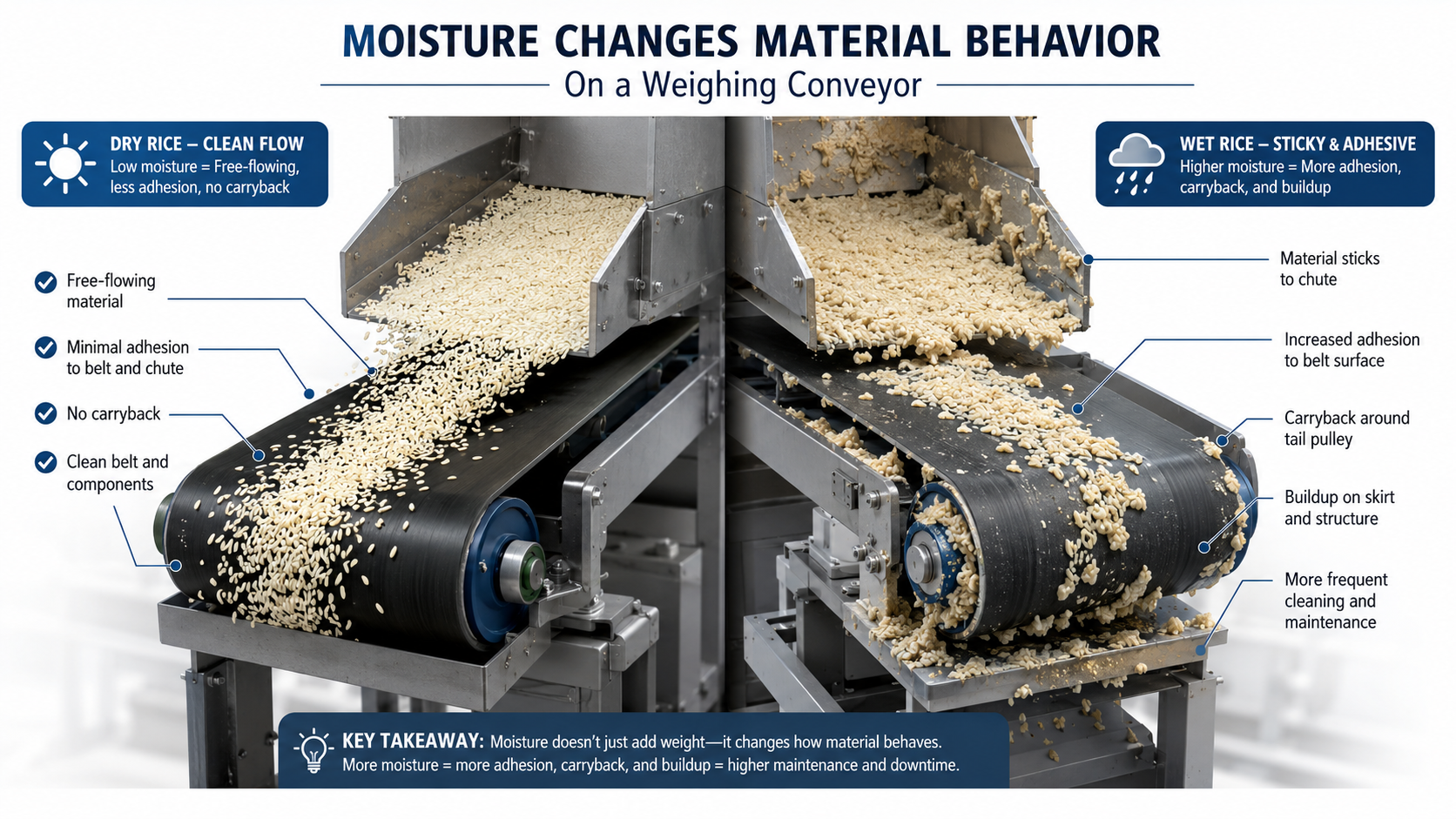
The real concern is whether moisture changes how the material behaves on the conveyor.
Wetter material may:
- stick more easily
- increase carryback
- change discharge from the chute
- alter the material loading profile
A better way to think about moisture is:
Moisture becomes important when it changes adhesion, buildup, flow behavior, or material distribution.
There is another important consideration during a material test.
Do not compare a reference weight taken before drying, cleaning, or impurity removal with a belt scale located after that process.
The reference measurement and the belt-scale measurement must represent the same material quantity across the same process boundary.
8. Use a Material Test That Represents Production
A material test should be carried out as close as practical to normal operating conditions.
If the rice conveyor normally operates at: 40 t/h
but the test is performed at: 5 t/h
the result mainly tells you how the scale performs at 5 t/h.
At lower flow, belt loading is lower and zero-related effects become more significant.
If the conveyor regularly operates across a wide flow range, test more than one representative operating point where practical.
For example:
| Rice Flow | Error |
| 10 t/h | +2.0% |
| 25 t/h | +0.8% |
| 40 t/h | +0.4% |
This pattern suggests that low-load performance or zero stability deserves closer attention.
Now compare it with:
| Rice Flow | Error |
| 10 t/h | +1.0% |
| 25 t/h | +1.1% |
| 40 t/h | +1.0% |
This pattern looks more like a proportional bias.
The error pattern does not provide a final diagnosis, but it helps determine what should be checked first.
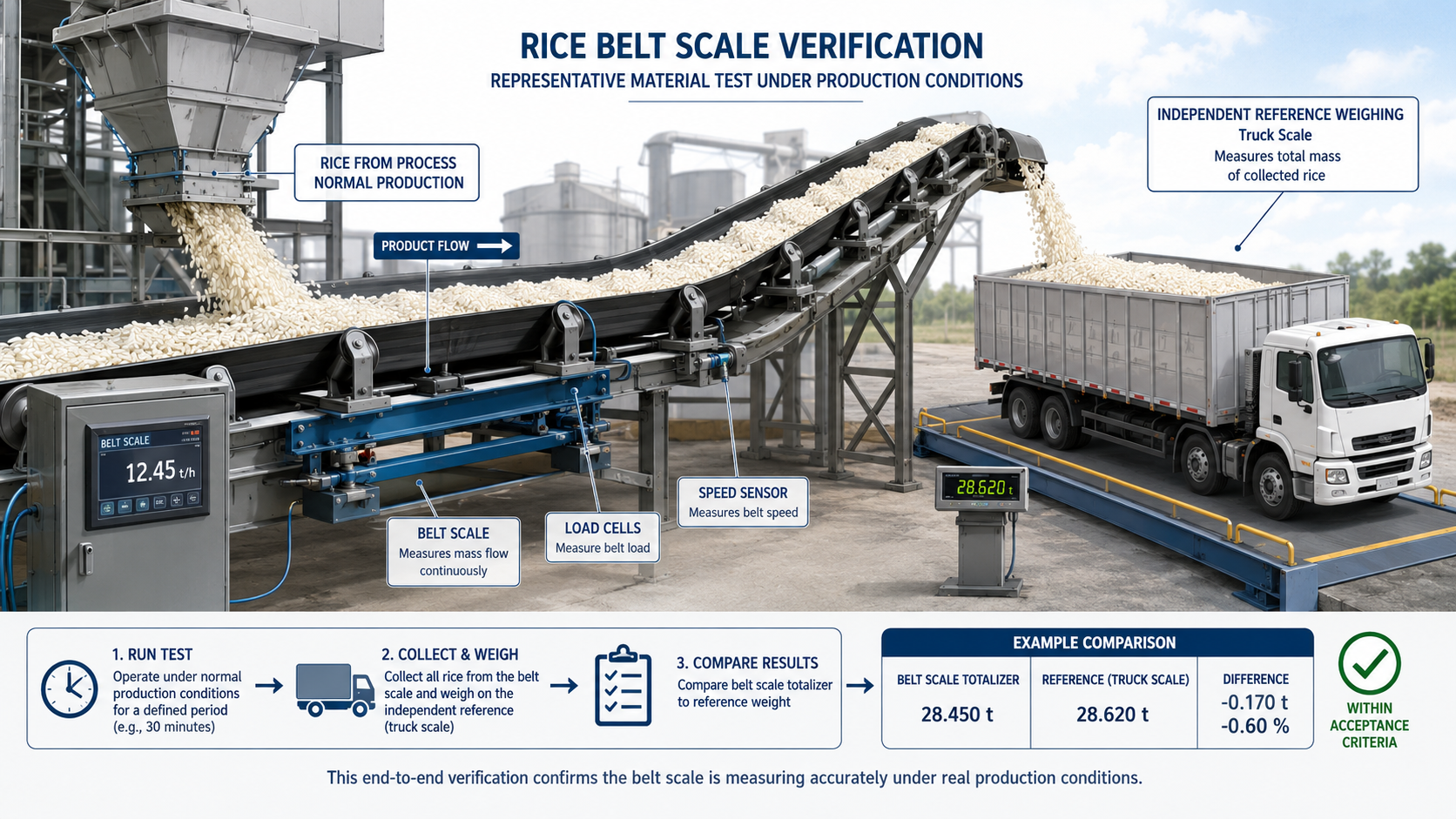
9. Check Repeatability Before Correcting Span
Suppose three material tests produce:
−0.42%
−0.45%
−0.44%
The scale is consistently reading low.
Now compare that with:
−0.20%
+0.70%
−0.55%
The second set of results is not repeatable.
In that situation, adjusting the span factor is unlikely to solve the real problem because the system is not producing a stable measurement.
Check:
- feeding consistency
- material loading profile
- zero stability
- material buildup
- the reference measurement
A useful field rule is:
Repeatability first. Correction second.
10. Make Sure the Reference Weight Is Reliable
A material test compares two measurements:
the belt scale result and the reference quantity.
If the reference quantity is wrong, the conclusion from the test will also be wrong.
In rice applications, reference errors may come from:
- incorrect tare weight
- material remaining in a truck or bin
- product lost during transfer
- comparing measurements taken before and after a process that changes material mass
Before adjusting a belt scale by 0.5%, make sure the reference measurement is reliable enough to justify a 0.5% correction.
11. Quick Diagnostic Guide
| What You See | Check First |
| Error becomes much worse at low flow | Zero stability and kg/m belt loading |
| Zero drifts during the shift | Dust, husk, carryback, belt tracking |
| Error repeats every belt revolution | Belt splice or localized belt condition |
| Reading changes after chute adjustment | Material loading profile and side loading |
| Error changes after wetter rice arrives | Adhesion, buildup, and carryback |
| Percentage error remains similar across flow range | Span calibration or proportional bias |
| Material-test results vary widely | Feeding stability and reference measurement |
12. Calibration Considerations for the LCS-Series
The KELISCALES LCS-Series uses a floating-balance weighing structure with dual Keli load cells.
The dual-load-cell arrangement helps the weighing system respond to off-center loading, while the weighing structure is designed to reduce unnecessary mechanical force-transfer links.
For rice applications, however, good calibration still depends on the actual conveyor condition.
Before calibration, confirm that:
- the weigh frame moves freely
- the weigh idlers are correctly aligned
- the belt tracks normally
- the speed signal is stable
- the running zero is repeatable
When selecting or configuring the belt scale, do not provide only the maximum capacity in t/h.
Useful application data also includes:
- rice type
- minimum and maximum flow rate
- belt speed
- belt width
- bulk density
- conveyor inclination
- expected material loading profile
Two rice conveyors with the same 40 t/h capacity can still create very different weighing conditions.
13. The Main Point
Calibrating a rice belt scale is not mainly about following a special “rice calibration procedure.”
The more important task is understanding the actual weighing condition.
Three questions matter most:
Is the zero stable?
How much rice is actually being carried per meter of belt?
Does the test represent normal production conditions?
If those three conditions are not understood, adjusting the calibration factor is usually premature.

Need customized model matching your production line, technical drawings and accurate quotation?
Submit your inquiry now, our engineering sales team will send full solution within 24 working hours.