
Choosing a conveyor belt scale manufacturer should involve more than comparing capacity, accuracy, and price.
A belt scale measures through the conveyor. Its performance depends on belt loading, idler alignment, belt tracking, speed measurement, installation geometry, and calibration.
So before asking:
“Which model do you recommend?”
it is more useful to ask:
“What information does the manufacturer need before recommending one?”
That question often tells you how seriously the supplier approaches the application.
1. What Does the Manufacturer Ask Before Quoting?
Maximum flow and belt width are not enough for reliable belt-scale selection.
A useful application review should normally include:
- minimum, normal, and maximum flow
- belt width
- belt speed
- conveyor incline
- idler spacing
- required accuracy
- installation location
- fixed- or variable-speed operation
For more difficult applications, the supplier should also consider:
- kg/m belt loading
- material buildup tendency
- off-center loading
- distance from the loading point
- conveyor drawings or site photos

Two conveyors can both carry 500 t/h but still create very different weighing conditions.
A faster belt may carry much less material per meter than a slower belt at the same throughput.
The hourly capacity is the same.
The load signal available to the weighing system is not.
This is why How to Choose a Conveyor Belt Scale starts with operating range and belt loading rather than maximum capacity alone.
2. Can the Manufacturer Evaluate the Whole Measurement Chain?
A belt scale is not simply a load-cell product.
The material load follows this mechanical path:
Material → Belt → Weigh Idler → Weigh Frame (Weighbridge) → Load Cells
At the same time:
Belt Travel → Speed Sensor
The integrator processes the load and speed signals to calculate:
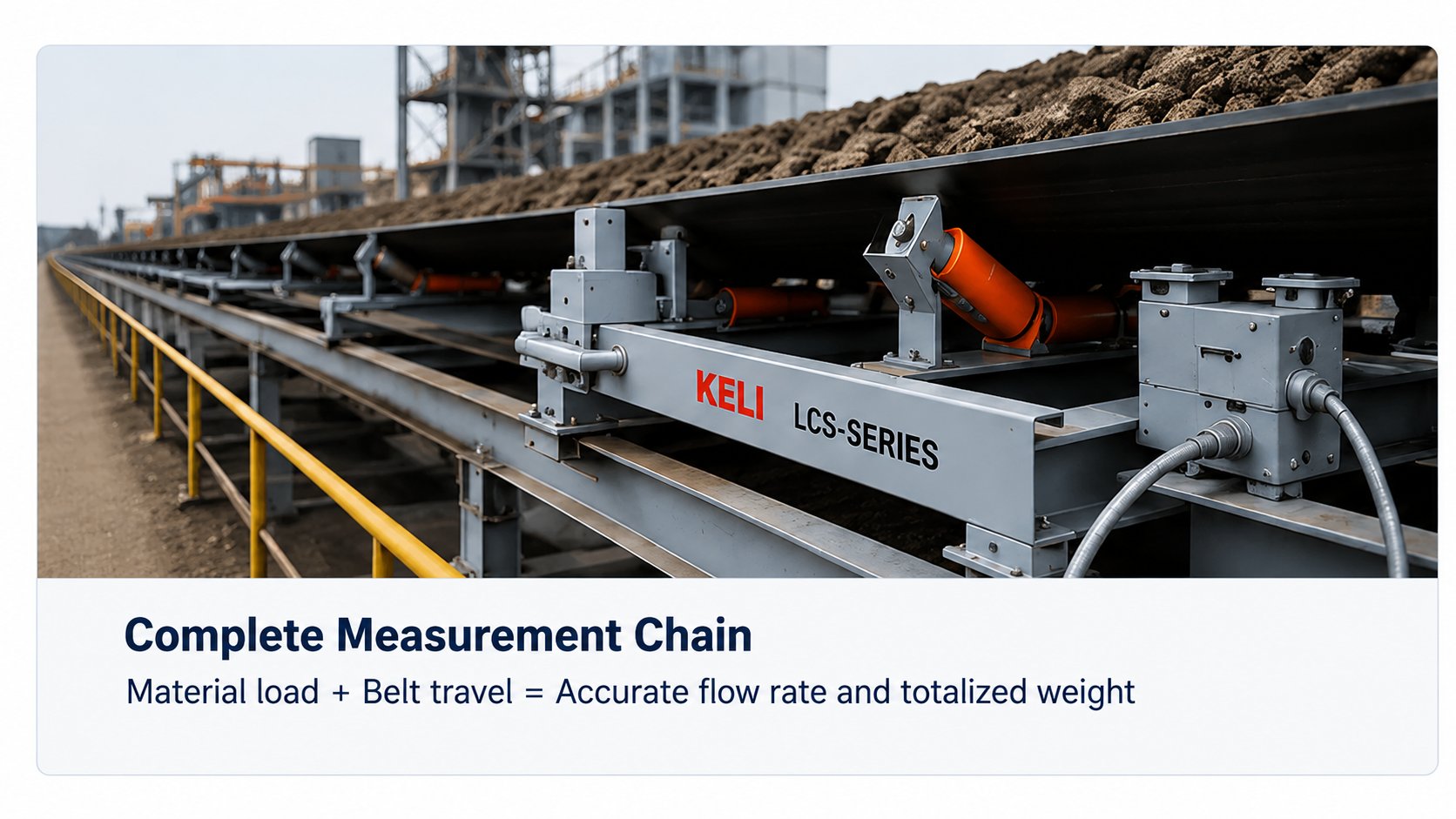
flow rate + totalized weight
A technically capable supplier should therefore understand:
- weigh-frame mechanics
- weigh-idler alignment
- mechanical freedom of the weigh frame
- belt-travel measurement
- zero stability
- calibration
See Conveyor Belt Scale Components Explained for the complete measurement chain.
One useful question is:
“What could make this scale read incorrectly even if the load cells are working properly?”
Possible answers should include:
- idler misalignment
- force shunting
- material buildup
- unstable belt tracking
- incorrect belt-speed measurement
If the discussion focuses only on load-cell accuracy, the application review is probably too narrow.
3. Will the Manufacturer Review the Weighing Zone?
A good belt scale installed in a poor location can still perform badly.
A suitable weighing zone normally needs:
- settled material
- stable belt tracking
- aligned idlers
- no major vertical curve nearby
- a mechanically free weigh frame
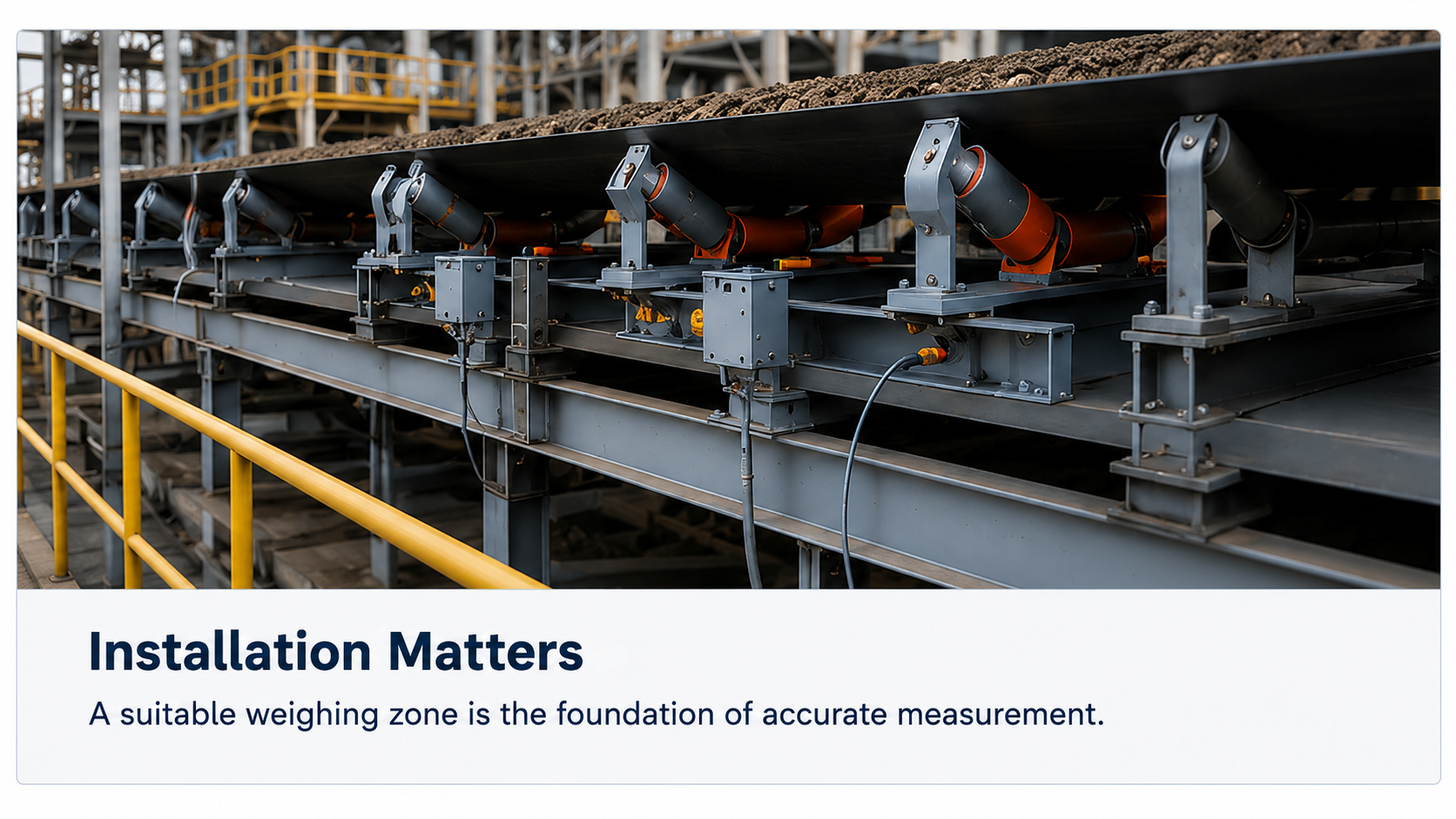
If the proposed location is directly below a loading chute or close to a major conveyor transition, the manufacturer should identify that risk before installation.
The main site requirements are explained in Conveyor Belt Scale Installation Guide.
Sometimes the most useful answer from a supplier is:
“Do not install the scale there.”
4. Ask What the Accuracy Figure Actually Means
An accuracy claim without operating conditions has limited value.
Instead of asking only:
“What is the accuracy?”
Ask:
“Under what flow range, installation conditions, and verification method is that accuracy expected?”
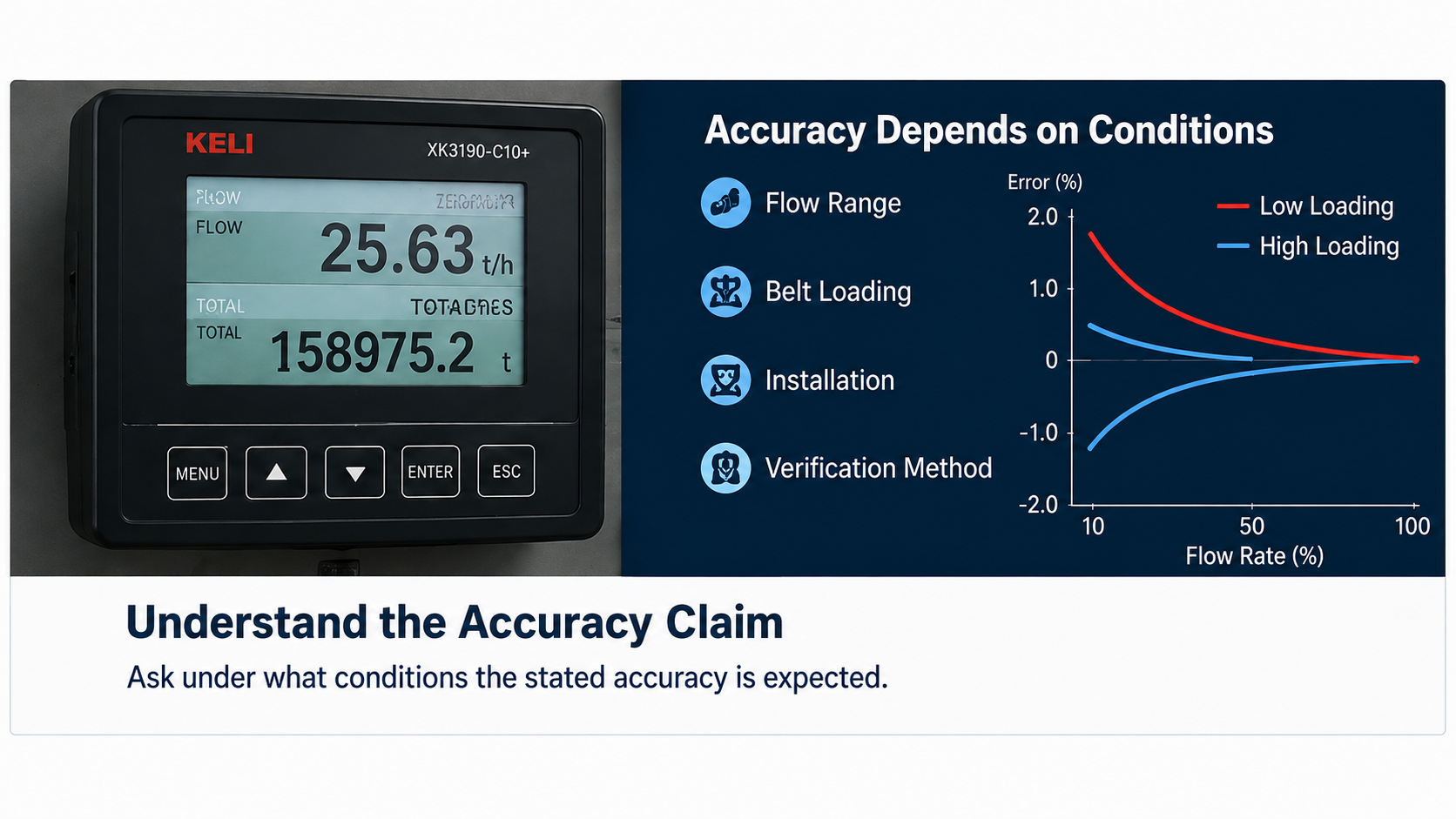
Useful follow-up questions include:
- What happens at minimum flow?
- Is there a minimum recommended belt loading?
- Does the figure apply to variable-speed operation?
- How is the result verified?
Low belt loading is especially important because the same zero error becomes a larger percentage of the material signal.
This is why real conveyor belt scale accuracy depends on the complete system, not only the sensor specification.
A quotation that simply says:
Accuracy: ±0.5%
the next question should be:
“Under what conditions?”
5. Ask How Calibration and Verification Will Be Done
A supplier should understand the difference between:
zeroing ≠ calibration ≠ verification
Depending on the installation, calibration may involve:
- test weights
- calibration chains
- electronic calibration
- material testing
These methods do not verify exactly the same parts of the system.
Electronic calibration may confirm the electronics while missing a mechanical force-path problem.
A material test checks more of the complete weighing system, but the reference weight also needs to be reliable.
The useful question is not only:
“How do I change the span factor?”
but:
“How do I know the system actually needs adjustment?”
See How to Calibrate a Conveyor Belt Scale for the calibration and verification logic.
6. Can the Supplier Diagnose Problems Before Recalibrating?
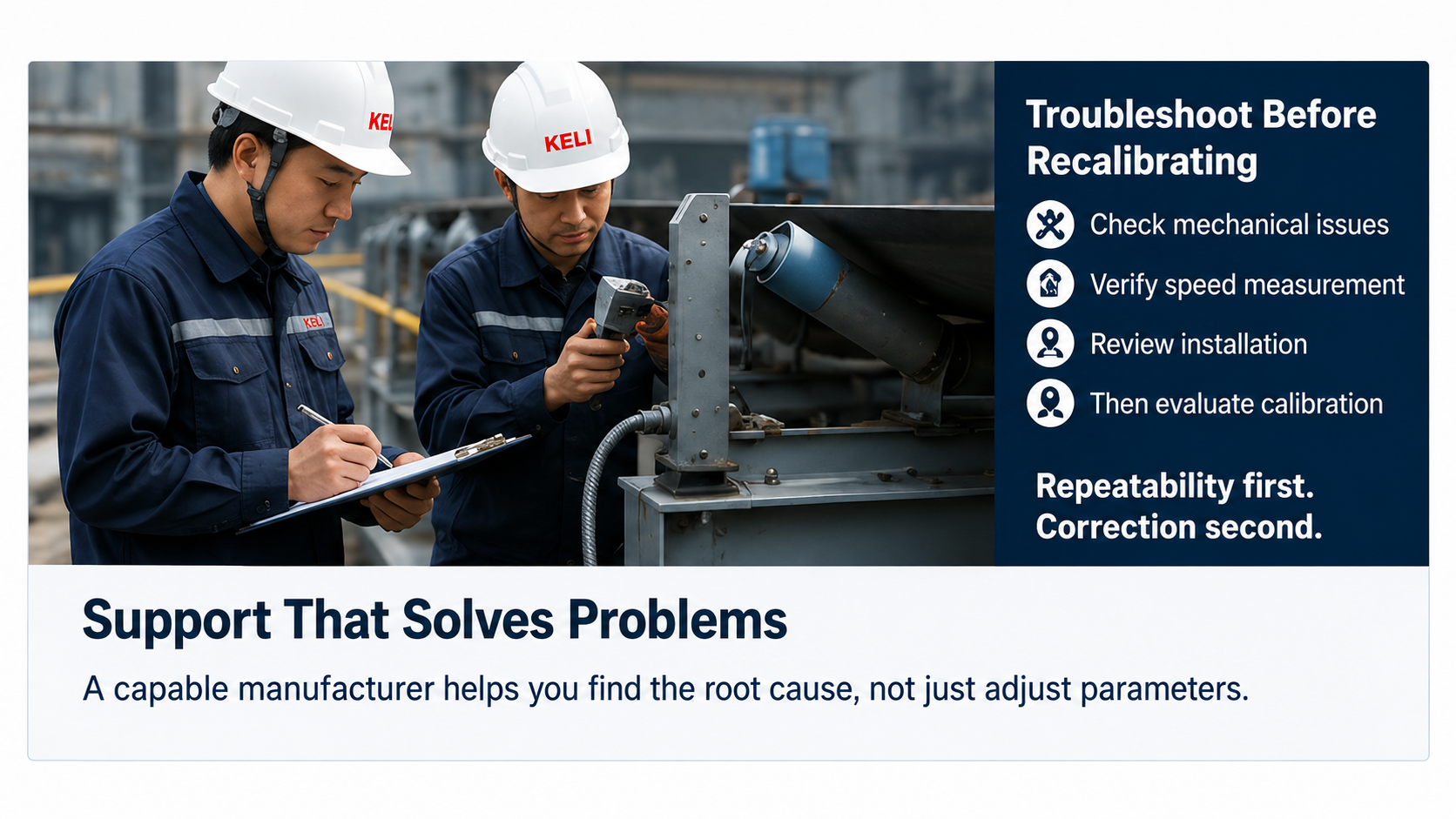
Troubleshooting ability is more useful than a generic promise of “good after-sales service.”
Suppose three material tests show:
+1.0%, +1.1%, +1.0%
The system is repeatable, but it may have a proportional bias.
Now compare:
-0.4%, +0.8%, -0.3%
The problem is different.
The system is not repeating.
Adjusting the span factor immediately would not correct that instability.
Likewise, if electronic calibration passes but a material test fails, the supplier should check:
- idler alignment
- force shunting
- buildup
- belt speed
- tracking
- other mechanical conditions
The troubleshooting principle should be:
Repeatability first. Correction second.
See Conveyor Belt Scale Troubleshooting & Maintenance for common error patterns.
7. Lowest Price Is Not Always Lowest System Cost
The purchase price is only one part of a belt-scale project.
Total cost can also include:
- installation
- conveyor modification
- idler alignment
- commissioning
- calibration
- downtime
- spare parts
- future troubleshooting
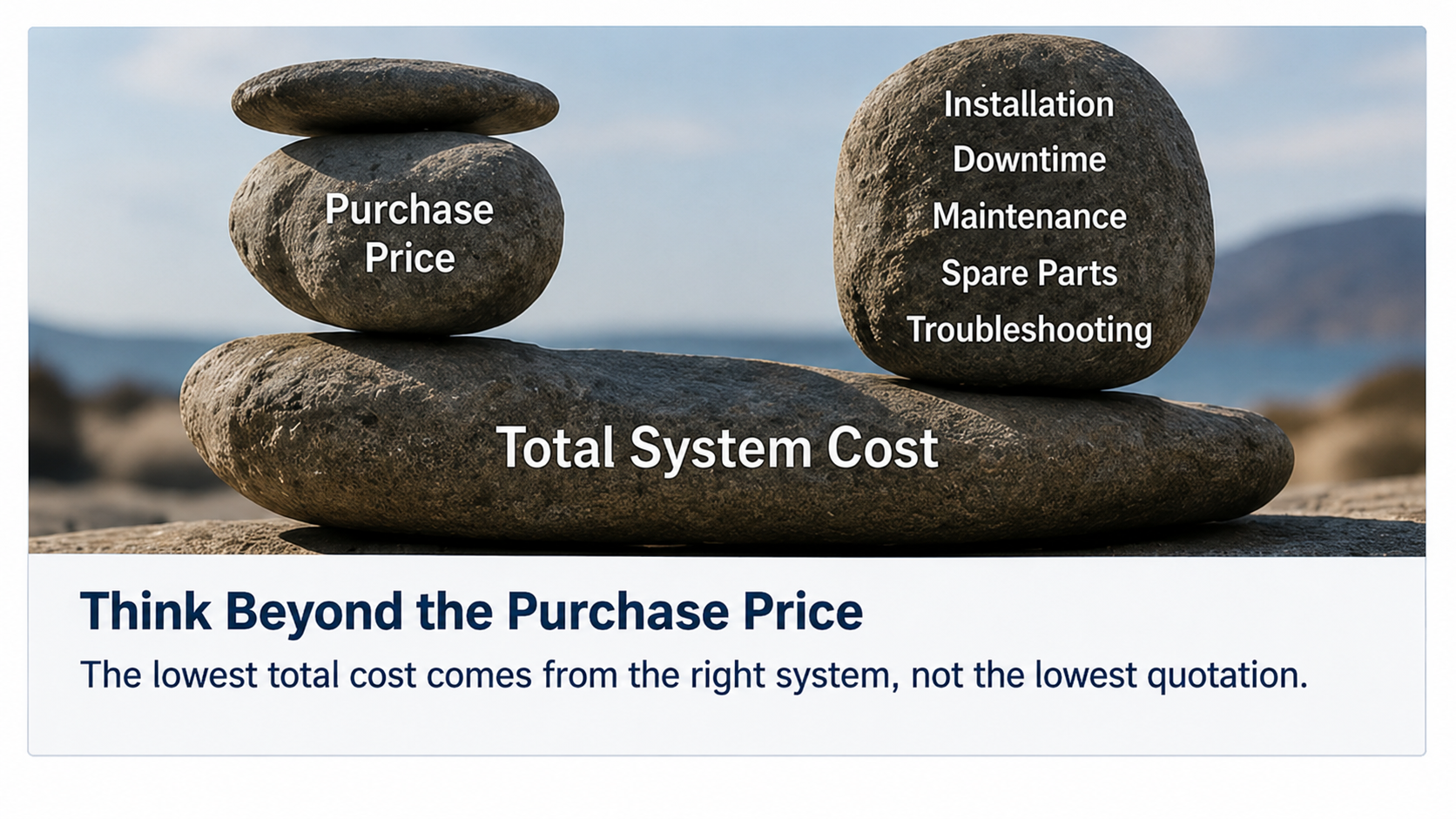
A lower-cost scale that requires frequent correction can become expensive to operate.
But the most expensive scale is not automatically the best choice either.
The goal is:
a system that provides the required performance under the real conveyor conditions and can be maintained reliably.
8. Does the Manufacturer Know When a Belt Scale Is Not the Right Choice?
A good belt-scale supplier should not recommend a belt scale for every bulk-weighing application.
If the requirement is:
measure material already moving on a conveyor
a belt scale may be appropriate.
If the requirement is:
actively maintain a target feed rate
a weigh feeder may be better.
If the requirement is:
weigh a defined batch and then discharge it
a hopper scale or weigh hopper may be more suitable.
See Belt Scale vs Weigh Feeder vs Hopper Scale for the differences between these systems.
A supplier who can identify when its own product is not the best solution is usually providing a more useful engineering recommendation.
9. Conveyor Belt Scale Manufacturer Checklist
| What to Check | What You Want to See |
| Application data | Min/max flow, belt speed and kg/m loading |
| Installation review | Weighing zone and conveyor geometry checked |
| Mechanical design | Clear explanation of load path and restraints |
| Speed measurement | Actual belt travel considered |
| Accuracy | Conditions behind the stated figure explained |
| Calibration | Zero, span and verification methods defined |
| Troubleshooting | Mechanical, speed and calibration errors separated |
| Engineering support | Drawings or site photos reviewed before final selection |
The purpose is to identify assumptions before they become installation problems.
10. Where the LCS-Series Fits
For continuous conveyor applications requiring higher measurement stability, the LCS-Series High-Accuracy Conveyor Belt Scale uses a floating-balance weighing structure with dual Keli load cells.
The design is intended to reduce unnecessary mechanical force paths and reduce sensitivity to off-center loading.
Useful application data before selecting a configuration include:
belt width + belt speed + min/max flow + kg/m loading + incline + material behavior + installation geometry
The model should follow the application.
If the conveyor cannot provide a stable weighing environment, a higher specification alone will not remove that limitation.
11. The Main Point
A conveyor belt scale manufacturer should do more than provide a model number and an accuracy figure.
A capable supplier should understand:
application → conveyor → load path → belt travel → installation → calibration → verification → troubleshooting
Pay attention to the questions the supplier asks before quoting.
If they ask only:
“What is your maximum capacity?”
the application has probably not been fully defined.
If they ask about minimum flow, belt speed, kg/m loading, installation geometry, and verification method, they are beginning to evaluate the complete weighing system.
For conveyor belt scales, that engineering work can matter as much as the hardware itself.

Need customized model matching your production line, technical drawings and accurate quotation?
Submit your inquiry now, our engineering sales team will send full solution within 24 working hours.