
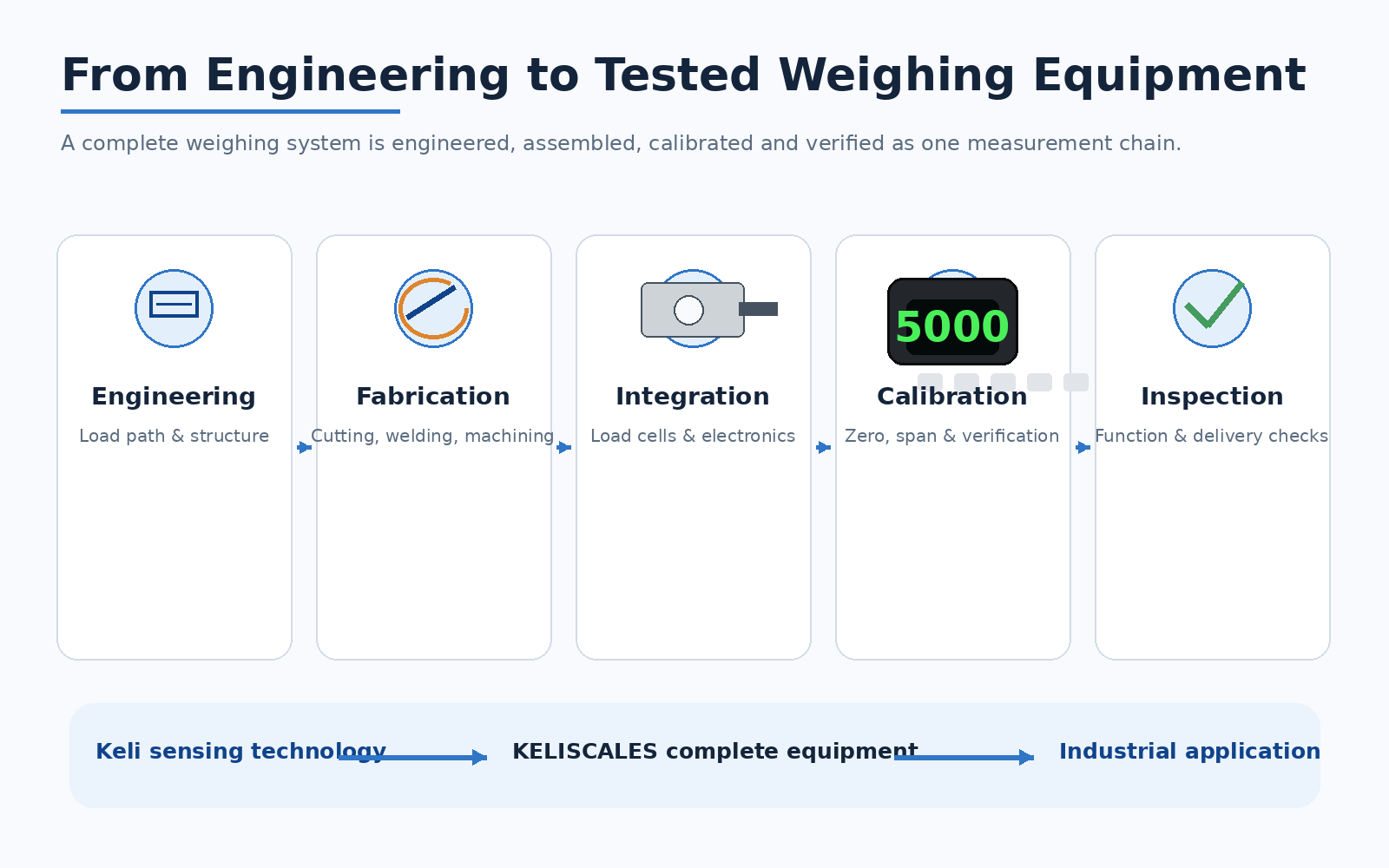
When people compare industrial weighing equipment, the conversation often starts with capacity, platform size, accuracy class and steel thickness.
Those specifications are useful, but they do not tell you whether a weighing system will still behave well after thousands of loading cycles, a rainy season, several temperature changes, or years of daily operation.
For that, you need to look further inside the system.
A truck scale is not simply a steel deck with several load cells underneath it. A belt scale is not simply a sensor installed below a conveyor. And a hopper weighing system is not automatically accurate just because high-accuracy load cells are installed.
The mechanical structure, force path, sensor mounting, signal processing, calibration and site conditions all influence the final reading.
That is the manufacturing problem KELISCALES has to solve when turning Keli sensing technology into complete weighing equipment.
1. Manufacturing Starts With the Load Path
Before steel is cut or welded, an engineer needs to answer a basic question:
Where does the force go?
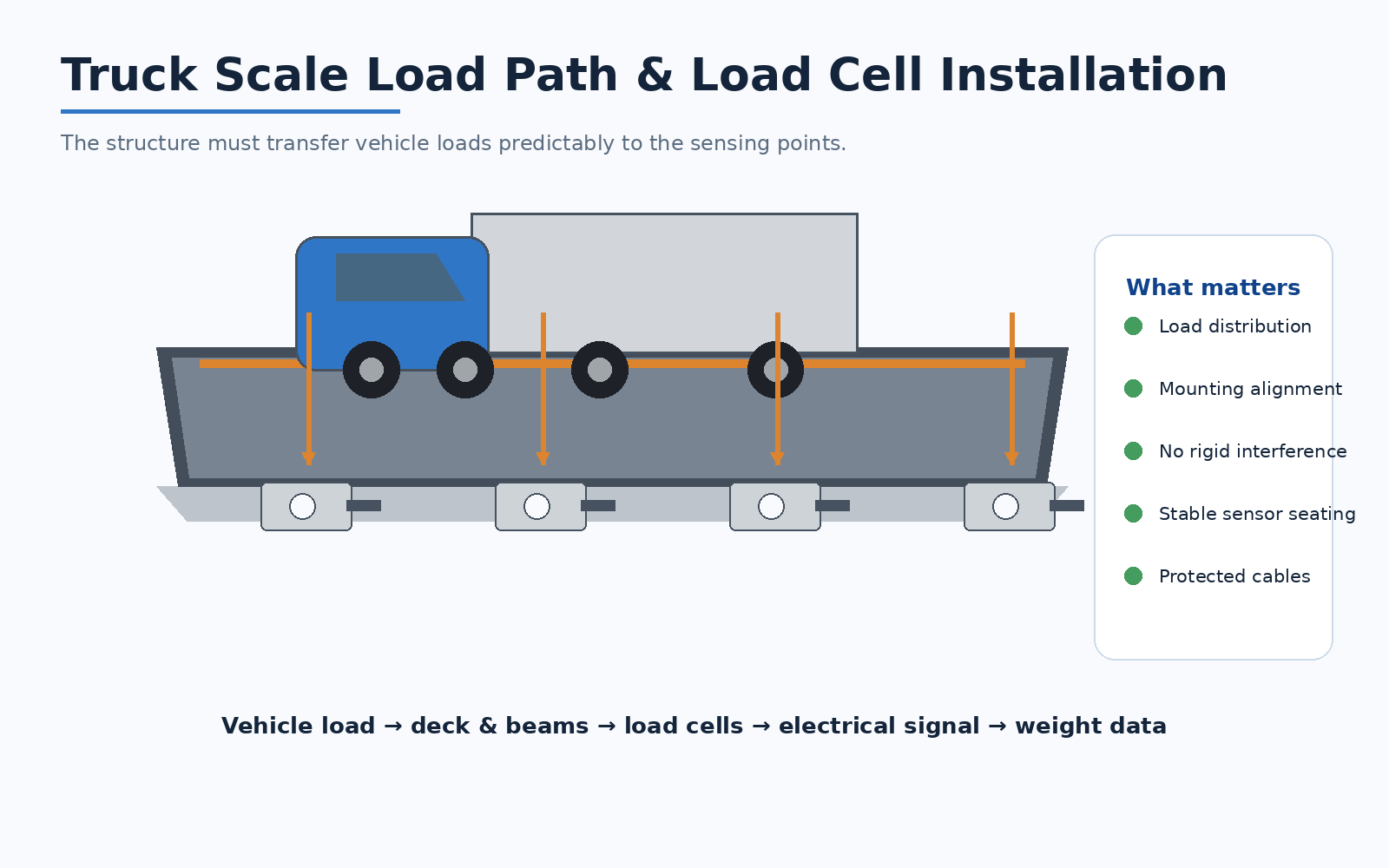
On a truck scale, the weight enters through the tires, passes into the weighing deck and supporting beams, and finally reaches several load cells.
On a hopper system, material weight passes through the vessel and support structure before reaching the load-cell mounting points.
If that force follows a predictable path, weighing becomes easier.
If part of the force escapes through another mechanical connection, the problem becomes much harder.
Engineers often call these unwanted influences parasitic forces or side forces.
They may come from a rigid pipe connected to a hopper, a badly aligned mounting surface, structural contact with the foundation, excessive belt tension, thermal expansion or mechanical interference.
This is one reason why good weighing equipment starts with mechanical engineering rather than with a catalog specification.
2. Steel Thickness Is Only One Part of Truck Scale Design
Steel thickness is easy to compare, so buyers naturally ask about it.
But a heavier deck is not automatically a better deck.
What matters is how the deck distributes concentrated wheel loads, how much it deflects under repeated loading, how the beams are arranged, and whether those forces reach the load cells consistently.
KELISCALES currently offers several weighbridge deck structures, including U-beam, channel-steel and concrete-deck configurations. Its published truck-scale specifications show U-beam deck plate options in the 8–14 mm range, with the final structure selected according to truck type, traffic and site conditions.
That is a more useful engineering question than simply asking, “Which scale has the thickest plate?”
What structure is appropriate for my axle loads and daily traffic?
3. Fabrication Accuracy Matters Because Sensors Notice Small Problems
Large weighing equipment looks forgiving because the structure is heavy.
The measurement system is less forgiving.
If a load-cell mounting surface is twisted or uneven, the sensor may receive force differently from the way it was designed to receive it.
If a truck-scale deck is distorted during fabrication, one weighing point may carry a different share of the load.
That does not always cause an obvious failure. More often, it appears later as corner differences, unstable zero, inconsistent readings or calibration difficulty.
This is why cutting, welding, machining and final dimensional inspection are all part of weighing accuracy, even though none of them directly produces a weight signal.
4. The Sensor Is Installed Into a Mechanical System, Not Into Empty Space
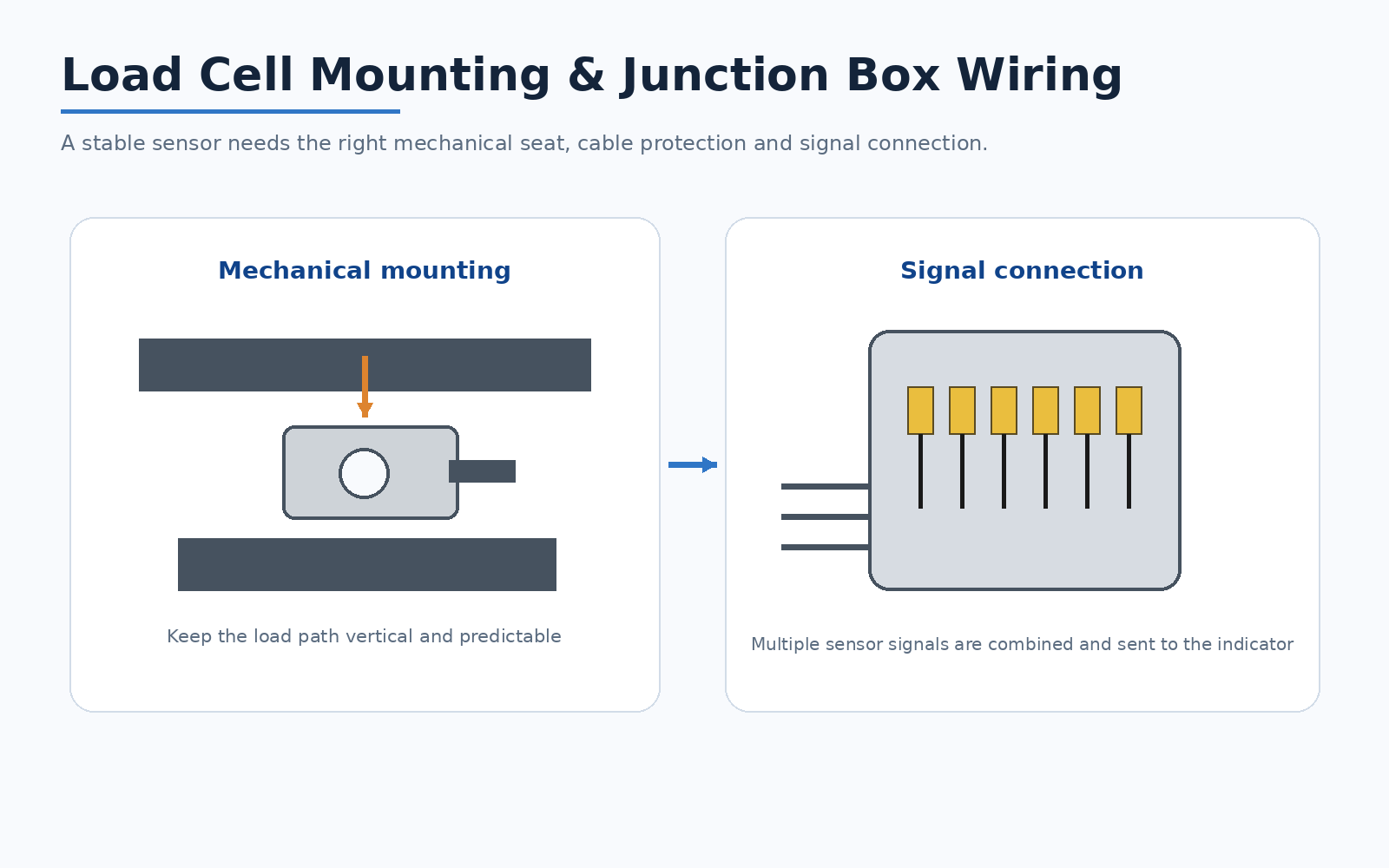
A good load cell can only perform properly when it is installed correctly.
The main load should enter the sensor in the intended direction.
The mounting surfaces should be stable.
Cables should be protected from pulling, crushing and water entry.
The structure should not touch surrounding objects that can bypass part of the load.
These details matter particularly on multi-load-cell systems.
A typical truck scale may use several load cells distributed along both sides of the deck. If one point behaves differently from the others, technicians need to determine whether the cause is the sensor, wiring, junction box, mounting point, foundation or mechanical interference.
KELISCALES’ own troubleshooting guidance makes the same point: unstable or inconsistent truck-scale readings are not automatically caused by a defective load cell; cables, junction boxes, debris, the foundation and the indicator can also be responsible.
That is an important distinction because replacing a sensor does not fix a mechanical problem.
5. What Happens After the Load Cells Are Installed?
Once the sensors are mounted, the system moves from mechanical assembly into measurement integration.
In a typical truck-scale system, the measurement chain includes the weighing deck, load cells, junction box, indicator and weighing software. KELISCALES describes the same basic architecture on its current truck-scale product page.
At this stage, technicians are interested in questions such as:
Do all load cells respond? Is the zero signal stable? Are individual weighing points reasonably balanced? Is communication with the indicator normal? Does the software receive the expected data?
This is no longer steel fabrication.
It is system commissioning.
6. Calibration Does Not Mean Pressing the Zero Key
This is one of the most common misunderstandings in industrial weighing.
Zeroing and calibration are related, but they are not the same operation.
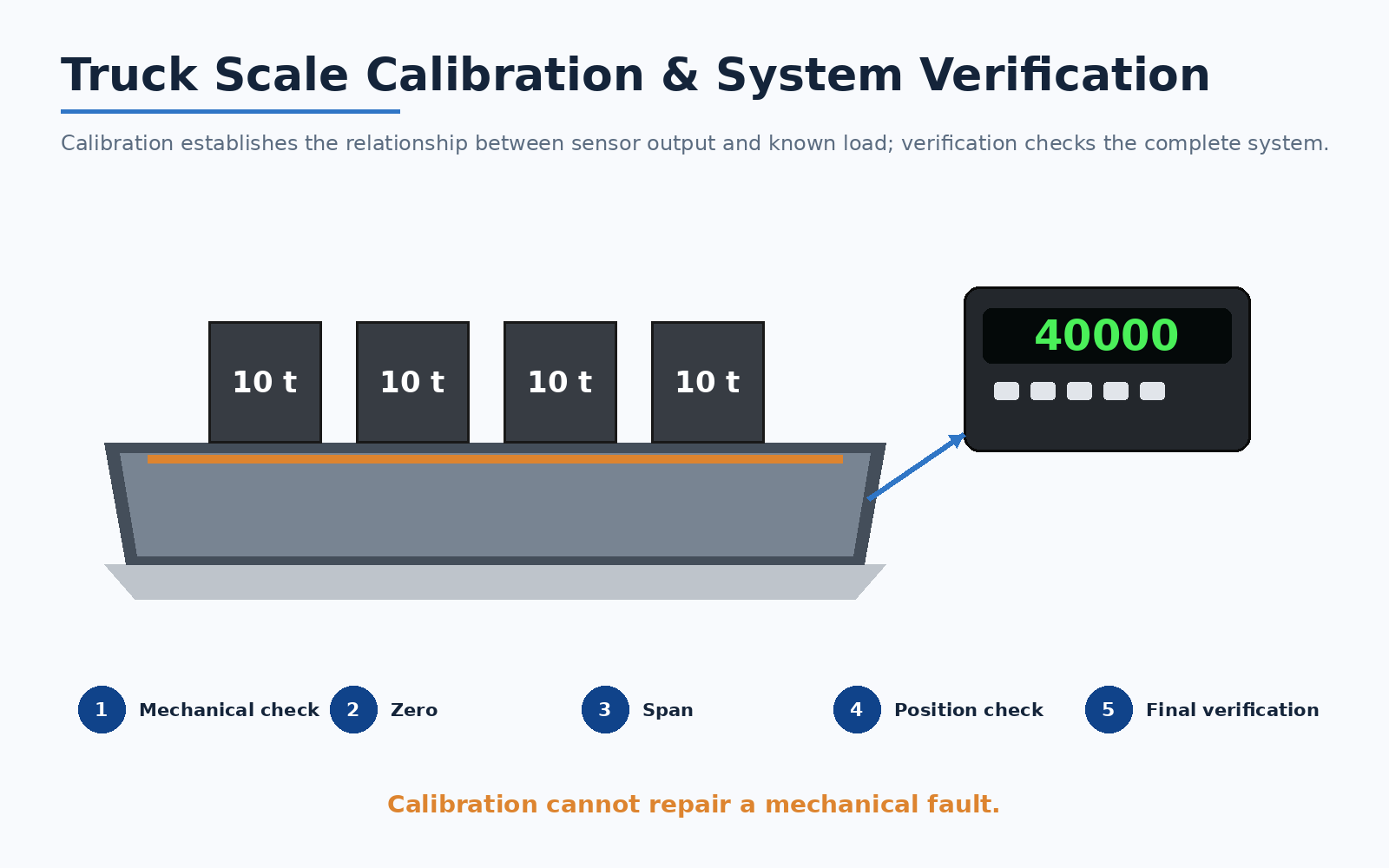
Zero calibration establishes the empty reference condition.
Span calibration establishes the relationship between sensor output and a known applied load.
After that, the system still needs verification.
KELISCALES’ current truck-scale calibration guide describes the sequence as inspection, zero calibration, span calibration and final weight verification. It also notes that calibration should begin only after mechanical conditions, cables, junction boxes and load-cell connections have been checked.
This is a useful field rule:
Calibration cannot repair a mechanical fault.
If the platform is rubbing against the foundation, the load path is wrong or one sensor mounting point is mechanically constrained, changing calibration parameters may hide the symptom temporarily but will not remove the cause.
7. Truck Scale Verification Should Include Position, Not Just Total Weight
A useful weighbridge test does not end when one known load produces one correct reading.
The position of the load also matters.
When a truck moves from one end of the scale to the other, different load cells carry different portions of the total force.
A system can therefore appear correct at one position and show a different error at another.
This is why corner or section checking is useful on multi-point weighing equipment.
The purpose is not simply to prove that the indicator works. It is to confirm that the mechanical structure and load cells behave consistently across the usable weighing area.
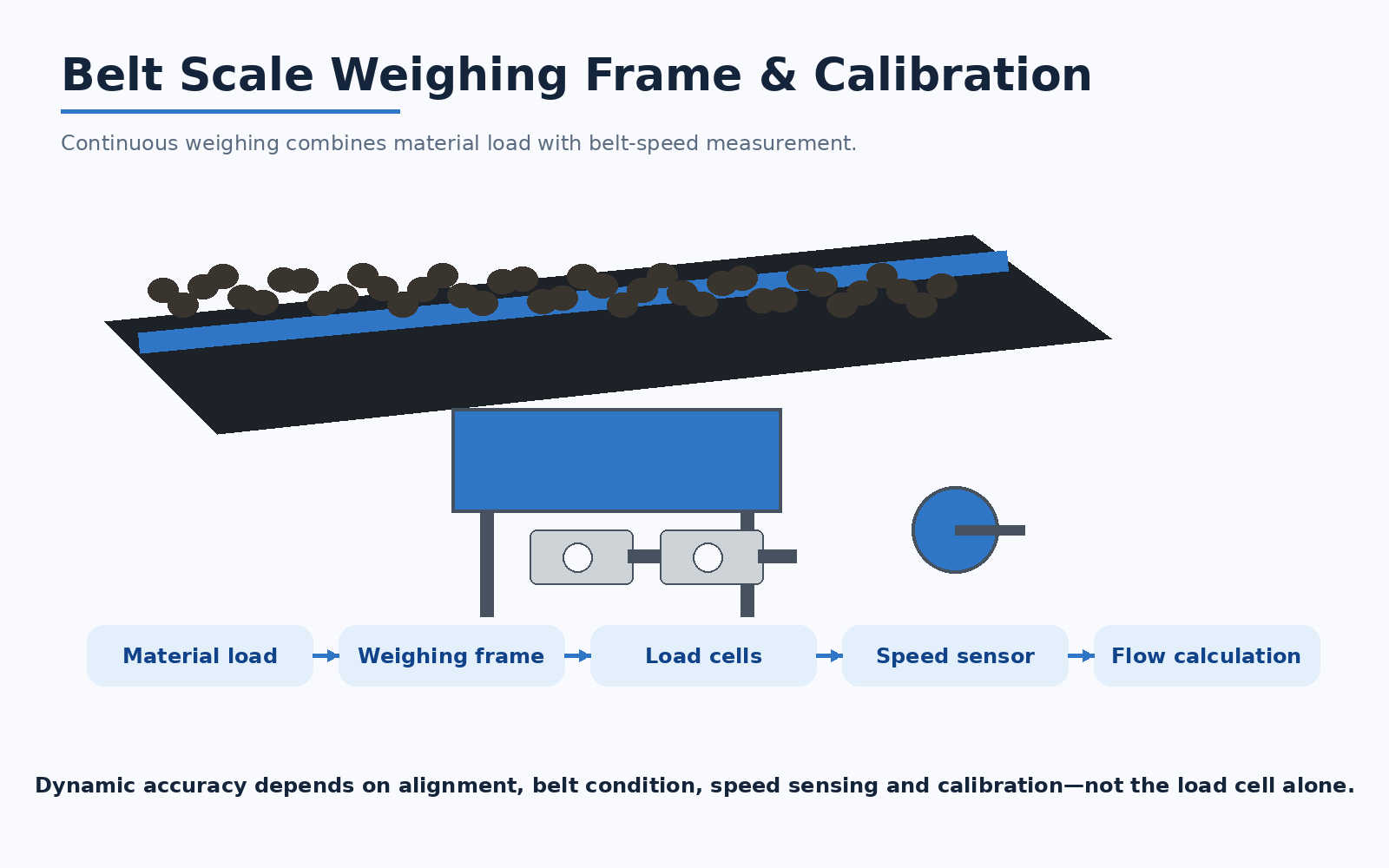
8. Belt Scales Need a Different Kind of Testing
A truck scale is mainly static.
A belt scale measures material while the conveyor is moving.
That changes the problem completely.
A belt scale has to combine two pieces of information:
how much load is on the weighing section, and how fast the belt is moving.
That means an accurate load cell alone is not enough.
The weighing frame, idler alignment, belt tension, speed measurement and signal processing all matter.
KELISCALES’ HJSD belt-scale speed sensor, for example, publishes a linear-speed acquisition error of ≤0.05%. The product is designed to feed speed data to belt-scale flow calculations, cumulative weighing and control systems. That specification belongs to this particular speed-sensor product rather than to every KELISCALES belt scale, but it illustrates why speed measurement deserves its own engineering attention.
A belt scale should therefore be treated as a dynamic measurement system rather than as “a load cell under a conveyor.”
9. Hopper Weighing Has Its Own Hidden Error Sources
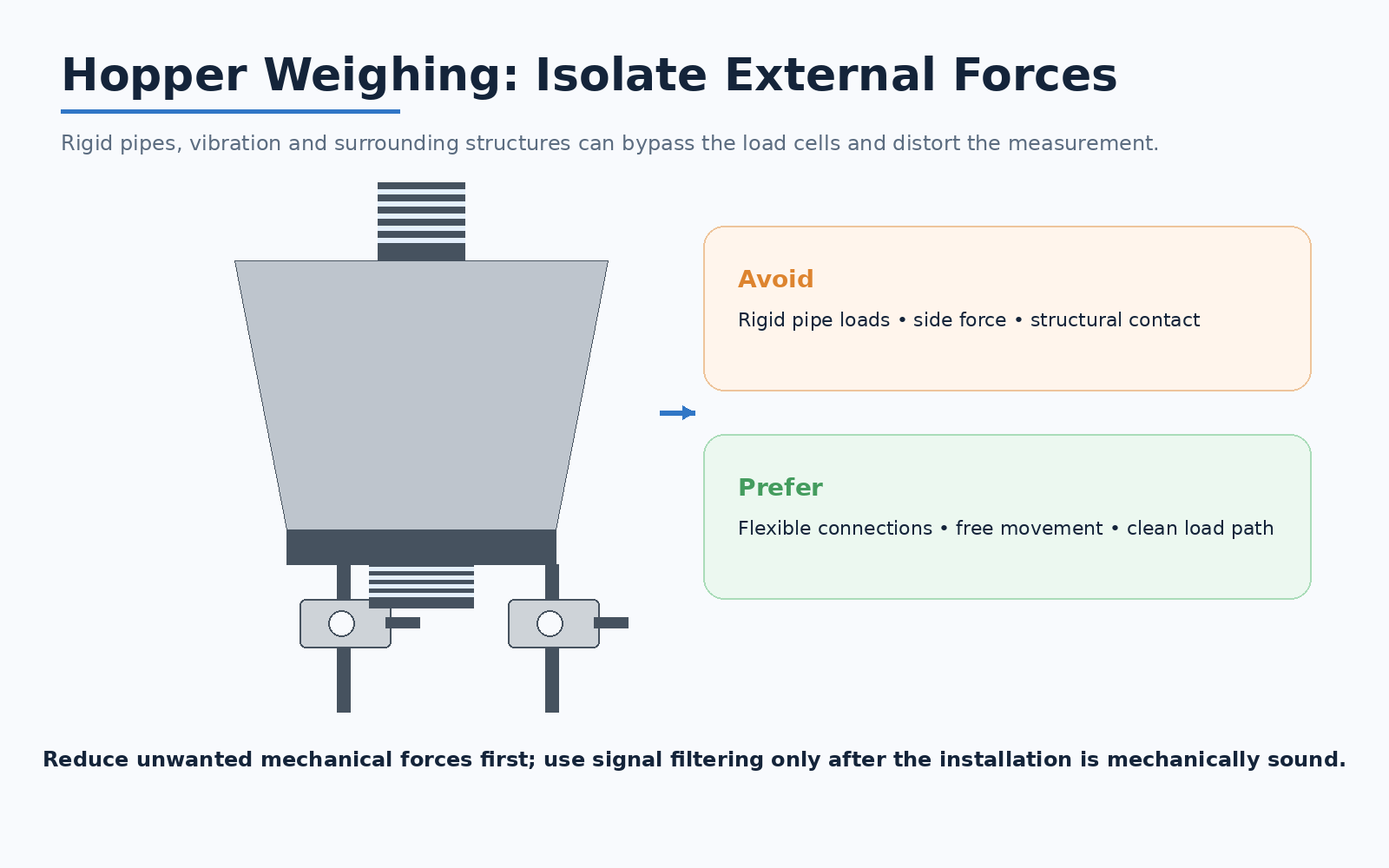
A hopper can look perfectly still while external forces are influencing the sensors.
Pipes are a classic example.
If an inlet or outlet pipe is connected rigidly to the hopper, part of the hopper’s force may be transferred through that pipe instead of through the load cells.
The same problem can appear with cables, dust-collection ducts, feeders and surrounding support structures.
This is why hopper weighing often uses flexible connections around the weighing vessel.
Vibration creates another issue.
A hopper positioned above a feeder or next to rotating machinery may show a stable average weight but noisy instantaneous readings.
Signal filtering can help, but filtering should not be used to hide poor mechanical design.
The better approach is to reduce unwanted mechanical forces first and then optimize signal processing.
10. Factory Testing and Legal Certification Are Not the Same Thing
These two terms are often mixed together.
Factory testing asks:
Does this particular machine work as intended?
Certification asks:
Does this product or measuring instrument comply with a defined standard or regulatory requirement?
A machine can pass factory functional testing while still requiring separate legal-metrology approval in the destination market.
Likewise, an approved load-cell model does not automatically make every complete scale installation legally approved.
The final requirement depends on the equipment, application, accuracy class, whether the scale is used for commercial transactions, and local regulations.
This is worth confirming before an overseas project is manufactured rather than after the equipment reaches the site.
11. What KELISCALES Says Happens Before Delivery
KELISCALES’ official overseas-brand announcement states that complete machines share Keli Group’s production resources and are assembled, aged and precision-calibrated within Keli’s intelligent manufacturing facilities. The same announcement also describes access to technical support for installation, commissioning, calibration and maintenance.
The word “aging” is worth noticing.
For electronic and complete systems, an aging process is generally intended to expose early instability before equipment is shipped rather than after it reaches the customer.
It does not replace calibration or final functional inspection.
It is another stage in the delivery process.
12. What Should a Buyer Ask a Weighing Equipment Manufacturer?
Instead of asking only “How thick is the steel?” or “What is your accuracy?”, a more useful supplier discussion covers the actual operating conditions.
For a truck scale, ask how the structure is selected for axle load and traffic frequency, how load cells are mounted, how different weighing points are checked, and how the system is calibrated after installation.
For a belt scale, ask about conveyor speed, belt width, capacity range, weighing-idler alignment, speed sensing and calibration method.
For hopper weighing, ask what is connected to the hopper, whether piping is rigid or flexible, whether vibration is present, and how material impact is handled.
Those questions tell you much more about the manufacturer’s engineering process than a brochure full of adjectives.
13. Where Keli’s Sensor Background Fits In?
Keli Sensing Technology’s existing product ecosystem includes load cells, weighing indicators, junction boxes, weighing systems and IoT-related integration.
That background matters because complete weighing equipment sits at the intersection of mechanical engineering and measurement engineering.
A fabricator understands how to build the structure.
A sensor company understands what the measuring element needs.
A complete weighing-system manufacturer has to make the two agree.
This is where KELISCALES fits within the broader Keli ecosystem: Keli’s sensing and measurement technologies form part of the technical base, while KELISCALES focuses on complete equipment such as truck scales, belt scales, hopper weighing systems and other industrial weighing solutions.
14. Is KELISCALES a Manufacturer or a Trading Company?
For overseas buyers, this is a reasonable question.
KELISCALES is positioned as Keli Group’s overseas brand and online portal for complete weighing equipment rather than as an unrelated reseller of scale products. Its official launch information states that the complete-equipment business shares Keli Group’s production, technical and after-sales resources.
That distinction matters for customized projects because a buyer may need changes to mechanical dimensions, weighing capacity, control logic, communication interfaces or software integration.
The project is no longer simply a purchase order for a standard machine.
15. The Best Factory Test Still Does Not Replace Site Commissioning
This point is often overlooked.
A large weighing system changes environment when it leaves the factory.
A truck scale sits on a customer-built or project-specific foundation.
A belt scale becomes part of an existing conveyor.
A hopper system connects to actual pipes, valves and feeding equipment.
All of those interfaces can influence measurement.
Factory assembly and testing reduce risk, but final installation checking and calibration remain important after the equipment reaches its operating environment.
This is particularly true for legal-for-trade weighing or applications with tight accuracy requirements.
16. FAQ
Testing depends on the equipment. Typical work includes checking mechanical assembly, load-cell response, electrical connections, indicators, communication, software functions and weighing performance. Calibration and final verification are then performed according to the system and project requirements.
Zero calibration establishes the reference when the scale is unloaded. Span calibration uses a known load to establish the relationship between sensor signal and actual weight.
Because the load cell is only one part of the measurement chain. Poor mounting, side forces, cable issues, structural interference, incorrect calibration or foundation problems can affect the final result.
No. Truck scales mainly perform static weighing, while belt scales combine material load with belt-speed measurement. Conveyor alignment and dynamic operating conditions therefore become part of belt-scale performance.
Not necessarily. Component approval and complete-system approval are different issues. The requirements depend on the final equipment, application and local legal-metrology rules.
17. Conclusion
The manufacturing quality of a weighing system is difficult to judge from a product photograph.
The more useful questions are less visible:
How does the force reach the load cells?
Can the structure introduce unwanted forces?
How are individual weighing points checked?
How is the system calibrated?
What changes when the machine is installed at the customer’s site?
These are the questions that connect manufacturing with measurement.
For KELISCALES, that connection is also where the wider Keli background becomes relevant: the business does not start only from the visible steel structure, but from an existing ecosystem of load cells, weighing electronics, measurement systems and industrial integration.
A reliable weighing system is therefore not simply manufactured.
It has to be engineered as a measurement system from the beginning.

Need customized model matching your production line, technical drawings and accurate quotation?
Submit your inquiry now, our engineering sales team will send full solution within 24 working hours.