
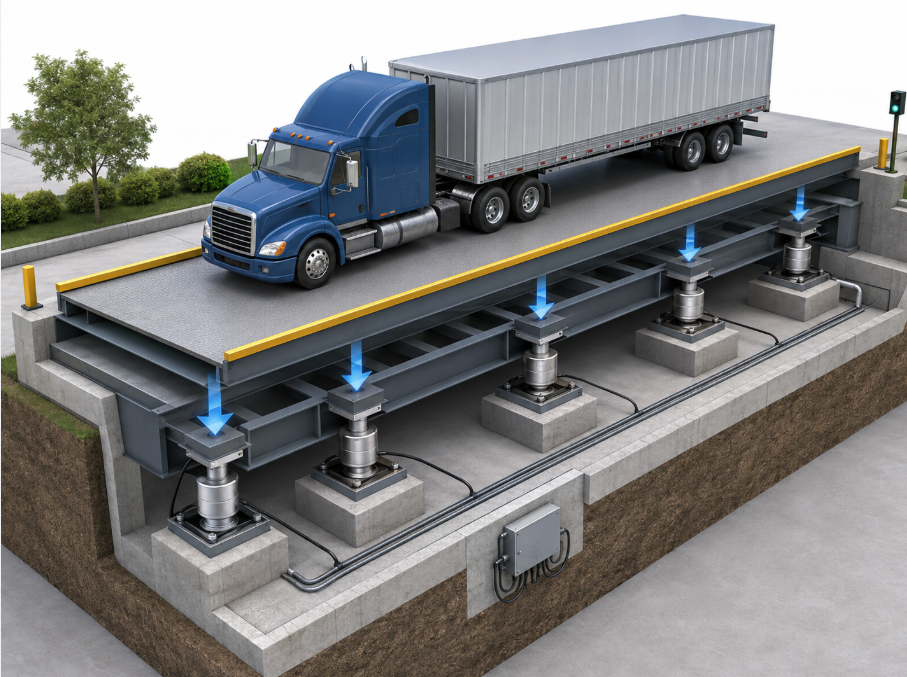
When a fully loaded truck drives onto a truck scale, the most noticeable component is usually the large steel weighing platform. However, the core components that actually perform the weight measurement are installed beneath the deck. These components are the truck scale load cells. Load cells receive the vehicle weight transferred through the weighing platform, convert the mechanical force into electrical signals, and then send those signals to the weighing indicator for further processing until the final vehicle weight is displayed.
For applications such as mines, logistics centers, grain storage facilities, factories, ports, and recycling yards, load cell performance directly affects the accuracy, stability, and long-term reliability of the truck scale. This is also where Keli’s accumulated expertise in load cell technology connects with the KELISCALES Truck Scale system.
What Is a Truck Scale Load Cell?
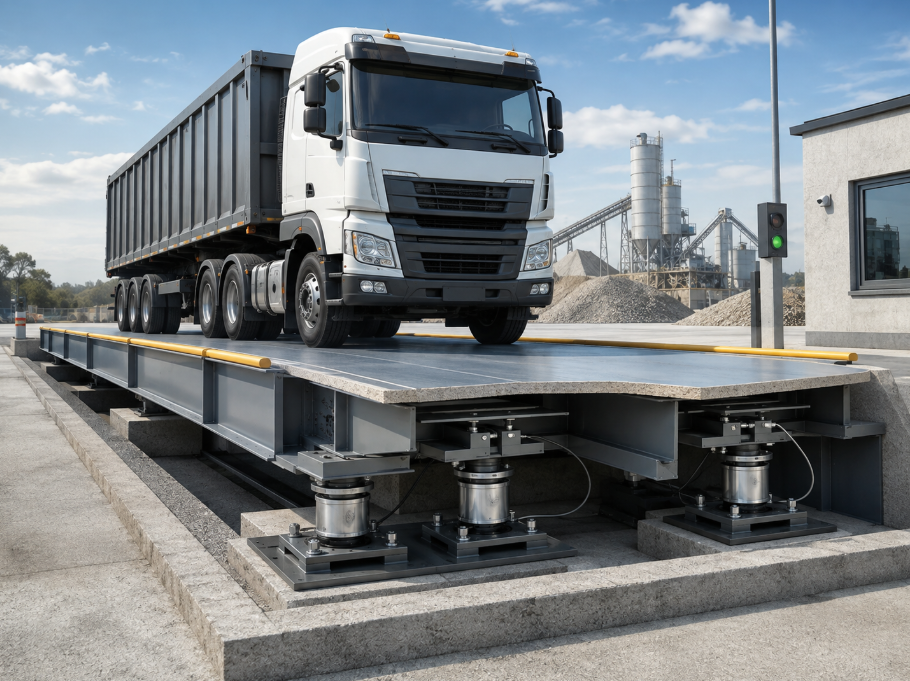
A Truck Scale Load Cell is a core sensor installed beneath the truck scale platform to measure applied loads. When a truck drives onto the scale, the vehicle weight is first transferred through the tires to the weighing platform, and then distributed by the platform structure to multiple load cells located at different support points.
The complete weighing process can be simply understood as: Truck → Weighbridge Platform → Load Cells → Weighing Indicator → Weight Data. A load cell itself does not directly display “how many tons the truck weighs.”
Its function is to convert mechanical force into a measurable electrical signal. The weighing indicator then receives signals from multiple load cells, calculates and processes them, and finally displays the total vehicle weight.
Therefore, a truck weighbridge load cell can be regarded as one of the most important components in the entire weighbridge system.
How Do Load Cells Measure Truck Weight?
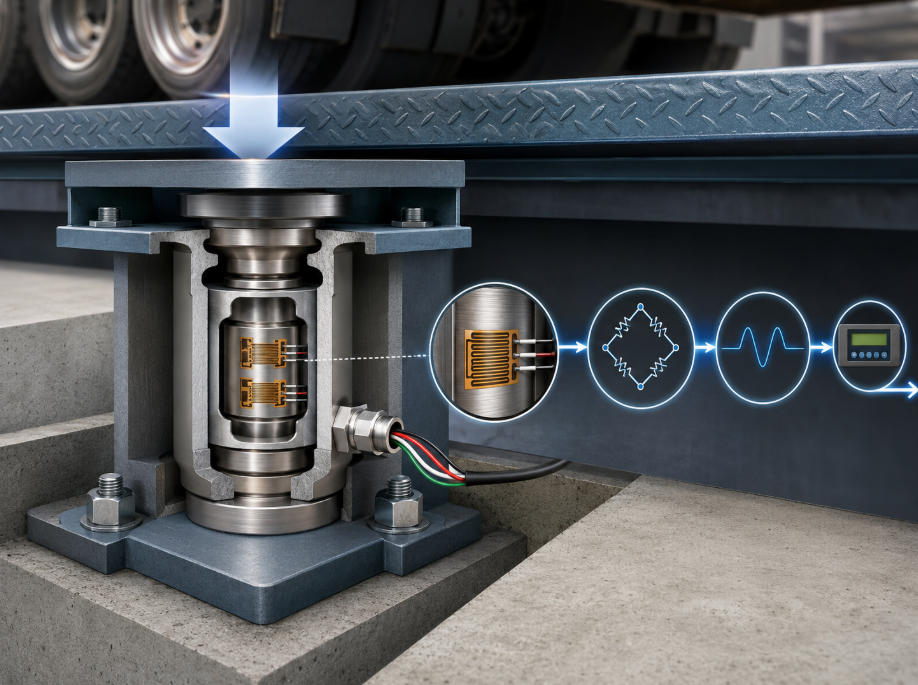
Most industrial load cells operate based on strain gauge technology. When weight is applied to a load cell, the elastic element inside the sensor undergoes an extremely small and controlled deformation. Strain gauges mounted on the elastic element detect this deformation and generate an electrical signal corresponding to the applied load. In a truck scale, one load cell usually supports only part of the total vehicle weight. Multiple load cells work together, while the weighing indicator collects and combines all sensor outputs before converting them into the final vehicle weight.
Therefore, truck scale performance depends not only on whether the steel weighing platform is strong enough, but also on whether multiple load cells can maintain stable and consistent output under different vehicle positions and load conditions.
How Many Load Cells Does a Truck Scale Need?
Not all truck scales use the same number of load cells. Large truck scales commonly use 6 or 8 load cells, although the exact number depends on the actual system design.
The main factors affecting truck scale configuration include platform length, number of platform sections, maximum weighing capacity, steel structure design, vehicle type, and foundation structure. Taking a truck scale equipped with six load cells as an example, three main support points may typically be arranged on each side of the platform. However, more load cells do not necessarily mean better performance. More importantly, the load cell capacity, installation position, and load transfer method must be properly selected according to the weighbridge structure so that all weighing points can work together effectively.
What Makes a Good Truck Scale Load Cell?
Accuracy
A high-quality load cell should provide stable and predictable output as the applied load increases. If the sensor itself introduces significant measurement error, that error already exists before the signal even reaches the weighing indicator. Therefore, load cell accuracy is one of the fundamental factors affecting truck scale accuracy.
Repeatability
When the same truck is weighed several times under the same conditions, the results should remain highly consistent. Repeatability is especially important for logistics centers, mines, and industrial facilities that may weigh dozens or even hundreds of vehicles every day. If repeated weighing results for the same vehicle fluctuate significantly, this may directly affect settlement, inventory management, and transportation records.
Creep
When a constant load remains applied to a load cell, the output may change slightly over time. This phenomenon is known as creep. A well-designed load cell should keep this variation within a limited range so that the weight reading remains stable while the truck is stationary on the platform.
Temperature Compensation
Truck scales are usually installed outdoors. High summer temperatures, low winter temperatures, and day-to-night temperature changes can all influence load cell output characteristics. Therefore, load cells used for truck scales should have effective temperature compensation to minimize the influence of environmental temperature changes on weighing results.
Overload Protection
The forces generated when a truck enters a weighbridge are not limited to static vertical loads. Vehicle acceleration, braking, uneven loading, and tires moving quickly onto the platform can all introduce additional mechanical impact to the weighing system. Therefore, truck scale load cells and their mounting structures should provide appropriate overload capacity to withstand complex industrial operating conditions.
Environmental Protection
Water, dust, mud, moisture, and temperature variations are all common around truck scale installations. Load cells used in outdoor weighbridges therefore require reliable sealing, while cables, junction boxes, and connection components should also be properly protected against environmental exposure. These details can directly affect long-term system stability and maintenance costs.
What Is the Difference Between Digital and Analog Truck Scale Load Cells?
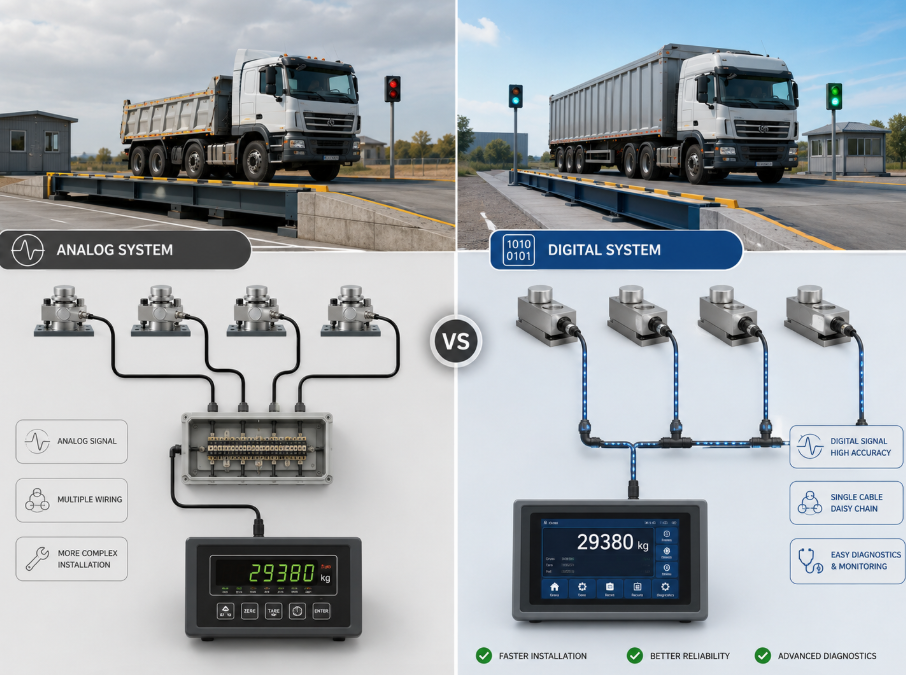
Truck scales can use either analog or digital load cells. In a traditional analog truck scale system, analog signals from multiple load cells are typically connected to a junction box before the processed signal is transmitted to the weighing indicator. A digital truck scale load cell, by comparison, generally integrates more signal-processing functions internally and can transmit and manage weighing data digitally.
Depending on the specific system design, digital weighing systems can offer several advantages. They can make it easier to diagnose the operating condition of individual load cells, improve resistance to electrical interference, help identify abnormal weighing points more quickly, simplify system maintenance and troubleshooting, and provide better compatibility with digital weighing management systems. However, there is no absolute “best” choice between analog and digital weighing systems. The final selection should consider project budget, required weighing accuracy, operating environment, automation level, and long-term maintenance requirements.
Keli Load Cell Technology
Keli Sensing Technology has long focused on the research, development, and manufacturing of load cells and related measurement technologies.
Its product portfolio covers a wide range of industrial weighing applications, including beam load cells, canister load cells, single-point load cells, digital load cells, weighing indicators, and other weighing components. For truck scale users, this accumulated experience in sensor technology is particularly important. A truck scale is fundamentally a large industrial measurement system, rather than simply a steel platform. Load cell design, manufacturing consistency, temperature performance, repeatability, and environmental adaptability can all affect the final vehicle weighing result.
How Are Keli Load Cells Integrated Into KELISCALES Truck Scales?
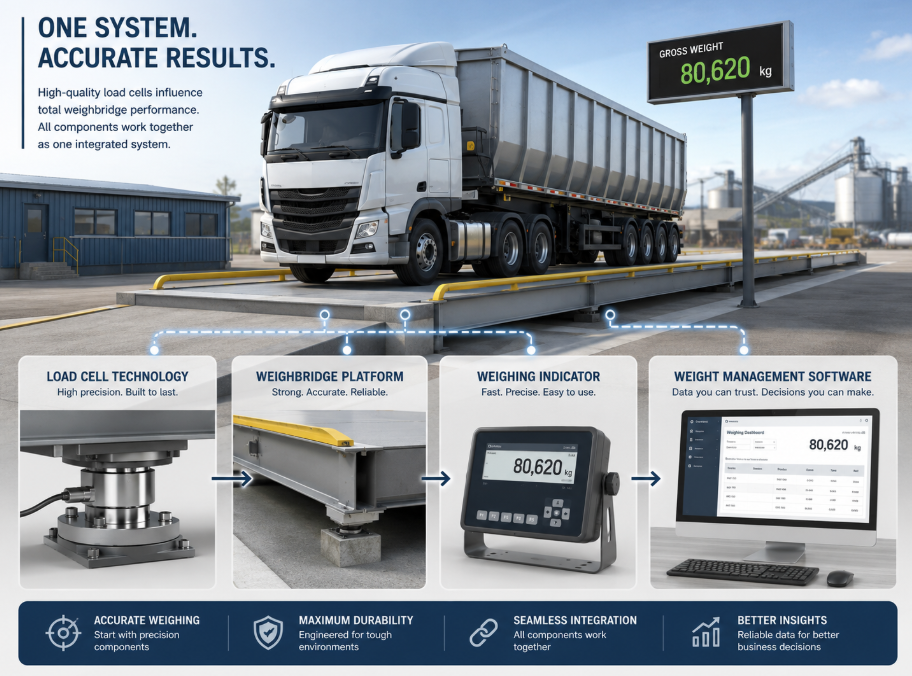
KELISCALES applies Keli’s expertise in load cell technology to complete industrial weighing equipment. From the perspective of the entire truck scale system, the technology chain can be understood as: Keli Sensor Technology → Truck Scale Load Cells → Weighbridge Platform → Weighing Indicator → Weighing Management Software. This creates a direct connection from the core sensor technology to the complete vehicle weighing system.
For users, what really matters is not simply the specification of one individual component, but whether the weighing platform, load cells, weighing indicator, and software can operate together reliably as one integrated system. You can learn more about our [Truck Scale / Weighbridge] solutions, which are suitable for factories, mines, logistics centers, ports, grain facilities, and other heavy-duty vehicle weighing applications.
How Does Load Cell Quality Affect Overall Truck Scale Performance?
A strong steel weighing platform alone cannot guarantee good truck scale accuracy.
Load cell performance can directly affect: weighing accuracy → repeatability → zero stability → maintenance frequency → long-term weighing reliability. At the same time, load cells are not the only factor that determines truck scale accuracy.
Overall weighbridge performance is also influenced by foundation construction quality, weighing platform structure, load cell installation, junction boxes, cables, weighing indicators, calibration quality, routine maintenance, and whether debris or foreign objects are obstructing movement around the platform. Therefore, when selecting a truck scale, users should not compare only maximum weighing capacity or steel plate thickness. The weighbridge should instead be evaluated as a complete weighing system.
KELISCALES Truck Scale Configurations
KELISCALES provides truck scale and weighbridge solutions for different industrial vehicle weighing applications.
The specific system configuration can be selected according to maximum vehicle weight, truck dimensions, weighbridge length, daily weighing frequency, site conditions, foundation requirements, automation needs, and data management requirements. Depending on the project, the system can be configured with different platform structures, digital load cells, weighing indicators, and weighing management software to achieve integrated vehicle weighing and weight data management.
If you are building a new truck scale project or planning to replace an existing weighbridge, you can provide KELISCALES with your maximum vehicle weight, vehicle dimensions, daily weighing frequency, and installation site conditions. We can then recommend a more suitable truck scale configuration based on your actual operating requirements.

Need customized model matching your production line, technical drawings and accurate quotation?
Submit your inquiry now, our engineering sales team will send full solution within 24 working hours.