
A buyer asks a truck-scale supplier:
“Do you have OIML?”
The supplier says yes and sends an OIML certificate for a load cell.
The document may be genuine, but it still does not answer the buyer’s most important question:
Can the complete weighing system be used for my application in my country?
This is where certification discussions often become confusing.
A certificate may apply to a load cell rather than the complete scale. A CE mark does not automatically mean a scale is approved for legal-for-trade weighing in Europe. An ATEX-certified component does not automatically make an entire weighing system suitable for every hazardous area.
For buyers, the better starting point is not the certificate logo.
It is the application.
1. A Certificate Belongs to a Specific Product or Model
Certification does not simply belong to a brand.
It normally applies to a defined product, model, type or configuration.
If a supplier says:
Suppose a supplier says:
“Our scales have OIML.”
A buyer should immediately ask:
the next question should be:
Which product and which model?
The certificate may cover a load cell, weighing indicator or complete measuring instrument.
These are different levels of compliance.
A practical check is simple: compare the certificate number, model, certificate scope and quoted equipment.
2. The Intended Use Changes the Compliance Requirement
Consider two similar 100-ton truck scales.
One is used inside a factory only for production monitoring.
The other determines how much a customer pays for material.
Mechanically, they may be almost identical.
From a legal-metrology perspective, they may not be.
This is the practical difference between process weighing and legal-for-trade weighing.
For overseas projects, buyers should define the intended use before the manufacturer finalizes the sensors, indicator and system configuration.
Adding compliance requirements after manufacturing can become expensive.
3. Where OIML Fits Into Industrial Weighing
OIML is the International Organization of Legal Metrology.
There is no single OIML recommendation that covers every type of industrial scale.
Different measuring functions belong to different categories.
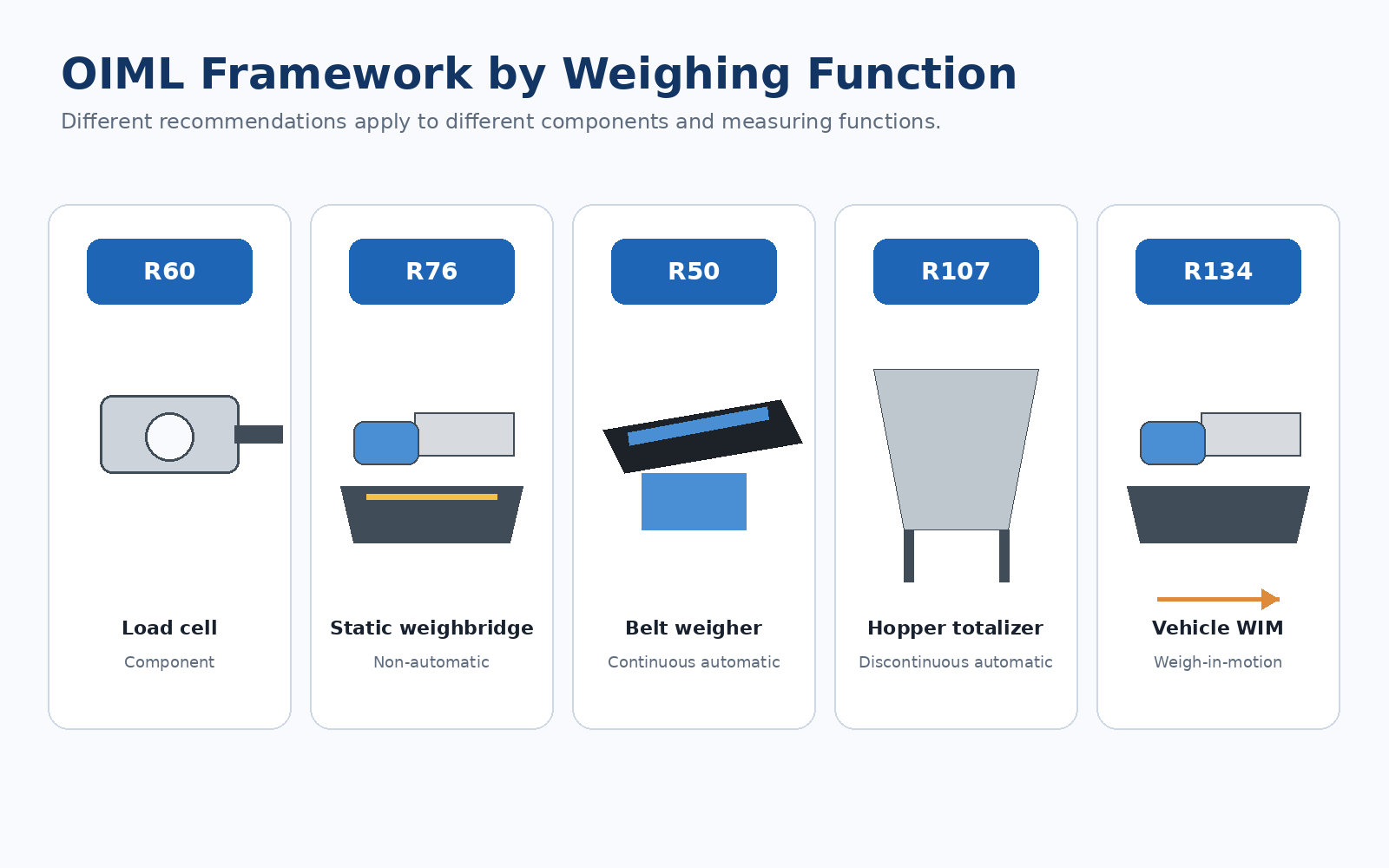
| Equipment / Component | Relevant OIML Recommendation |
| Load cell | R60 |
| Static non-automatic scale / weighbridge | R76 |
| Belt weigher | R50 |
| Totalizing hopper weigher | R107 |
| Vehicle weighing in motion | R134 |
This distinction is useful when reviewing supplier documents.
If you are buying a belt scale and receive only an R60 certificate, that document may confirm the load-cell certification.
It does not automatically describe the compliance of the complete belt-weighing system.
4. OIML R60: Important, but Still About the Load Cell
Keli is widely associated with load cells, which makes R60 particularly relevant when discussing the Keli and KELISCALES technology relationship.
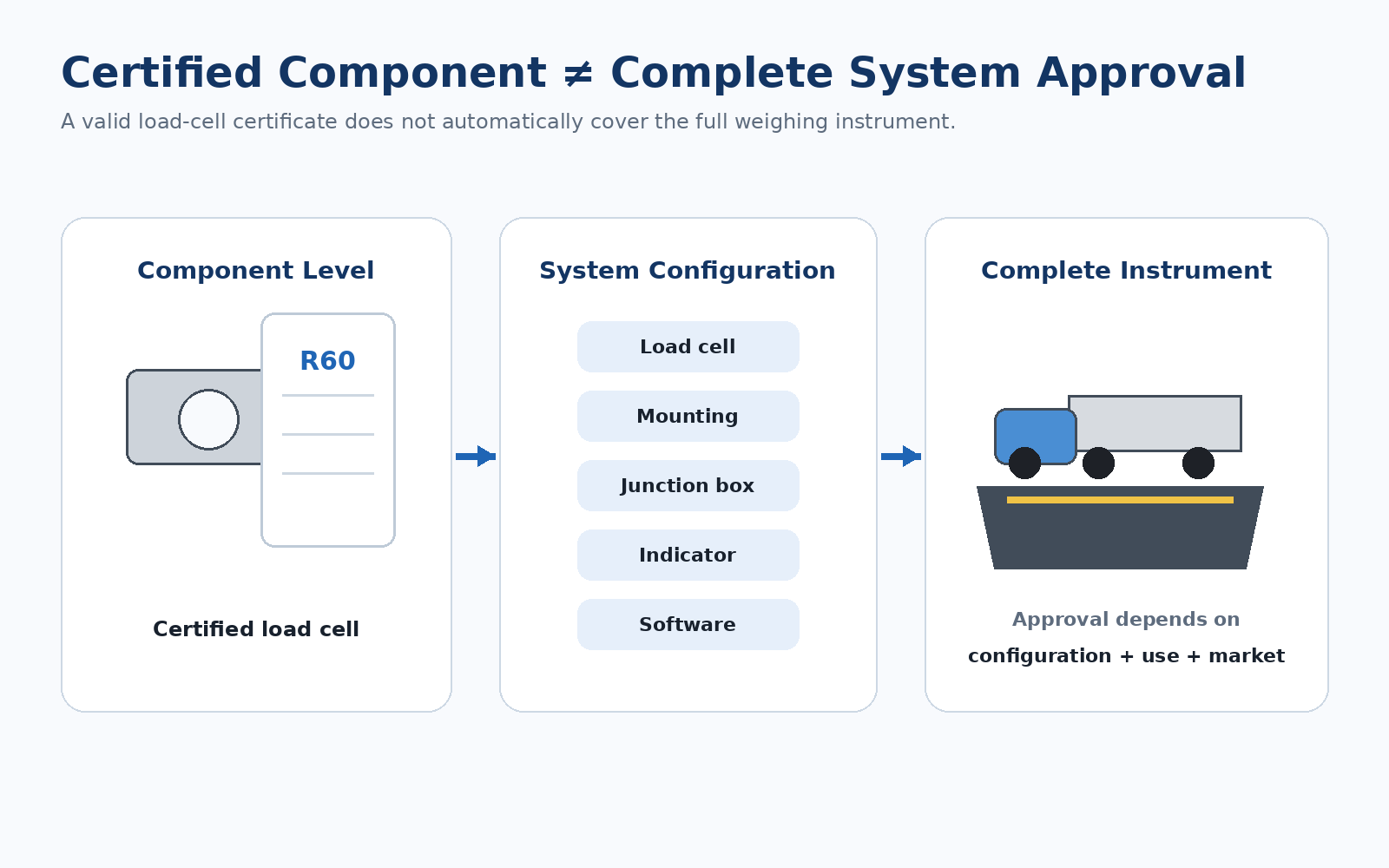
An R60-certified load cell can be an important component in a truck scale, hopper system or other weighing machine.
But a complete truck scale also includes:
The complete measurement depends on the whole system working together.
So the important procurement rule is:
An OIML-certified load cell does not automatically make every complete scale using it an approved legal-for-trade instrument.
5. OIML and NTEP Are Not Competing Quality Grades
For commercial weighing in the United States, NTEP is often an important part of the compliance discussion.
NTEP stands for the National Type Evaluation Program and evaluates commercial weighing and measuring device types against applicable U.S. requirements.
A buyer should not simply ask:
“Do you have NTEP?”
A better question is:
Does the exact model and configuration in my quotation match the applicable NTEP documentation?
OIML and NTEP serve different regulatory environments.
The useful question is therefore not:
“Which one is better?”
but:
Which one applies to my destination market and application?
6. CE Is Not a Weighing Accuracy Certificate
CE is another term that is frequently misunderstood.
A CE mark indicates conformity with applicable European Union legislation.
It should not automatically be interpreted as proof that a weighing instrument is approved for legal-for-trade use.
For regulated weighing applications in Europe, additional legal-metrology conformity requirements may apply.
Depending on the instrument, buyers may encounter the EU framework for non-automatic weighing instruments or automatic weighing instruments, together with relevant metrology markings and documentation.
For a European project, a useful question is therefore:
Which EU legislation applies to this exact weighing function, and what documentation covers the proposed model?
That is more meaningful than asking only for a CE certificate.
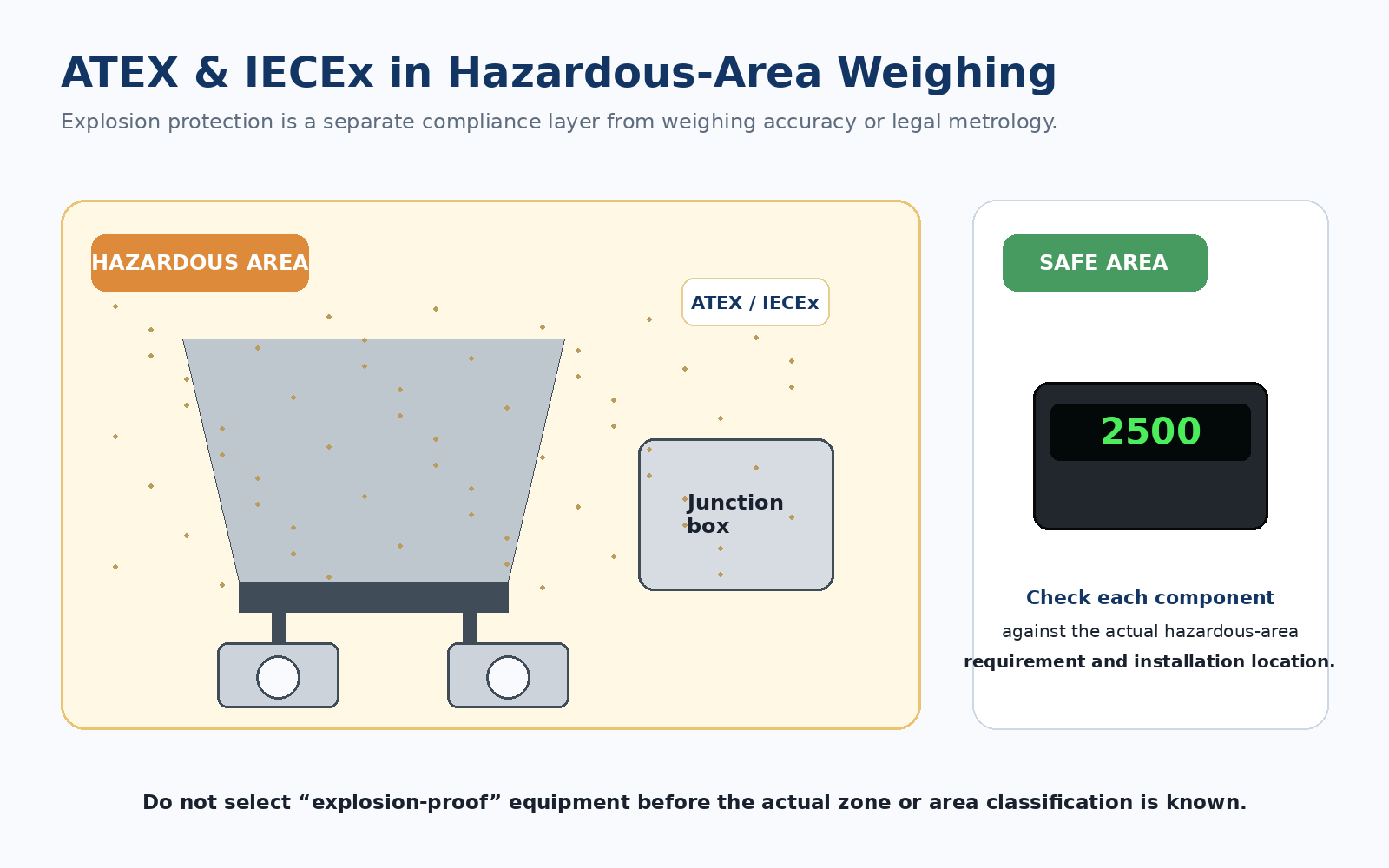
7. ATEX and IECEx Deal With Explosion Risk
OIML and NTEP are mainly connected with measurement and legal metrology.
ATEX and IECEx address a different issue:
explosive atmospheres.
This can matter in chemical plants, mines, grain handling, feed production and other processes involving flammable gas or combustible dust.
A hopper weighing system may have very accurate load cells and still require separate hazardous-area consideration.
The hazardous-area requirement can affect:
This is why the phrase:
“We need an explosion-proof scale.”
is usually not enough for engineering selection.
The project should provide the actual hazardous-area classification or specification.
8. ATEX vs IECEx
The simplest practical distinction is:
ATEX is part of the European regulatory framework.
IECEx is an international conformity-assessment system for explosive-atmosphere applications.
They use similar technical concepts, but they are not the same approval system.
A project may require ATEX, IECEx, both, or another national approval.
The destination country and project specification should determine the answer.
9. Three Compliance Layers Can Exist in One Project
A useful way to understand industrial weighing compliance is to separate three questions.
Measurement compliance:
Is the weighing instrument suitable for the required metrological use?
This is where OIML, NTEP and local legal-metrology requirements may apply.
Product conformity:
Does the equipment meet applicable market legislation?
European CE requirements may enter here.
Hazardous-area compliance:
Is the equipment suitable for the explosive environment?
ATEX or IECEx may become relevant here.
A single project can involve more than one layer.
This is why “certified weighing system” is often too vague a description.
10. What Documents Should a Buyer Request?
Instead of asking a supplier to send every certificate the company owns, request documents for the actual equipment in the quotation.
A practical request would be:
Please provide the compliance documents for the exact load cell, indicator and weighing-system configuration quoted for this project, including certificate numbers and model coverage.
Then compare the documents with the technical quotation or BOM.
If the certificate model does not match the quoted model, ask why.
This simple check can prevent many problems later.
11. Where Keli’s Certification Experience Helps KELISCALES?
Keli’s established business includes load cells, weighing indicators and other measurement components.
These products sit near the beginning of the complete weighing-system chain.
KELISCALES focuses further downstream on complete equipment such as truck scales, belt scales and hopper weighing systems.
The relationship can therefore be understood as:
qualified or certified component → system configuration → complete weighing equipment → destination-market compliance
Keli’s certification background is valuable at the component and measurement-technology level.
But the complete KELISCALES system should still be evaluated according to its actual configuration, application and destination market.
This is more credible than assuming every complete machine automatically inherits every certificate associated with Keli.
12. Factory Calibration Is Not Regulatory Approval
A weighing system can be mechanically sound and accurately calibrated before delivery.
That still does not automatically mean it is authorized for every legal-for-trade application.
Factory calibration asks:
Does the measurement system work correctly?
Legal-metrology conformity asks:
Does the instrument meet the requirements for this regulated use?
Local verification may then confirm the installed instrument according to local rules.
These are different stages and should not be confused.
13. Before Approving the Order
Before approving the purchase order, compare the final quotation with the compliance documents.
Check the load-cell model, indicator model, complete configuration, intended use and destination market.
For hazardous-area projects, also check the Ex documentation against the site’s actual requirement.
Do this before manufacturing and shipping.
Discovering a certificate mismatch after a large truck scale has already reached the site can be expensive.
14. FAQ
No. Load-cell certification relates to the component. The complete weighing instrument has separate configuration and compliance requirements.
R60 applies to load cells. R76 applies to non-automatic weighing instruments.
No. NTEP is mainly associated with U.S. commercial weighing type evaluation, while OIML provides an international legal-metrology framework.
Not necessarily. Additional legal-metrology conformity requirements may apply depending on the weighing function.
No. ATEX relates to equipment intended for potentially explosive atmospheres.
No. IECEx is an international conformity-assessment system, while ATEX is part of the EU regulatory framework.
15. Conclusion
For an overseas buyer, the question:
“Do you have certificates?”
is usually too broad.
A better question is:
“Please show me the compliance documentation that applies to the exact equipment configuration, application and destination market in this quotation.”
That immediately makes the discussion more useful.
For KELISCALES, Keli’s existing experience in load cells, weighing electronics and certified measurement components provides a useful technical foundation.
KELISCALES then has another responsibility:
matching the complete weighing system to the customer’s actual application and destination-market requirements.
Because in industrial weighing:
Having a certificate and having the right certificate for the equipment you actually bought are two different things.

Need customized model matching your production line, technical drawings and accurate quotation?
Submit your inquiry now, our engineering sales team will send full solution within 24 working hours.