
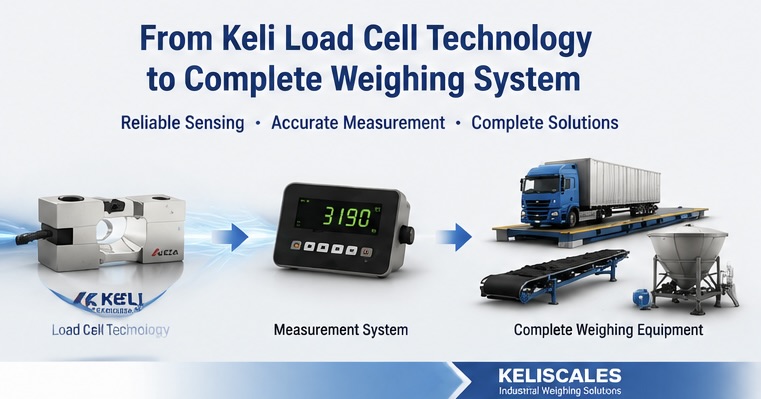
When people choose industrial weighing equipment, they often pay attention to the visible parts first — the weighing platform, capacity, structure design and installation requirements.
However, the accuracy of a weighing system depends on the sensing technology inside the equipment.
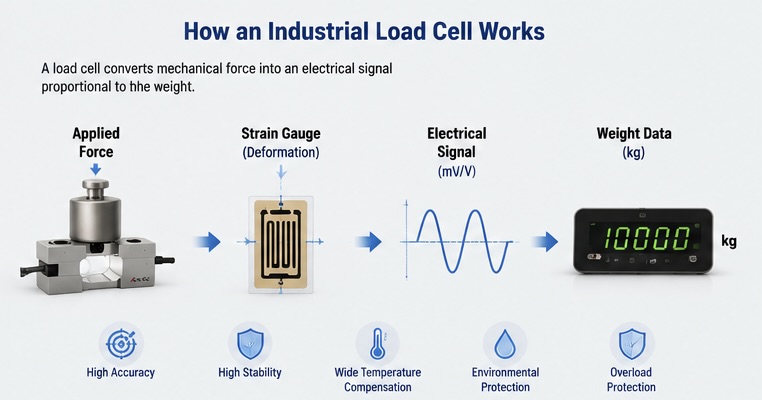
The load cell is the component that directly measures the applied force. It converts mechanical pressure into electrical signals, which are then processed into weight data.
For this reason, load cell technology plays an important role in the performance of truck scales, belt scales, hopper weighing systems and other industrial weighing equipment.
Keli Sensing Technology has developed long-term experience in weighing sensors and measurement technology. Based on this technical background, KELISCALES provides complete industrial weighing equipment and integrated weighing solutions for global customers.
The connection between the two is straightforward:
Keli focuses on sensing technology.
KELISCALES applies this technology to complete weighing systems.
1. Why Load Cells Are Important in Industrial Weighing Systems?
A complete weighing system usually contains several parts:
- Mechanical structure
- Load cells
- Junction boxes
- Weighing indicators
- Control systems
- Software platforms
Among these components, the load cell performs the actual measurement.
When a load is placed on the weighing structure, the force is transferred to the load cells installed underneath or around the structure.
The load cell detects this force and generates an electrical signal according to the applied load.
The system then calculates the weight based on this signal.
The basic process is:
Load → Load Cell → Signal Processing → Weight Data
The quality of the load cell affects several important factors:
- Accuracy
- Repeatability
- Long-term stability
- Environmental resistance
- Overload protection
This is especially important for industrial applications where equipment may operate outdoors, under heavy loads, or continuously for many years.
2. Keli Load Cell Technology: The Sensor Foundation Behind Weighing Equipment
Keli has been widely recognized in the weighing industry for its load cell technology.
Different weighing applications require different sensor designs.
For example:
Truck scales require load cells with strong mechanical performance and long-term stability.
Platform scales often require compact designs with high accuracy.
Industrial equipment may require sensors that can operate under vibration, dust, moisture or temperature changes.
Over years of development, Keli has accumulated experience in different load cell applications, including:
- Compression load cells
- Shear beam load cells
- Single point load cells
- S-type load cells
- Digital load cells
Each design serves different weighing requirements.
The purpose is not simply to measure weight, but to provide reliable measurement under real working conditions.
3. How Keli Load Cells Support Complete Weighing Systems
A load cell is only one part of a weighing system.
To achieve reliable weighing results, the sensor must work together with mechanical structures, electronics, software and application requirements.
This is why complete weighing equipment requires more than selecting a suitable sensor.
The manufacturer needs to understand:
- how the load is transferred through the structure
- how the sensor performs under different environments
- how signals are processed
- how weighing data is collected and managed
KELISCALES applies this system-level understanding to complete weighing equipment.
Instead of looking at a scale as a single machine, the design considers the entire measurement process, from force detection to final data application.
4. From Keli Load Cells to Truck Scale Systems
Truck scales are one of the most common examples of large industrial weighing equipment.
A truck scale may appear simple from the outside, but the measurement process involves several technical layers.
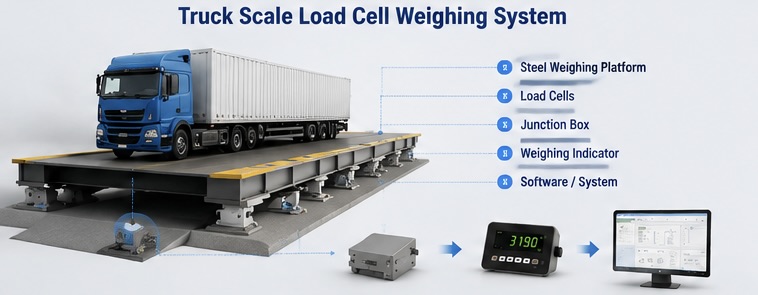
A typical truck scale includes:
- Steel weighing platform
- Load cells
- Junction boxes
- Weighing indicators
- Weighing software
- Optional automation systems
When a loaded vehicle enters the weighing platform, the vehicle weight is transferred through the steel structure to the load cells.
The sensors measure the applied force and send signals to the weighing system.
After processing, the system provides the final weight result.
In modern industrial applications, truck scales are often connected with additional functions:
- Vehicle identification
- Camera monitoring
- Automatic ticket printing
- Traffic control
- Remote data management
The truck scale becomes part of the customer’s logistics and production management system.
This is where the difference between a component and a complete solution becomes clear.
A load cell provides the measurement foundation.
A complete truck scale integrates that technology into an operating system.
5. How Load Cell Technology Supports Belt Scales?
Belt scales represent another important industrial application of weighing technology.
Unlike static weighing equipment, belt scales measure materials continuously while they move on a conveyor.
They are widely used in industries such as:
- Mining
- Cement
- Aggregates
- Grain processing
- Bulk material handling
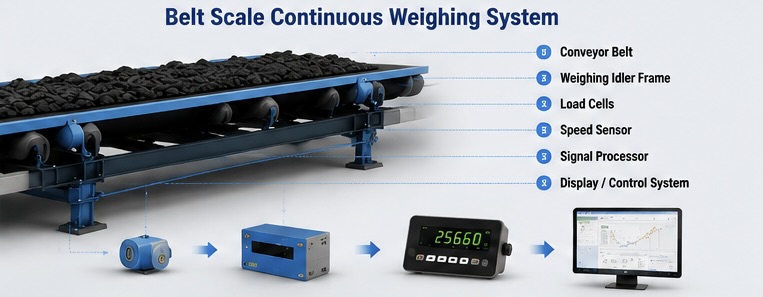
A belt scale system usually includes:
- Weighing frame
- Load cells
- Speed sensors
- Signal processing unit
- Display or control system
The load cell measures the force generated by the material passing through the weighing section.
The system combines this information with conveyor speed to calculate material flow and total weight.
For continuous production industries, accurate belt weighing helps companies:
- monitor production output
- control material usage
- improve process management
- reduce material loss
The challenge is that belt scales operate in dynamic conditions.
The sensor must maintain stable performance while dealing with vibration, changing material flow and long operating periods.
This requires both reliable load cell technology and proper system design.
6. Load Cell Technology in Hopper Weighing Systems
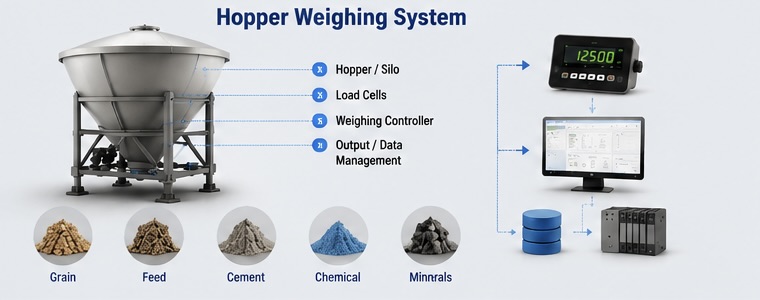
Hopper weighing systems are commonly used when materials need to be measured during storage, mixing, filling or transferring processes.
Typical applications include:
- Grain
- Feed
- Chemicals
- Cement
- Minerals
In these systems, the load cells measure changes in hopper weight during different production stages.
Compared with simple weighing applications, hopper systems often face additional challenges:
- uneven loading
- vibration
- dust
- temperature changes
- frequent loading cycles
A reliable weighing solution must consider both the sensor performance and the installation environment.
The load cell provides the measurement signal, while the complete system ensures that the data can be used effectively in production operations.
7. Why Sensor Experience Matters for Complete Equipment?
Many weighing equipment manufacturers focus mainly on mechanical design and assembly.
However, industrial weighing is not only about building a strong structure.
The equipment must also accurately measure, process and communicate weight information.
Experience with sensor technology helps manufacturers better understand:
- measurement accuracy
- signal stability
- environmental influence
- calibration requirements
- long-term equipment performance
This is one reason why experience in load cells is valuable when developing complete weighing systems.
The sensor is the starting point of measurement.
The complete equipment is the final application.
8. Keli Technology Inside KELISCALES Solutions
A complete weighing system requires more than a single component.
The final performance depends on how different technologies work together:
- mechanical design
- load measurement
- electronic processing
- software functions
- data management
Keli’s experience in weighing sensors provides the measurement foundation, while KELISCALES focuses on applying weighing technology to complete equipment and industrial applications.
This combination is especially important for customers who need more than a standard scale.
For example, an industrial customer may need:
- a truck weighing station at a factory entrance
- a belt weighing system for continuous production
- a hopper weighing solution for material control
- an automated weighing system connected with factory management software
In these projects, the customer is not simply buying a weighing machine.
They need a system that can operate reliably in their working environment.
That requires understanding both the measurement technology and the practical application.
9. The Relationship Between Keli and KELISCALES
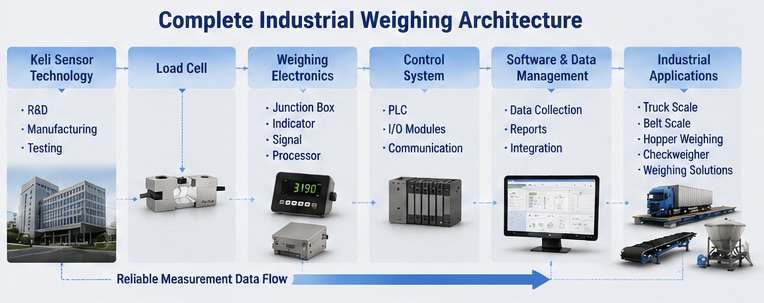
The relationship between Keli and KELISCALES can be understood through the weighing value chain.
At the technology level:
Keli Sensing Technology
provides experience in:
- load cells
- weighing sensors
- measurement technology
- weighing electronics
At the equipment level:
KELISCALES
focuses on:
- truck scales
- belt scales
- hopper weighing systems
- complete weighing equipment
- industrial weighing projects
The two areas are connected.
The sensing technology determines how weight is measured.
The complete equipment determines how that measurement is applied in real industrial operations.
This relationship allows customers to choose the right solution according to their needs.
A weighing equipment manufacturer may need a sensor component.
A mining company may need a complete truck weighing system.
An industrial plant may need a complete material weighing solution.
Different requirements require different approaches.
10. From Measurement Technology to Industrial Applications
Modern industrial weighing is becoming more connected with automation and data management.
A weighing system is no longer only used to display a weight value.
In many industries, weighing data is used for:
- production monitoring
- inventory management
- logistics control
- quality management
- process optimization
This trend has increased the importance of integrated weighing solutions.
For example:
A truck scale can become part of an automated logistics process.
A belt scale can provide production information in real time.
A hopper weighing system can support accurate material handling.
A checkweighing system can improve manufacturing quality control.
The value of weighing equipment is no longer limited to measurement itself.
It also comes from how the collected data supports business operations.
11. Choosing the Right Weighing Solution
The right solution depends on the customer’s actual requirements.
If the requirement is:
- a load cell
- a weighing sensor
- a weighing indicator
- a measurement component
the focus is usually on component technology.
If the requirement is:
- a truck scale project
- a belt weighing system
- a hopper weighing solution
- an automated industrial weighing system
the focus moves toward complete equipment and system integration.
Understanding this difference helps customers communicate their needs more efficiently.
12. FAQ
Because load cells directly measure the applied force, their performance affects weighing accuracy, stability and long-term reliability.
A load cell is one measurement component. A complete weighing system combines sensors with structures, electronics, software and automation.
KELISCALES is built on Keli’s weighing technology background and applies weighing sensor experience to complete industrial weighing equipment and solutions.
KELISCALES provides industrial weighing equipment including truck scales, belt scales, hopper weighing systems, checkweighers, weigh belt feeders and automated weighing solutions.
13. Conclusion
A reliable weighing system starts with accurate measurement.
Although customers usually see the final equipment, the performance of that equipment depends on the sensing technology inside.
Keli’s experience in load cells and weighing measurement provides the technical foundation.
KELISCALES builds on this foundation to deliver complete industrial weighing equipment and solutions.
From individual sensors to complete weighing systems, the connection between Keli and KELISCALES represents a complete path from measurement technology to industrial application.

Need customized model matching your production line, technical drawings and accurate quotation?
Submit your inquiry now, our engineering sales team will send full solution within 24 working hours.