
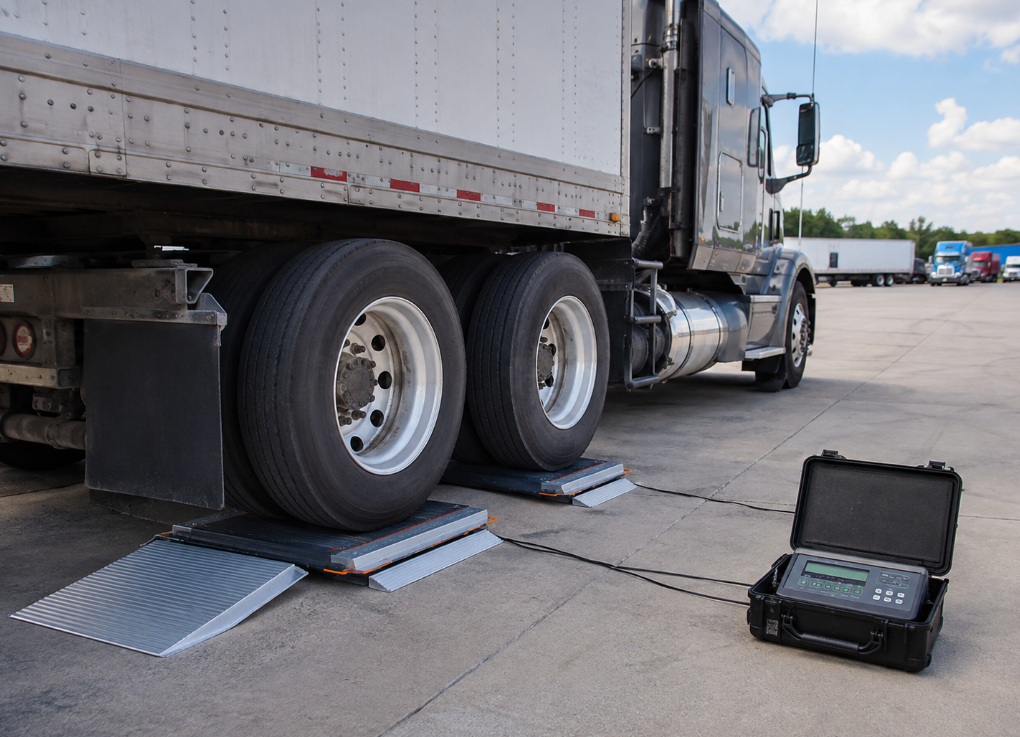
A Portable Truck Axle Scale is a mobile vehicle weighing system mainly used to measure the weight carried by individual truck axles or axle groups. Unlike a fixed truck scale or weighbridge, it can be moved from one location to another and usually does not require large-scale foundation construction.
For trucking companies, construction sites, mines, farms, logistics yards, and temporary vehicle inspection points, portable axle scales provide a more flexible way to weigh vehicles without building a large permanent weighing station.
This article explains what a portable truck axle scale is, how it works, its common applications, and the main factors to consider when choosing one.
What Is a Portable Truck Axle Scale?
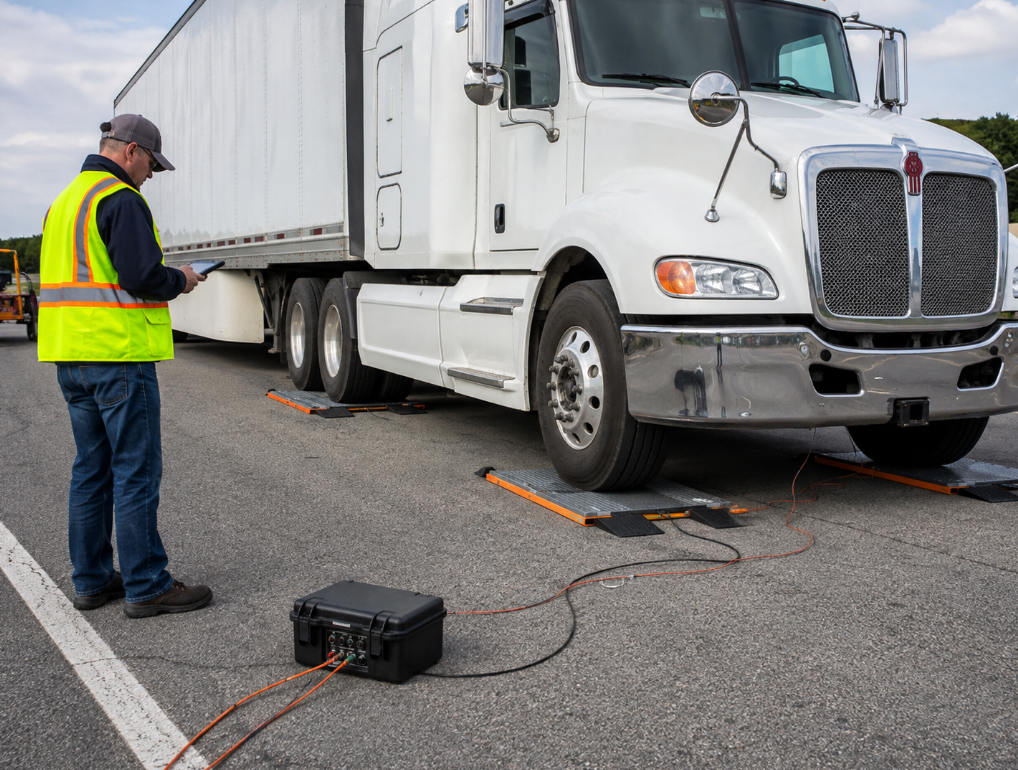
A portable truck axle scale usually consists of one or more weighing pads or low-profile weighing modules placed on a firm and relatively level surface. When a truck enters the weighing area, its wheels or axle groups are positioned on the corresponding weighing pads, allowing the system to measure the load carried by each axle or wheel.
Depending on the system configuration, a portable axle scale can generally measure individual axle weight, axle group weight, and vehicle weight distribution, while also calculating or estimating the gross vehicle weight. One of the most important features of this type of equipment is its mobility. Compared with large truck scales that require permanent installation, portable axle scales can be transported to different construction sites, vehicle yards, or operating areas.
Therefore, when weighing locations change frequently or when there is not enough space to install a conventional weighbridge, a portable axle scale can be a more practical solution.
How Does a Portable Truck Axle Scale Work?
The basic weighing process of a portable axle scale is relatively simple.
First, the weighing pads are placed on a firm and as level as possible surface, and their positions are adjusted according to the vehicle’s wheel track and axle configuration. The truck then slowly drives onto the weighing pads, or the required wheels are positioned accurately on the corresponding platforms.
Each weighing platform is usually equipped with Load Cells. When the vehicle’s weight is applied to the weighing pad, the load cells detect the load and transmit the measurement signal to a weighing indicator, controller, or software system.
The operator can then view the weight data for each axle and, depending on the system functions, save or print the weighing records. Portable axle scales generally support two common weighing methods. Static Weighing means the vehicle comes to a complete stop before the weight is recorded. Dynamic Weighing means the vehicle passes over the weighing platform at a low speed while the system records the weight of each axle in sequence.
The choice between static and dynamic weighing mainly depends on accuracy requirements, weighing efficiency, and the actual application.
Main Components of a Portable Axle Scale
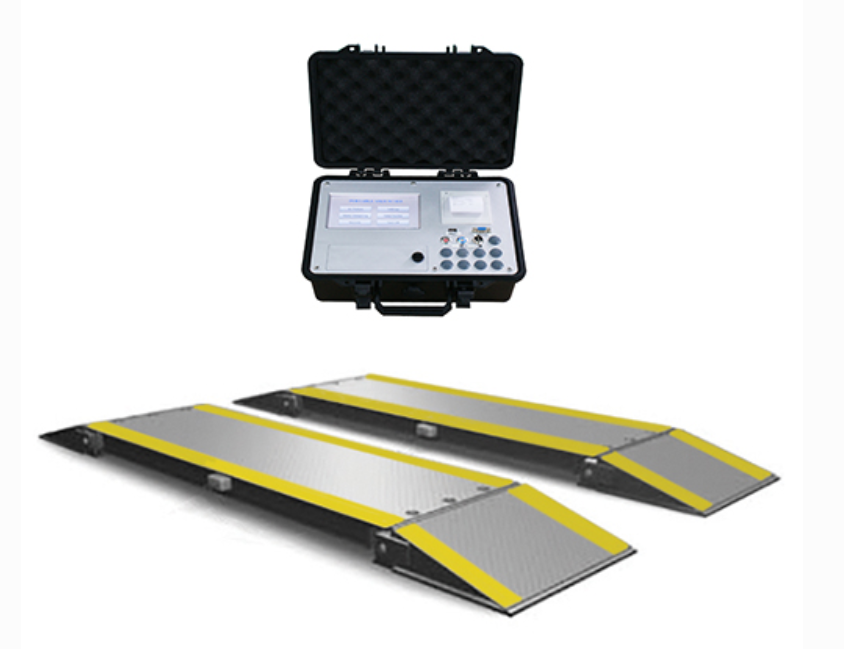
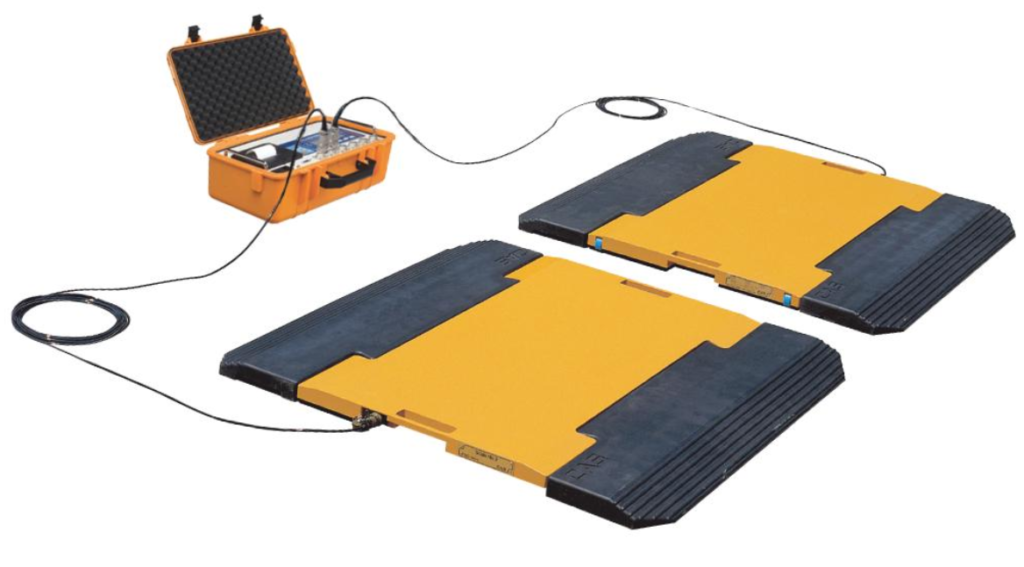
A typical portable truck axle weighing system usually consists of several components.
Weighing Pads or Platforms
Used to support the vehicle wheels and transfer the load to the sensors.
Load Cells
Used to convert the mechanical load generated by the vehicle into readable electrical signals.
Weighing Indicator
Used to display axle weight and other weighing data.
Ramps
Help vehicles drive smoothly onto low-profile weighing pads.
Some systems are also equipped with wired or wireless communication modules for transmitting weighing data. More advanced configurations may also include printers, data storage, vehicle identification, and computer software for managing and reviewing weighing records.
What Is the Difference Between a Portable Truck Axle Scale and a Fixed Truck Scale?
Portable axle scales and fixed truck scales can both be used for truck weighing, but they are better suited to different operating environments.
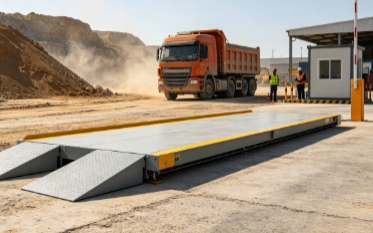
A portable truck axle scale can be moved between different locations, is quick to deploy, occupies less space, and is easy to transport. It is mainly used for temporary or mobile weighing applications and typically measures axle or wheel loads. In contrast, a fixed truck scale is designed for permanent installation, usually requires foundation construction, needs a longer weighing area, and is difficult to relocate once installed. It is better suited to permanent weighing stations and can generally measure the entire vehicle weight in one weighing operation.
If a factory or logistics center needs to weigh a large number of trucks every day at the same location, a fixed truck scale is usually more suitable. However, when the weighing location changes, site space is limited, or the main requirement is to check the weight distribution across different axle groups, a portable axle scale is often more flexible.
Therefore, neither system is absolutely better than the other. The right choice depends on the actual operating environment.
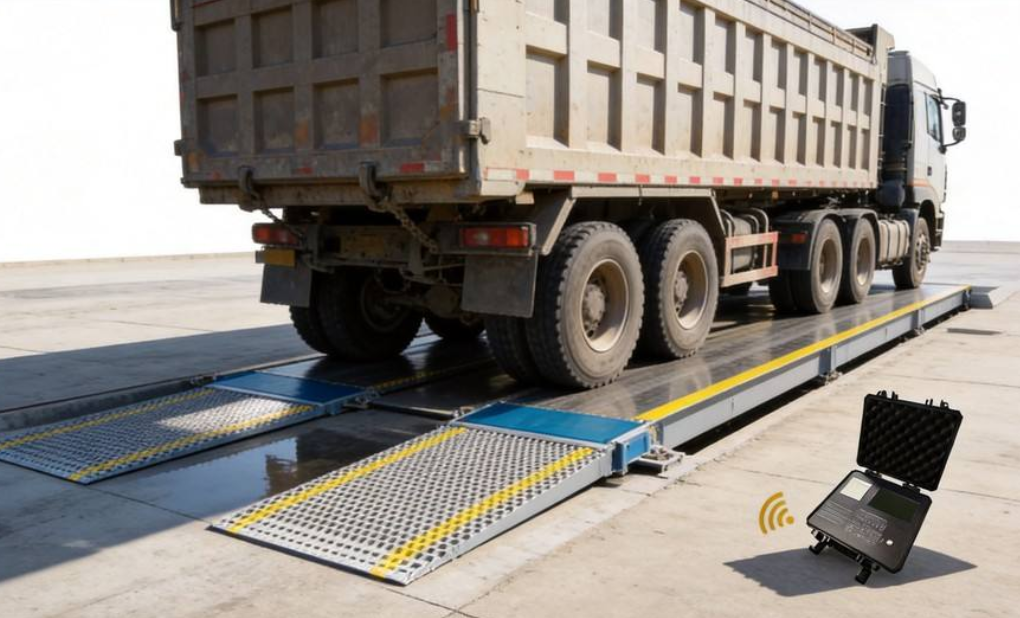
Where Are Portable Truck Axle Scales Commonly Used?
Portable truck axle scales can be used in many industries and vehicle weighing applications. Common uses include trucking and fleet management, logistics yards, construction sites, mining transport, agricultural transport, waste and recycling operations, temporary vehicle inspection points, and vehicle overload inspection.
For example, a construction project may need to check truck weights at several temporary access points.
Installing a fixed truck scale at every location would not only be expensive but also impractical. In this case, a portable axle scale can be moved to different locations as the project progresses. Similar situations are also common on farms, at mines, and in temporary logistics areas. These sites may require vehicle weighing but may not have enough space or long-term demand to justify building a permanent weighbridge.
Advantages and Limitations of Portable Axle Scales
Portable axle scales offer several practical advantages. They are easy to transport, require less installation work, occupy less space, and can be moved flexibly between different weighing locations. They are also useful for checking weight distribution among a truck’s steer axle, drive axles, and trailer axles.
However, this type of equipment also has certain limitations. First, ground conditions can affect weighing performance.
When higher axle-weight accuracy is required, the weighing area should usually be firm and level. Vehicle positioning is also important. If the wheels are not properly centered on the weighing pads, the measurement results may be affected. In dynamic weighing mode, the vehicle’s speed across the weighing platform also needs to be controlled appropriately.
In addition, not every portable axle scale can be used for legal-for-trade or enforcement weighing. Certification requirements, metrological classes, and local regulations vary between products and regions, so these factors should be confirmed before purchasing.
How to Choose a Portable Truck Axle Scale?
When choosing a portable truck axle scale, it is not advisable to compare products based only on price. A more practical approach is to evaluate the vehicle type and actual operating conditions first. Key factors include the maximum axle load, weighing platform dimensions, number of weighing pads, whether the system supports static or dynamic weighing, wired or wireless communication, weighing accuracy, protection rating, power supply and battery life, as well as whether data storage and printing functions are suitable for the site conditions and working environment.
For heavy-duty trucks, special attention should be paid to the maximum axle load capacity allowed by the equipment.
The dimensions of the weighing platform should also be suitable for the actual tire width and tire configuration of the vehicles being weighed. If the equipment will be used for long periods in outdoor environments such as mines or construction sites, requirements for dust resistance, water resistance, and overall durability are usually higher than for equipment used inside warehouses or logistics yards.
Conclusion
A portable truck axle scale is a flexible vehicle weighing solution that can be used as an alternative to a fixed truck scale. It can measure axle loads, check vehicle weight distribution, and is suitable for temporary or frequently changing weighing locations.
For companies that need to weigh vehicles at multiple job sites, have limited installation space, or mainly need to monitor individual axle and axle group weights, a portable axle weighing system can be a practical choice. Before selecting a system, it is advisable to confirm the vehicle type, maximum axle load, weighing method, site conditions, and data management requirements, and then determine the appropriate weighing pad dimensions, quantity, and system configuration.
A properly configured system can not only improve weighing efficiency but also help improve the stability and reliability of weighing results.

Need customized model matching your production line, technical drawings and accurate quotation?
Submit your inquiry now, our engineering sales team will send full solution within 24 working hours.