
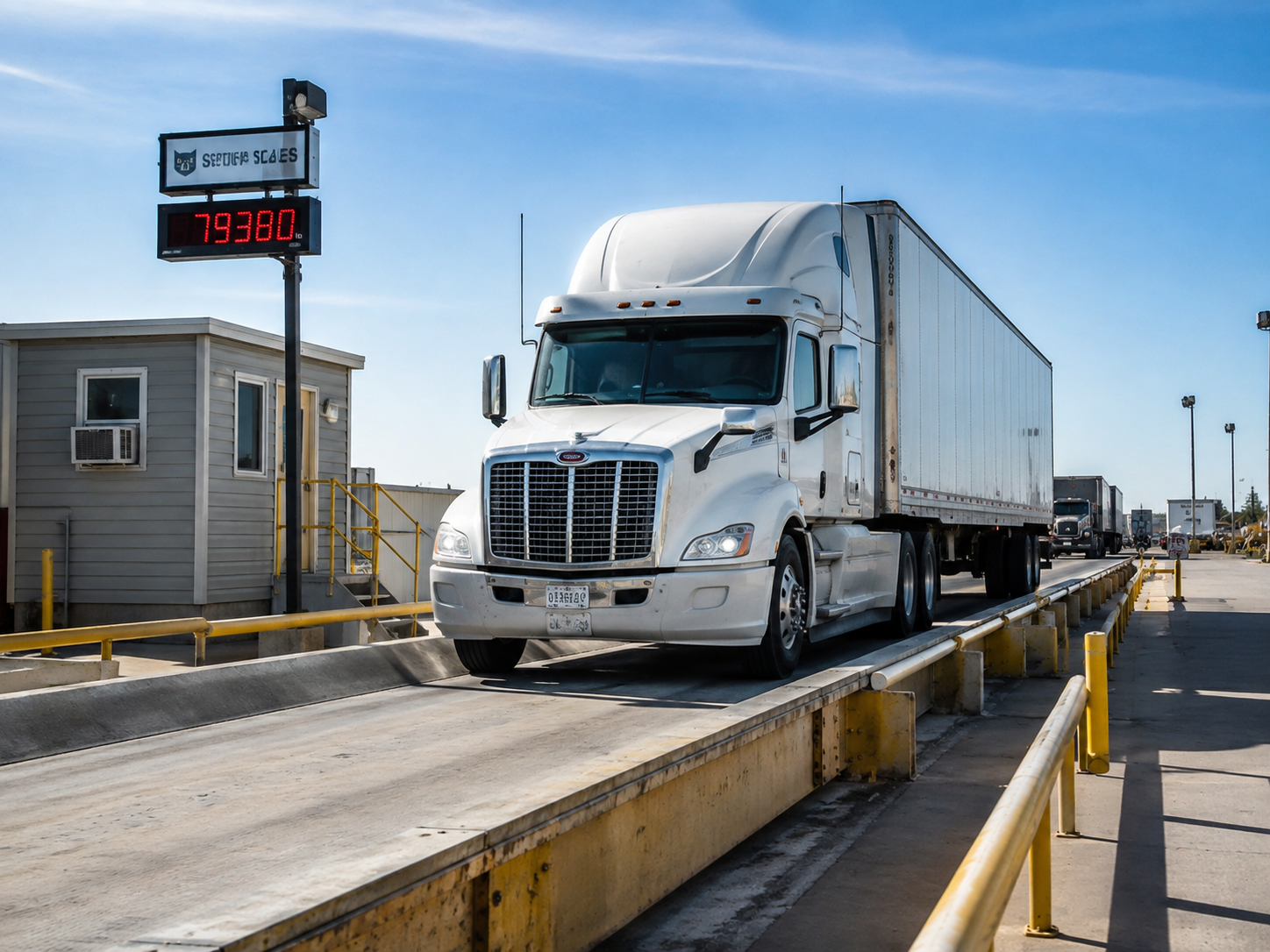
You weigh a loaded truck and get 79,760 lb.
A few hours later, another scale says 79,820 lb.
The truck has not been reloaded, so naturally you start wondering: which number should I trust?
This is really what most people want to know when they search “how accurate are truck scales.”
A modern commercial truck scale can provide very reliable weight readings when it is installed correctly, calibrated properly and kept in good condition. But there is no useful rule saying that every truck scale is always accurate to exactly 20 lb, 50 lb or a fixed percentage.
In practice, accuracy depends on the scale itself, the way it is installed, its calibration condition and how the truck is weighed.
1. How Accurate Are Truck Scales in Everyday Use?
For most drivers, there is no need to turn truck scale accuracy into a metrology lesson.
What matters is fairly simple:
Does the scale give stable and repeatable readings, and is it suitable for the type of weighing being done?
A commercial truck scale may be used to check whether a tractor-trailer is within its road weight limits.
At a grain elevator, quarry, recycling plant or warehouse, the same type of scale may be used to determine how much material was delivered.
Because money, inventory or legal vehicle weight can depend on these readings, commercial scales are normally subject to testing and weights-and-measures requirements.
In the United States, NIST Handbook 44 provides technical requirements widely used for commercial weighing equipment.
But for a driver, there is one detail that matters much more than memorizing a tolerance table.
2. A 20-lb Display Does Not Mean ±20-lb Accuracy
This is one of the most common misunderstandings about truck scales.
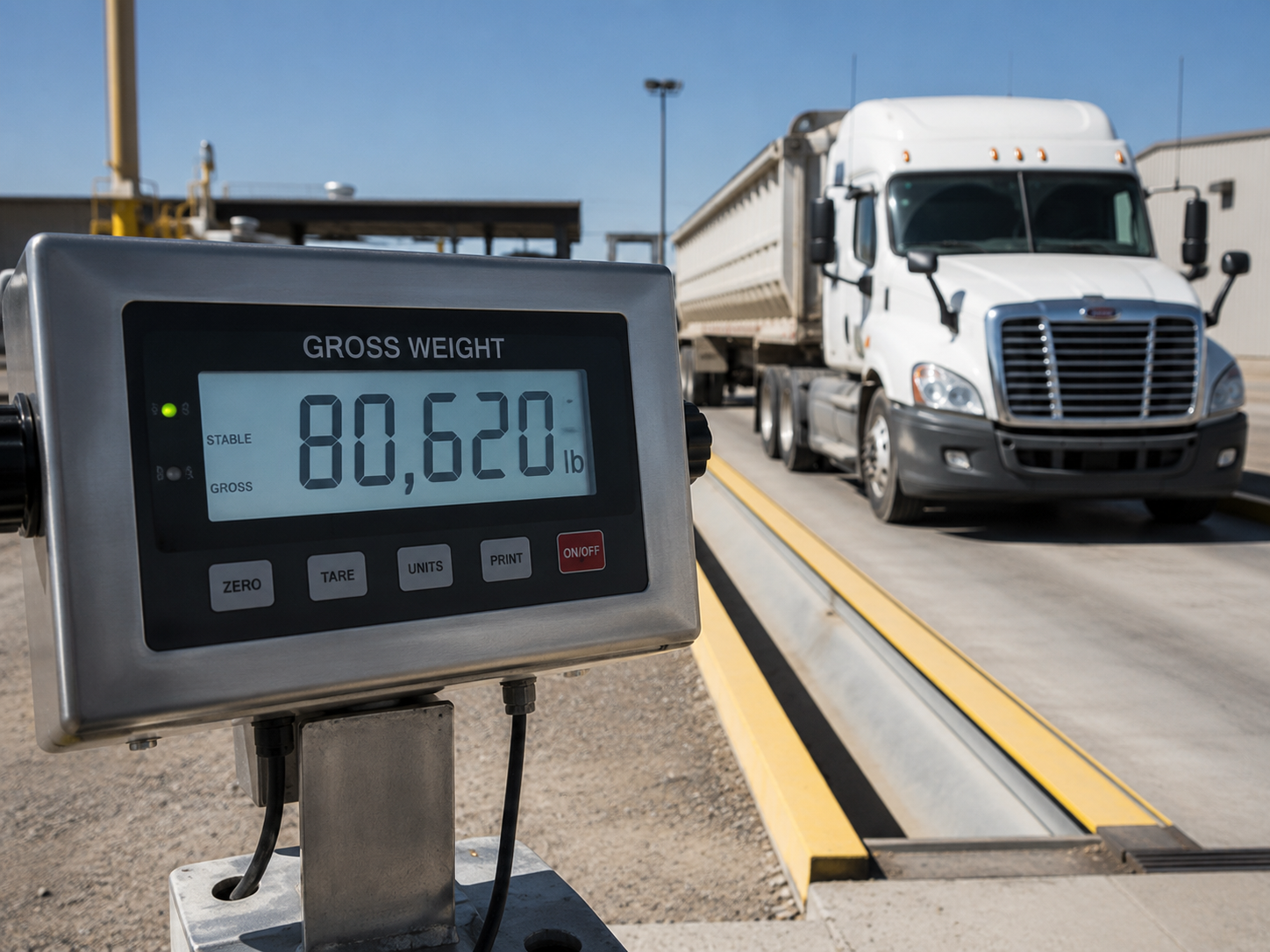
Suppose the indicator shows: 79,720 lb
then: 79,740 lb
and then: 79,760 lb
The display is changing in 20-lb increments.
That means 20 lb is the displayed scale division.
It does not automatically mean that the entire truck scale is guaranteed to be accurate within ±20 lb under every condition.
Those are two different ideas.
A simple way to remember it is: Resolution tells you how finely the scale displays weight. Accuracy tells you how close the measurement is to the reference weight.
3. Why Can Two Truck Scales Give Different Weights?
Imagine the same truck gets these readings during one trip:
| Location | Gross Weight |
| Shipping Yard | 79,720 lb |
| Public Truck Scale | 79,780 lb |
| Receiving Facility | 79,740 lb |
The highest and lowest readings differ by 60 lb.
Does that prove one of the scales is wrong?
Not necessarily.
Before blaming the scale, look at what changed between the weighings.
- Fuel was used
The truck burns fuel while driving.
If several hours passed between weighings, the truck may genuinely be lighter.
- Someone got in or out of the cab
A driver, passenger, tools or supplies all add weight.
If any of them were present during one weigh but not another, the result can change.
- Mud, snow or water can add weight
A truck working through poor weather or on an unpaved site can carry surprisingly large amounts of mud, water or snow around its wheels and chassis.
- The two scales are simply different
Two properly operating commercial scales do not have to display exactly the same number every time.
Small differences can exist because of calibration condition, scale design, vehicle position and other operating factors.
4. Repeatability May Tell You More Than One Weight Ticket
If you suspect a scale is giving an unusual reading, a reweigh can tell you a lot.
Suppose nothing changes on the truck and you weigh it twice.
First weigh: 77,840 lb → Second weigh: 77,840 lb
That is a good sign.
Now consider:
First weigh: 77,840 lb → Second weigh: 78,100 lb → Third weigh: 77,720 lb
If no fuel, cargo or people changed between those weighs, the variation deserves attention.
It may be related to the scale, vehicle position or another condition at the weighing site.
This is why repeatability is often a more useful real-world indicator than trying to judge a scale from a single ticket.
how to read a truck scale ticket
5. How Accurate Are CAT Scales?
For U.S. truck drivers, this is probably the most common follow-up question.
CAT Scale does not simply tell drivers that every measurement is guaranteed to fall within one fixed ±X-lb figure.
Instead, its official guarantee covers both gross weight and axle weights.
If a CAT Scale ticket shows a truck is legal and the driver later receives an overweight citation, CAT says it will check the scale. Its guarantee explains what happens if the scale is found to have been incorrect.
For a driver, that is more useful than trying to attach one universal error number to thousands of individual scales.
Vehicle position also matters when getting axle weights.
For a standard tractor-trailer, the steer axle, drive axles and trailer axles need to sit on the correct weighing platforms.
how to use a CAT Scale at a truck stop
If the truck is positioned incorrectly, the axle-group readings may not be useful even though the weighing equipment itself is functioning normally.
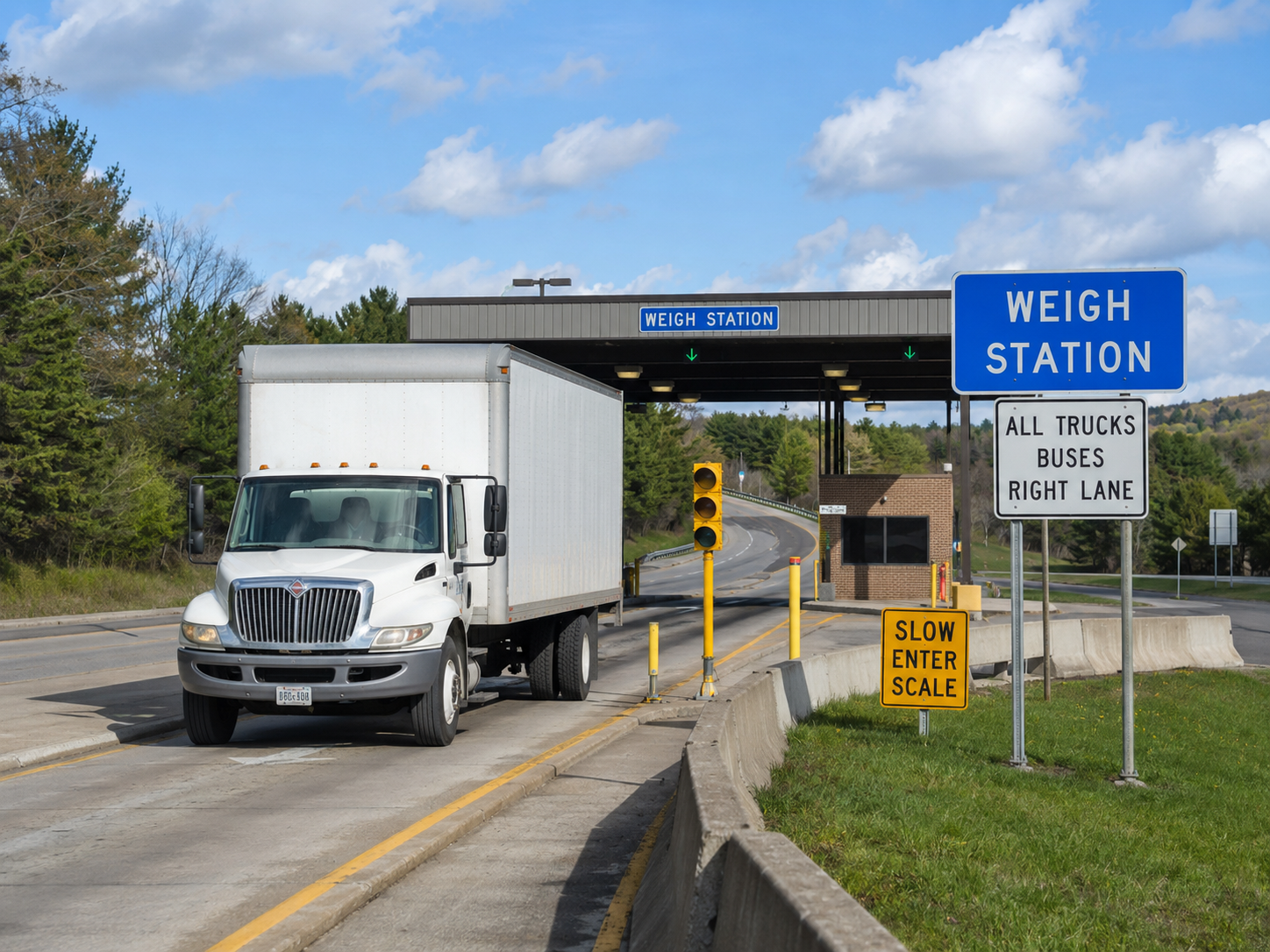
6. Are Highway Weigh Station Scales Accurate?
Another source of confusion is that a highway weigh station may use more than one type of weighing system.
Many inspection sites use weigh-in-motion, or WIM, equipment to screen trucks while they are still moving.
Vehicles that need a closer check can then be directed onto a static scale.
These two systems are not doing exactly the same job.
WIM is very useful for screening large numbers of vehicles efficiently.
A static scale provides a more controlled weighing condition.
So if a moving highway sensor and a static scale appear to produce slightly different numbers, that alone does not prove either system is defective.
7. Gross Weight and Axle Weight Are Different Problems
A truck can be under its gross-weight limit but still have too much weight on one axle group.
For example:
Steer Axle: 11,900 lb
Drive Axles: 34,400 lb
Trailer Axles: 32,800 lb
Gross Weight: 79,100 lb
The gross number only tells you the total.
It does not show whether the load is distributed correctly.
This is why drivers sometimes slide the trailer tandems and then weigh the truck again.
The cargo has not disappeared.
The goal is to move part of the load from one axle group to another.
8. What Can Make a Truck Scale Read Wrong?
A truck scale is much more than a digital indicator and a few load cells.
The weighbridge, foundation, load cells, junction boxes, cables and indicator all work together.
Problems can come from several places.
- Calibration drift
A scale that was accurate when it was first installed may not remain that way forever.
- Debris around the deck
Mud, stones, grain, scrap or other material can build up around the weighbridge.
If the deck cannot move freely, the weighing result may be affected.
- Load cell or cable problems
Damaged cables, moisture in connections or a faulty load cell can all create unstable or incorrect readings.
- Foundation movement
A truck scale handles very heavy loads every day.
Foundation problems can eventually affect how that load is transferred to the weighing system.
This is why buying a truck scale based only on a load-cell accuracy specification is not very meaningful.
The entire installation determines the final result.
Load Cell + Scale Structure + Foundation + Installation + Calibration + Maintenance
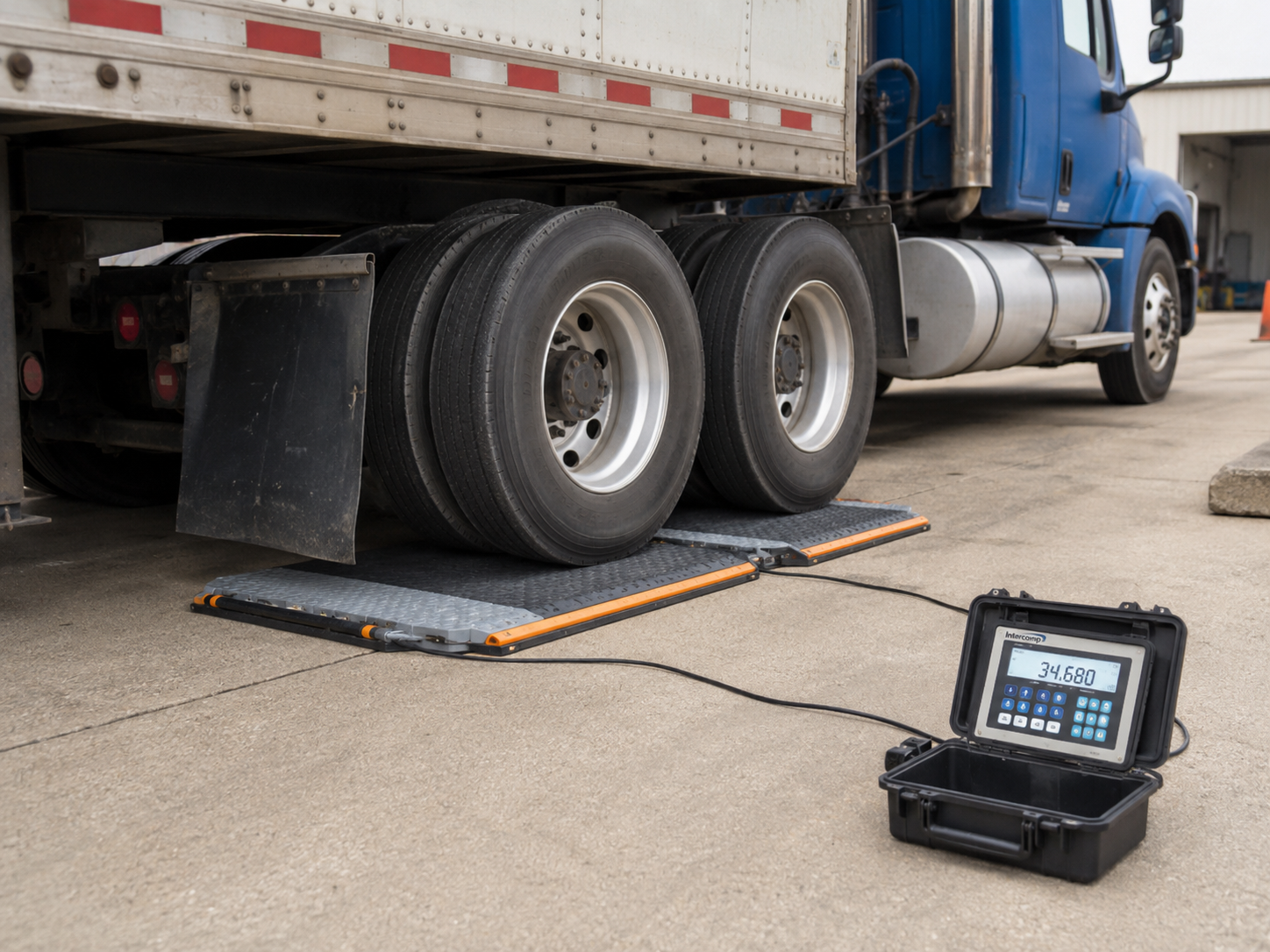
9. How Accurate Are Portable Truck Axle Scales?
Portable truck scales are useful when installing a permanent weighbridge is not practical.
They are often used in:
- fleet yards
- farms
- construction sites
- mines
- temporary inspection points
- logistics yards
A good portable axle scale can provide useful axle or wheel weight information.
But installation conditions matter more than many users expect.
Suppose one axle is sitting on a weighing pad while another axle is several inches lower on the surrounding ground.
The suspension may transfer part of the vehicle weight.
The result can then change even though the weighing pad itself is working correctly.
Level ground, correct wheel placement and proper setup are therefore important.
When comparing a portable axle scale with a full-length truck scale, do not look at one advertised accuracy percentage alone.
Look at:
- weighing method
- capacity
- division size
- number of pads
- calibration
- operating surface
- static or dynamic use
- whether legal-for-trade weighing is required
The right scale depends on what you actually need to weigh.
10. How Often Should a Truck Scale Be Calibrated?
There is no single calendar interval that makes sense for every scale.
Think about two sites.
A warehouse scale handles 20 trucks a day on clean concrete.
Another scale at a quarry handles hundreds of loaded dump trucks every day, surrounded by dust, stone and mud.
They clearly do not experience the same working conditions.
Inspection or recalibration is also worth considering after:
- load-cell replacement
- major scale repairs
- foundation work
- lightning damage
- unusual vehicle impact
- repeated unexplained weight differences
The better question is not simply: “Has it been 12 months?”
Instead ask: “Is the scale still giving stable, verified and repeatable results?”
11. When Should You Reweigh a Truck?
Not every small weight difference deserves another trip across the scale.
But there are several situations where a reweigh is useful.
- You are close to the weight limit
If you only have a small margin left, confirming the weight makes sense.
- You moved the trailer tandems
The gross weight may stay almost the same, but axle distribution has changed.
- You adjusted the fifth wheel
Again, part of the load is being transferred between axle groups.
- The cargo was repositioned
Moving cargo forward or backward may change axle weights significantly.
- The ticket simply looks wrong
If a truck that normally weighs around 76,000–77,000 lb suddenly shows nearly 80,000 lb and nothing obvious has changed, checking again is reasonable.
12. Is a Certified Truck Scale Always Exactly Right?
No measuring device should be understood that way.
Certification does not mean the scale will produce a mathematically perfect number forever.
It means the equipment is tested and operated according to the applicable weights-and-measures requirements.
Commercial truck scales still require maintenance.
A certified scale can eventually develop problems if its load cells are damaged, its deck binds against debris or the foundation moves.
So the practical goal is not “zero error.”
It is: consistent, repeatable readings within the required tolerance.
13. How Much Difference Between Two Truck Scales Is Normal?
This is probably the question many drivers really want answered.
Unfortunately, there is no single number that works for every truck, every scale and every weighing condition.
A difference of a few tens of pounds does not automatically mean a scale is faulty.
Before deciding something is wrong, ask:
- Was the truck in the same condition?
- Was fuel consumed between weighs?
- Was the driver in the cab both times?
- Was the weighing static both times?
- Was the truck positioned correctly?
- Was any cargo moved?
If those conditions stayed the same and repeated weighs still move by an unusually large amount, then it is reasonable to investigate the scale.
14. So, How Accurate Are Truck Scales?
A well-installed and properly maintained commercial truck scale can provide very reliable weight measurements.
But there is no single answer such as: “Every truck scale is accurate within ±20 lb.” “Every truck scale is 99.9% accurate.”
Those statements leave out too much.
For a driver, three questions are more useful:
- Is the scale suitable for this weighing job?
- Does it give repeatable results?
- Do I have enough margin below my axle and gross limits?
And remember the point that causes the most confusion: A truck scale displaying weight in 20-lb increments does not automatically mean its total accuracy is ±20 lb.
If your truck is comfortably below its limits, a small difference between two scales usually matters far less than it first appears.
If you are right on the edge, reweigh the truck, check the axle distribution and leave yourself some working margin before getting back on the road.

Need customized model matching your production line, technical drawings and accurate quotation?
Submit your inquiry now, our engineering sales team will send full solution within 24 working hours.